
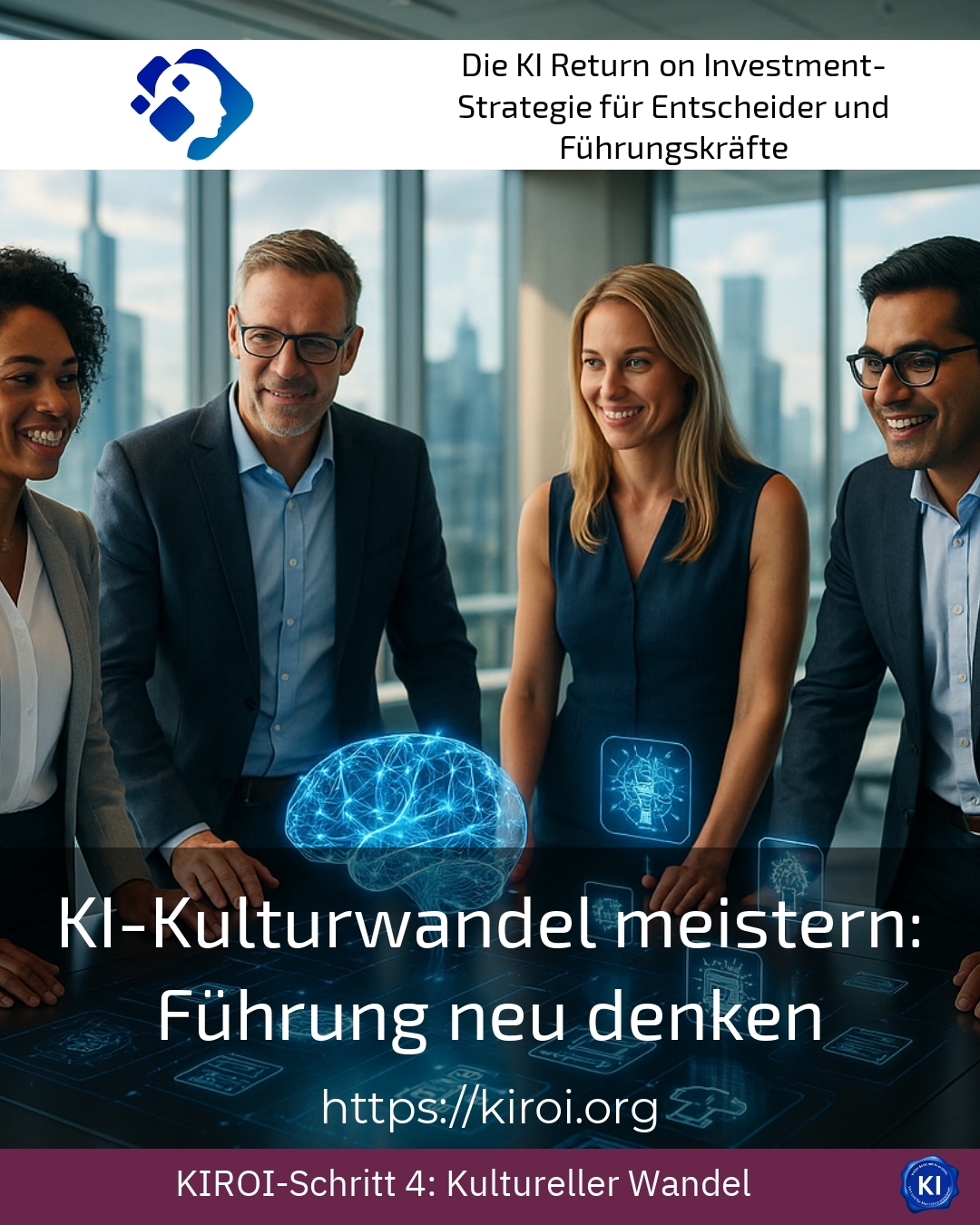
The working world is at a turning point, and many business leaders feel the growing pressure to navigate their organisations through a period of fundamental transformation while simultaneously facing the challenge of Mastering AI cultural change having to do so without losing the people in their teams or giving up the established values of their corporate culture. Clients frequently report that they find themselves caught in a tension between the executive board's expectations for rapid technological adaptation and their employees' need for security and guidance. This article provides impulses on how you, as a leader, can find this balance.
Why traditional leadership models are reaching their limits
The classical leadership approaches, which have been taught in business schools for decades and practised in companies, are based on assumptions that must increasingly be questioned in a world of algorithmic decision-making and automated processes. This is particularly evident in the manufacturing industry, when production managers suddenly have to work alongside intelligent systems that carry out quality controls faster and more precisely than experienced skilled workers. Similarly, department heads in logistics are finding that route optimisation through machine learning calls their many years of expertise into question. And in the financial sector, team leaders are struggling to explain to their analysts why certain tasks are now being taken over by algorithms.
Transruptions coaching guides leaders not to view this uncertainty as a weakness, but as a necessary transition to a new understanding of authority and competence. In this context, leadership no longer primarily means being the best technical expert. Instead, the ability to orchestrate heterogeneous teams of humans and technical systems is gaining in importance. A software development project manager today needs to understand how to make sensible use of code generation tools. At the same time, they must foster the creative problem-solving skills of their developers. This dual requirement initially overwhelms many leaders.
Mastering the AI cultural shift through emotional intelligence
The more technical intelligence is integrated into corporate processes, the more paradoxical the emotional intelligence of leaders becomes, because in times of uncertainty, employees primarily need empathetic support rather than technical explanations, and the feeling that their fears and concerns are taken seriously. In executive search and recruitment, we observe that recruiters initially show resistance when automated screening tools are introduced. They fear their judgement of character will be devalued. In customer service, on the other hand, team leaders experience their employees perceiving chatbots as a threat to their jobs. Tensions also arise in the marketing department when content generators suddenly produce texts.
In such situations, the role of leadership is to create a safe space where these emotions can be expressed without employees having to fear consequences. Transruption coaching helps leaders to develop and refine precisely these communication skills. A team leader in accounting thus learns not to sell the introduction of automated document processing as an efficiency measure. Instead, she frames the change as an opportunity for further development. This fundamentally changes the entire dynamic within the team.
Best practice with a AIROI customer
A medium-sized mechanical engineering company faced the challenge of equipping its design department with generative design tools, where the experienced engineers initially expressed massive reservations and in some cases even threatened to resign because they feared that their decades of expertise would be replaced by algorithms. Management turned to transruptions coaching to find a way that both enabled technological modernisation and preserved and integrated the valuable experiential knowledge of long-standing employees. In a companionship process lasting several months, we worked together with the department heads on their communication strategy and developed formats in which the engineers could voice their concerns while experiencing that the new tools support their creativity instead of replacing it. In the process, the managers learned to listen actively and not to dismiss emotional resistance as irrational blocks, but to understand it as important indications of unspoken needs. At the end of the process, team members reported a renewed appreciation for the collaboration between human experience and technical assistance, and the turnover rate in the department fell significantly.
The redefinition of competence and expertise
What does it actually mean to be competent when intelligent systems are able to retrieve knowledge faster, recognise patterns more reliably and make predictions more accurately than even the most experienced professionals in a company? This question is preoccupying leaders across all industries. In medical diagnostics, chief physicians are debating the ongoing value of clinical experience. In law firms, partners are wondering how they should redefine the value of legal expertise. Debates about the relationship between creative design and parametric design are also arising in architecture.
The AIROI model [1] provides a structured framework for addressing these complex issues and developing practical solutions that take into account both technological possibilities and human needs. In the insurance sector, for example, claims handlers have traditionally drawn their expertise from a deep understanding of complex contractual terms. With the introduction of intelligent contract review systems, this expertise is undergoing a fundamental shift. The new expertise no longer lies in retrieving rule-based knowledge. It now consists of the ability to recognise exceptions and apply human judgement.
Leadership as an act of translation between worlds
One of the central tasks of contemporary leadership consists of translating between different worlds: between the language of technology and the needs of people, between the expectations of stakeholders and the realities of day-to-day business, between short-term efficiency gains and long-term organisational development. In retail, store managers experience this translation task on a daily basis. They have to explain to their sales teams why algorithmic recommendation systems make sense. At the same time, they defend the importance of personal customer service to head office. In the hospitality industry, restaurant managers face similar challenges when introducing automated reservation systems.
Transruption coaching supports leaders in systematically developing and refining this translation competence by working together to determine which communication strategies are effective in which contexts and how resistance can be used as a resource for the change process. A bank branch manager thus learns not to present the introduction of automated advisory tools as a cost-cutting measure. She positions the change as an improvement in quality for demanding advisory meetings. This fundamentally changes the team's perception for the better.
Best practice with a AIROI customer
A major logistics company implemented a comprehensive transformation programme in which intelligent dispatching systems were to take over route planning; this met with considerable resistance from the experienced dispatchers, as they felt that their local knowledge – built up over many years – and their understanding of specific customer needs were under threat. As part of the AIROI support programme [2], we worked closely with middle management, who found themselves caught in the middle between the efficiency demands of senior management and the concerns of the operational teams. The managers developed a new understanding of their role, no longer seeing themselves as supervisory figures but as bridge-builders who valued their teams’ tacit knowledge whilst simultaneously harnessing the potential of the new technology. One approach proved particularly effective: dispatchers documented their special cases, thereby helping to continuously improve the system, which transformed them from passive participants into active agents of change. Managers learnt to highlight successes and recognise even small steps forward, which significantly strengthened confidence in the change process and transformed initial resistance into constructive participation.
Mastering the cultural shift towards AI requires new learning formats
Traditional training courses and seminars are not enough to prepare managers for the complex demands of a technologically transformed working world, because it is not primarily about imparting knowledge about specific tools or applications, but about a profound change in attitudes, mindsets and behavioural patterns. In the pharmaceutical industry, this is evident in the introduction of AI-supported research assistance. Laboratory managers not only have to learn how to operate new software, they develop a fundamentally new understanding of scientific methodology. In the media sector, editorial directors experience similar transformations when integrating automated research tools.
Transruptions coaching therefore relies on experience-based learning formats in which managers can experiment in safe spaces, make mistakes and learn from those mistakes without immediate consequences for their team or organisation. A production manager in the automotive supply industry can thus try out various communication strategies. He receives direct feedback and refines his approach iteratively. These learning loops enable sustainable behavioural changes rather than superficial knowledge transfer.
The role of trust in technological change
Trust proves to be perhaps the most important currency in times of fundamental change, because employees who do not trust their managers will also view the change processes initiated by them with scepticism and rejection. In the healthcare sector, we observe how nursing service managers have to win the trust of their teams. They must show that technical assistance systems improve care instead of dehumanising it. In education, school leadership teams are fighting similar issues of trust when introducing adaptive learning systems. Crises of trust also arise in public administration with the automation of administrative processing.
The AIROI model [3] emphasises the importance of transparency and participation as the foundations of trust; the aim is not to make all decisions democratically, but to make the reasoning behind decisions clear and to turn those affected into active participants. A department head in the insurance sector is thus learning to disclose her strategic thinking. She explains why certain processes are being automated and what new tasks will arise. This transparency significantly reduces anxiety and fosters constructive cooperation.
My AIROI Analysis
Observations from numerous support processes across a wide variety of industries reveal a consistent pattern: organisations that successfully navigate technological change invest at least as much energy in cultural transformation as in technical implementation, with the management team playing a key role because they set the tone for the entire organisation through their behaviour, communication and decisions. Mastering AI cultural change succeeds when leaders understand that their task is not to enforce change, but to create spaces in which change can emerge organically, while at the same time providing clear direction and security.
The AIROI perspective highlights that technological expertise alone is not enough to lead successfully in this new reality; rather, it requires an integration of technical understanding, emotional intelligence and strategic foresight, which, when combined, go far beyond traditional management skills. Leaders who embrace this development and are prepared to critically examine their own beliefs and behaviours will not only navigate their organisations more successfully through change, but will also grow personally and develop a new form of leadership effectiveness that meets the demands of an increasingly complex and interconnected world of work. ‘Transruptions’ coaching provides a structured framework for this, supporting and guiding both individual development and organisational transformation.
Further links from the text above:
[1] The AIROI model for successful transformation
[2] AIROI support for managers
[3] Trust as the basis for change
For more information and if you have any questions, please contact Contact us or read more blog posts on the topic Artificial intelligence here.






 Deutsch
  English (UK)