
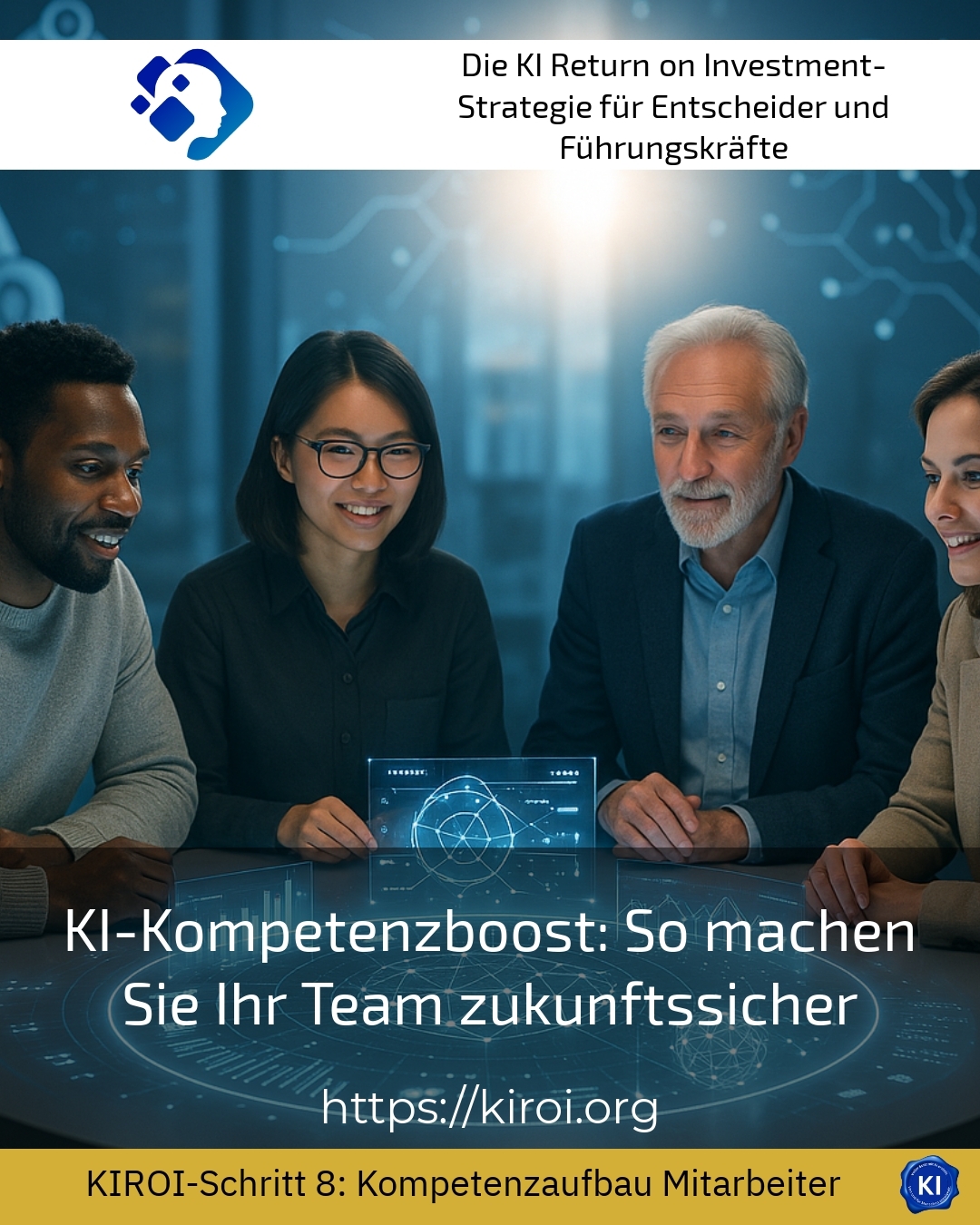
Imagine your staff had to work with completely new tools tomorrow that fundamentally change their previous ways of working. Exactly this situation is currently being experienced by countless companies because intelligent systems are permeating and transforming almost every business area. The AI Skills Boost is no longer a luxury, but a strategic necessity for any organisation that wants to remain competitive in the years to come. Many leaders come to me with precisely this challenge because they sense that traditional training concepts are no longer sufficient. The good news is that there are proven approaches that can systematically prepare teams for this new world of work.
Why traditional training concepts no longer work today
The speed of technological change has reached a pace that simply overwhelms traditional learning methods. In the past, it was sufficient to introduce employees to new software every few years. Today, however, requirements change almost weekly. An example from the financial sector illustrates this impressively: customer advisors now need to understand how automated analysis systems generate portfolio recommendations. They require this knowledge because they have to interpret the results and explain them to clients. At the same time, customers expect personal advice that goes beyond machine-generated evaluations.
A similar dynamic can be seen in the healthcare sector, where medical staff have to learn to work alongside diagnostic support systems. Radiologists, for example, are increasingly using intelligent image recognition software that highlights abnormalities. However, the real skill lies in critically evaluating these markings and placing them within the clinical context. A third example comes from the logistics industry, where dispatchers work with predictive systems that optimise supply chains. These professionals need to understand which data the algorithms use and where their limitations lie.
The AI competency boost begins with an honest assessment.
Before companies invest in training measures, they should first determine the current level of knowledge of their workforce. Clients frequently report that they are surprised by how varied the prior knowledge is within a team. Some employees are already experimenting privately with language models and image generators. Others, however, have never consciously interacted with such technologies. This heterogeneity requires differentiated learning paths that meet each individual where they are.
In retail, for example, the requirements differ significantly from one department to another. Purchasing staff need skills in the analysis of demand forecasts. Sales personnel, on the other hand, benefit from an understanding of personalised product recommendations. The marketing department, in turn, must learn to review and adapt automatically generated content. A one-size-fits-all training programme for all areas would not be able to take these specific needs into account.
Best practice with a AIROI customer
A medium-sized manufacturing company faced the challenge of modernising its quality control. Management had invested in a vision-based recognition system designed to automatically identify product defects. The long-serving quality assurance staff initially reacted with scepticism to this innovation. They feared that their experience and expertise would no longer be in demand in the future. As part of a transruption coaching process, we accompanied the company in introducing structured skills development. First, we conducted one-on-one discussions with the affected employees to take their concerns seriously. Subsequently, we jointly developed a training concept that combined technical understanding with practical application. The employees learned how the system is trained and what data it requires. As a result, they also understood where the system needs support from human expertise. After six months, the team members reported that they found their work more valuable because they now act as trainers and auditors of the system. At the same time, the defect rate fell by around thirty percent because human and machine complemented each other.
Strategic competence fields for the working world of tomorrow
An effective AI Skills Boost covers several dimensions that go beyond purely technical knowledge. The first dimension concerns the fundamental understanding of how learning systems work. Employees do not need to be able to program, but they should be able to comprehend the logic behind automated decisions. In the insurance industry, for example, claims handlers are increasingly using systems that pre-check claims. If these specialists understand the criteria according to which the system categorises cases, they can better contextualise its recommendations.
The second dimension encompasses the ability to critically evaluate machine-generated results. In the legal sector, intelligent systems already assist with the analysis of contract documents. However, legal professionals must be able to recognise when a system overlooks or misinterprets relevant clauses. This critical competence does not develop through theoretical learning alone. It arises from practical exercises with real-world use cases and through dialogue with experienced colleagues.
The third dimension concerns the capacity for ethical reflection when dealing with automated systems. In human resources, for example, systems that pre-sort application documents are increasingly being used. Recruiters must understand what biases such systems can exhibit and how to compensate for them. They continue to bear responsibility for fair selection processes, even if algorithms carry out the pre-selection.
Practical learning formats for sustainable skills development
Experience shows that traditional seminar formats are often insufficient for building technology-related skills. Instead, formats that combine learning and work are proving effective [1]. In the banking sector, for example, so-called learning circles have become established, in which employees discuss new use cases on a weekly basis. These short, regular formats make it possible to address current developments in a timely manner. At the same time, they promote the exchange of experience between different departments.
In the field of public administration, pilot projects show that tandems made up of tech-savvy and experienced staff members are particularly effective. The younger colleagues often bring an affinity for new technologies. The experienced staff members, on the other hand, know the professional requirements and processes precisely. Through this collaboration, both sides learn from one another and jointly develop practical solutions.
A third proven format is so-called experimentation spaces, where teams can try out new tools risk-free. In the media industry, several publishing houses have set up such spaces to test automated text generation. Editors can experiment there without erroneous results being published directly. This protected environment reduces anxieties and fosters an open learning culture.
Best practice with a AIROI customer
A large retail chain wanted to empower its store managers to make data-driven decisions. Head office had introduced a dashboard that automatically calculated sales forecasts and staffing requirements. However, the store managers hardly used this tool because they did not trust the recommendations. As part of our support, we developed a multi-stage competence development programme. In the first phase, we invited the store managers to workshops where they got to know the system's calculation logic. As a result, they understood which historical data was incorporated and how seasonal effects were taken into account. In the second phase, we formed regional learning groups that met monthly and exchanged their experiences. One store manager, for example, reported how he had identified and corrected an obviously flawed forecast. His colleagues learned from this example what they needed to watch out for. In the third phase, we established a feedback channel to head office through which store managers could submit suggestions for improvement. This involvement significantly increased trust in the system because the employees experienced themselves as active shapers. After a year, over eighty per cent of the store managers were regularly using the dashboard for their planning.
The role of leaders in boosting AI competence
Leaders play a crucial role in the skills development of their teams. Through their own behaviour, they significantly shape the learning culture of the entire organisation [2]. When leaders openly discuss their own learning processes, it also encourages their employees. In the consulting sector, clients frequently report that partners were initially reluctant to admit their own gaps in knowledge. However, as soon as they began to share their learning experiences, the atmosphere throughout the entire team changed.
Interesting developments are emerging in executive development within the automotive industry. Plant managers are increasingly learning how predictive maintenance systems work and what data they provide. This knowledge enables them to make informed decisions regarding investments and staff development. At the same time, they are better able to communicate to their teams why certain changes are necessary.
In the healthcare sector, consultant physicians face the challenge of integrating clinical decision support systems into their departments. In doing so, they must both ensure medical quality and bring their staff along with them. Many therefore seek guidance in developing a strategy that takes both aspects into account. Transruption coaching supports them in finding a balance between technological innovation and human expertise.
Understanding and constructively addressing resistance
Resistance to change is completely normal during technological transformations and is often even constructive. It frequently points to real problems that were overlooked during planning [3]. In banking, for instance, experienced client advisors expressed concerns about automated investment recommendations. On closer inspection, these concerns turned out to be justified. The systems did not sufficiently take into account certain client needs that long-standing advisors knew from experience.
In tax consultancy, professionals reported unease regarding systems that automatically check tax returns. Their concern was less about their own jobs and more about the quality of the advice. They feared that standardisation could lead to superficial results. This feedback led to an adjustment of the implementation strategy with more scope for individual checks.
Similar patterns are emerging in the education sector with the introduction of adaptive learning systems. Teachers are concerned about the quality of the pedagogical relationship with their pupils. This concern deserves to be taken seriously because it points to an important aspect. Technology can support learning, but it does not replace the human dimension of education.
Long-term perspectives for future-proof teams
A sustainable AI Skills Boost is not a one-off project, but an ongoing process. Companies should create structures that enable and promote continuous learning. In the pharmaceutical sector, some corporations have established internal academies that provide regularly updated learning opportunities. These academies work closely with the specialist departments to identify relevant content.
In the energy sector, it is evident that partnerships with higher education institutions can provide valuable impetus. Engineers at grid operators learn there, for example, how smart grids are controlled. At the same time, they contribute practical experience that is relevant to research. These collaborations create a cycle of knowledge from which both sides benefit.
Interesting models for inter-company skills exchange are developing in the trade sector. Guilds and associations organise discussion groups in which businesses present their digitalisation projects. A master carpenter recently reported how he successfully introduced computer-aided manufacturing systems. His peers from other businesses were able to learn from his experience and avoid mistakes.
My AIROI Analysis
The analysis of numerous transformation projects clearly shows that technological investments rarely unleash their full potential without accompanying skills development. Companies that invest early in empowering their employees demonstrably achieve better results when implementing new systems. The decisive success factor lies not in the number of training hours, but in the quality of the learning formats and their integration with daily work. Organisations benefit particularly when they involve their employees as active shapers of change rather than merely viewing them as users of new tools. Experience from supporting various industries also shows that heterogeneous teams with different prior knowledge and perspectives often develop more innovative solutions than homogeneous groups of experts. Leaders play a key role by exemplifying a learning culture that fosters curiosity and views mistakes as learning opportunities. The AI Skills Boost is ultimately an investment in the resilience of the entire organisation, because empowered employees can respond more flexibly to future changes. Companies should not view this development as a cost factor, but as a strategic investment in their future viability. Guidance from experienced partners can help to avoid typical pitfalls and adapt proven approaches to one's own situation. Ultimately, it is about bringing people and technology together in such a way that both can make the most of their respective strengths.
Further links from the text above:
[1] McKinsey – Building workforce skills at scale
[2] Harvard Business Review – Leadership Insights
[3] World Economic Forum – Future of Work
For more information and if you have any questions, please contact Contact us or read more blog posts on the topic Artificial intelligence here.








 Deutsch
 English (UK)