
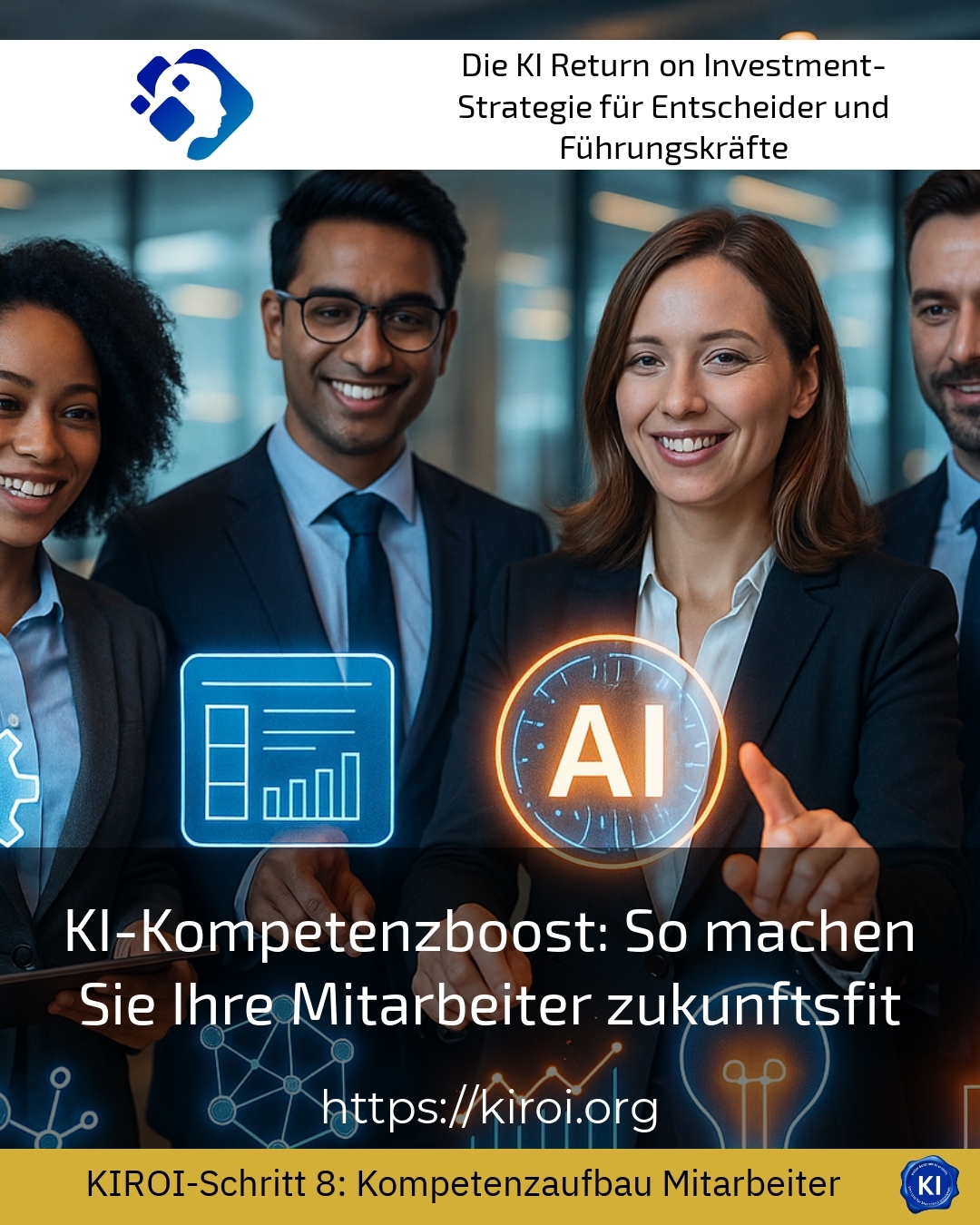
The digital revolution is changing our working world at a breathtaking pace. Companies are facing the enormous challenge of preparing their teams for this transformation. A AI Skills Boost becomes the decisive success factor for sustainable growth. Those who invest in the skills of their workforce today are securing the competitiveness of the entire company tomorrow. But how does this transformation succeed in practice? This article shows you concrete ways and inspiring examples from various industries.
Why the AI skills boost is becoming indispensable now
The speed of technological change now exceeds the adaptability of many organisations. Leaders frequently report a growing gap between available technologies and the skills of their employees. This discrepancy leads to frustration at all levels and significantly curbs the power of innovation. At the same time, intelligent systems are creating entirely new job profiles and fields of activity. Traditional tasks are undergoing fundamental changes and require an expanded range of competencies.
In healthcare, medical professionals already use intelligent diagnostic systems to support their work. Radiologists, for instance, work alongside image analysis algorithms, thereby increasing their accuracy in early detection. Nursing staff rely on digital assistance systems for documentation and to relieve the burden of administrative tasks. In the financial sector, algorithms analyse market movements and provide investment advisors with valuable bases for decision-making. Claims handlers in insurance companies use automated verification systems for faster claims processing.
Retail is also transforming rapidly through the use of intelligent technologies. Store managers are optimising their inventory using forecasting systems and thus significantly reducing losses. Sales assistants receive real-time information on customer preferences and can provide more individual advice. These examples clearly show that the change is encompassing all industries and leaving no one untouched.
The fundamental pillars of a successful AI skills boost strategy
A thoughtful upskilling strategy always begins with an honest inventory of existing skills. Businesses must first understand which competencies are already present and where gaps exist. This analysis forms the foundation for all further measures and prevents costly misallocations. Furthermore, organisations should consider and respect the individual learning needs of their employees. People learn at different speeds and in different ways, which is why one-size-fits-all solutions rarely lead to success.
In manufacturing, successful qualification programmes often begin on the shopfloor itself. Machine operators gradually learn to interpret data analyses of their equipment and predict maintenance needs. Quality inspectors work with image recognition systems and understand how they function through practical application. Logistics specialists optimise material flows using simulation tools, thereby developing new problem-solving skills. These hands-on approaches frequently achieve better results than purely theoretical training.
Best practice with a AIROI customer
A medium-sized mechanical engineering company with around three hundred employees faced the challenge of upskilling its workforce for the digital future. The management team recognised early on that technological investments are doomed to failure without corresponding skills development. As part of a transruptions coaching programme, the company first developed a differentiated skills map for all departments. This revealed that there was a significant need for training, particularly in the area of data analysis and interpretation. The coaching accompanied the development of a tailored learning programme over a period of eight months. Managers learned first and were then trained as internal multipliers for their teams. The combination of theoretical principles and immediate practical application on real projects proved particularly effective. The employees worked on concrete optimisation tasks from their daily operations and experienced immediate successes. Upon completion of the programme, participants reported increased self-confidence when dealing with new technologies. The productivity of individual departments improved measurably, and employee satisfaction increased significantly.
Individual learning paths as the key to success
Standardised training programmes quickly reach their limits when it comes to qualification for new technologies. People bring different prior experience, learning speeds and preferences into the learning process. Therefore, forward-thinking companies are increasingly relying on personalised learning paths that are tailored to individual needs. These approaches take into account both the participants' prior technical knowledge and their personal learning styles.
In the banking sector, client advisors complete modular online courses on intelligent analysis tools at their own pace. Clerical staff deepen specific application skills through practical simulations and case studies. Managers receive strategic impulses on integrating new technologies into their business divisions. In the pharmaceutical industry, researchers qualify themselves in the use of algorithms for drug discovery. Production employees learn the monitoring of automated quality controls through step-by-step introductions. These differentiated approaches lead to more sustainable learning outcomes and higher acceptance among those involved.
Leaders as catalysts for the AI competency boost
The role of managers in the transformation process cannot be overestimated. Through their own behaviour, they shape the learning culture of their teams and set important signals. Managers who are themselves open to new technologies also encourage their staff to experiment. Conversely, skeptical or anti-technology superiors can torpedo even the best training programmes. Therefore, experts recommend involving managers in the change process at an early stage and empowering them.
In the energy sector, department heads personally coach their teams through the introduction of smart grid control systems. In doing so, they demonstrate their own willingness to learn and create an atmosphere of psychological safety. In the telecommunications industry, team leaders moderate regular experimentation sessions with new customer service tools. Hotel managers accompany their staff in using personalization systems for guest relations. This exemplary role significantly accelerates competence building and reduces resistance to change.
Leaders frequently report initial uncertainties when dealing with technological innovations. Transruption coaching guides them in using these uncertainties productively and dealing with them authentically. Instead of simulating perfection, successful leaders transparently show their own learning journey. This openness builds trust and encourages employees to ask their own questions and view mistakes as learning opportunities.
Best practice with a AIROI customer
A large logistics company with several thousand employees at various locations recognised the need for a comprehensive culture change. The previous corporate culture had been heavily characterised by hierarchies and a certain pressure for perfection. As part of several months of transruption coaching, the management team initially worked on their own attitude towards change. The managers reflected on their unconscious resistance and developed a new perspective on continuous learning. Afterwards, they set up so-called learning laboratories in which employees could experiment with new technologies without taking risks. These safe spaces enabled genuine trial and error without fear of negative consequences in the event of mistakes. The managers themselves took part in the learning laboratories, thereby demonstrating their personal appreciation. The introduction of learning tandems, in which experienced employees accompanied younger colleagues, proved particularly effective. The reciprocal exchange of knowledge fostered team spirit and significantly accelerated skill development. After a year, the company recorded a significantly higher innovation rate and improved employee retention.
Establish learning culture as a competitive advantage
A vibrant learning culture does not emerge overnight and cannot be forced by top-down directives. It grows organically when the framework conditions are right and learning is recognised as value-adding. Companies with a pronounced learning culture grant their employees time and resources for further training. They visibly celebrate learning successes and consistently integrate skills development into their performance appraisal systems.
In the automotive sector, leading manufacturers are establishing in-house academies for digital skills [1]. These learning centres offer a broad spectrum ranging from foundational training to specialised expert programmes. In the food industry, quality managers from various locations network for regular exchanges of experience. Media houses are establishing community platforms on which journalists share best practices for data-driven research. These examples show how diverse learning cultures can be shaped.
Practical implementation of the AI skills boost in everyday working life
The transfer from the training room to everyday work often represents the greatest hurdle. Many well-intentioned qualification programs fail precisely at this critical interface between theory and practice. The decisive factor for success is therefore the close integration of learning and working from the very beginning [2]. Employees must be able to apply what they have learned immediately in order to build sustainable skills.
In the trades, electricians use mobile learning apps for a step-by-step introduction to smart home technologies. They scan products and immediately receive context-sensitive instructions and background information on how to use them. Roofers use drones for building inspections and train on this technology using real objects. Installers learn how to program intelligent heating controls directly on site during customer jobs.
In public administrations and authorities, digital assistants guide case workers in the use of new software systems. Librarians acquire knowledge about intelligent cataloguing systems themselves through guided practical exercises. Social workers use digital tools for case analysis and receive accompanying coaching for critical decision-making situations. These approaches integrate learning seamlessly into the work process.
Constructively use and transform resistance
Resistance to change is not a disruptive factor, but an important signal from the organisation. It indicates where fears exist, information is missing or past experiences have left negative traces. Wise managers do not ignore this resistance, but invite open dialogue about it. Through active listening and honest communication, many concerns can be dispelled or at least reduced.
Many employees come to coaching sessions with the concern of being replaced by technology. This fundamental existential anxiety must be taken seriously and addressed through transparent future scenarios. Others report feelings of being overwhelmed in view of the speed of technological change in their daily work. Transruption coaching provides impetus here on how organisations can better support their employees. Yet others have had negative experiences with previous change projects and are correspondingly sceptical.
In the healthcare sector, nursing staff frequently express concerns about the loss of human closeness due to technology. These worries are justified and merit a nuanced examination involving concrete application scenarios. In the education sector, teachers sometimes fear the devaluation of their pedagogical expertise by digital systems. Here, it helps to clarify that technology can support, but does not replace, human judgment.
Best practice with a AIROI customer
A traditional retail company with a history spanning over a hundred years was facing the digital transformation of its branch network. Many long-serving employees met the announced changes with clear scepticism and reservation. The management commissioned a transruption coaching agency to accompany the entire transformation process over eighteen months. In the first step, the coaching team conducted one-to-one interviews with employees at all hierarchy levels and of all age groups. In doing so, specific fears emerged that went far beyond technical uncertainties and touched upon questions of professional identity. The coaching team subsequently developed a narrative of transformation that honoured the strengths of the experienced employees. Their customer knowledge and advisory expertise were positioned as an indispensable foundation for the digital future. Younger, tech-savvy colleagues were paired with experienced employees for mutual knowledge sharing. This appreciation of both areas of expertise triggered a positive cycle and sustainably shifted the mood. By the end of the process, precisely the employees who had been most sceptical at the beginning had become the most convinced ambassadors.
My AIROI Analysis
Upskilling employees for a technology-driven future is not an optional extra, but a strategic necessity. Companies that invest in the skills development of their workforce today are sustainably securing their innovation and competitiveness for tomorrow. This is not about simply imparting technical skills, but about a comprehensive cultural shift towards continuous learning.
My analysis clearly shows that successful upskilling initiatives have several success factors in common. They always begin with the managers and their role model function for the entire organisation. They take into account the individual learning needs of the employees and offer differentiated learning paths. They integrate learning directly into the working day and enable immediate practical application of what has been learned.
I find the recognition of existing skills as a basis for building new capabilities particularly important. Employees who feel valued for their previous expertise are more open to new learning experiences. Resistance should not be fought, but understood and used as valuable indicators of potential for improvement.
Transruption coaching can effectively guide and support organisations through this complex change process. It does not offer ready-made solutions, but rather provides impetus for the development of tailored strategies. The path to becoming a learning organisation is not a sprint, but a marathon that requires perseverance and consistency.
Further links from the text above:
[1] McKinsey Insights – Building Workforce Skills at Scale
[2] World Economic Forum – The Future of Jobs Report
For more information and if you have any questions, please contact Contact us or read more blog posts on the topic Artificial intelligence here.






 Deutsch
  English (UK)