
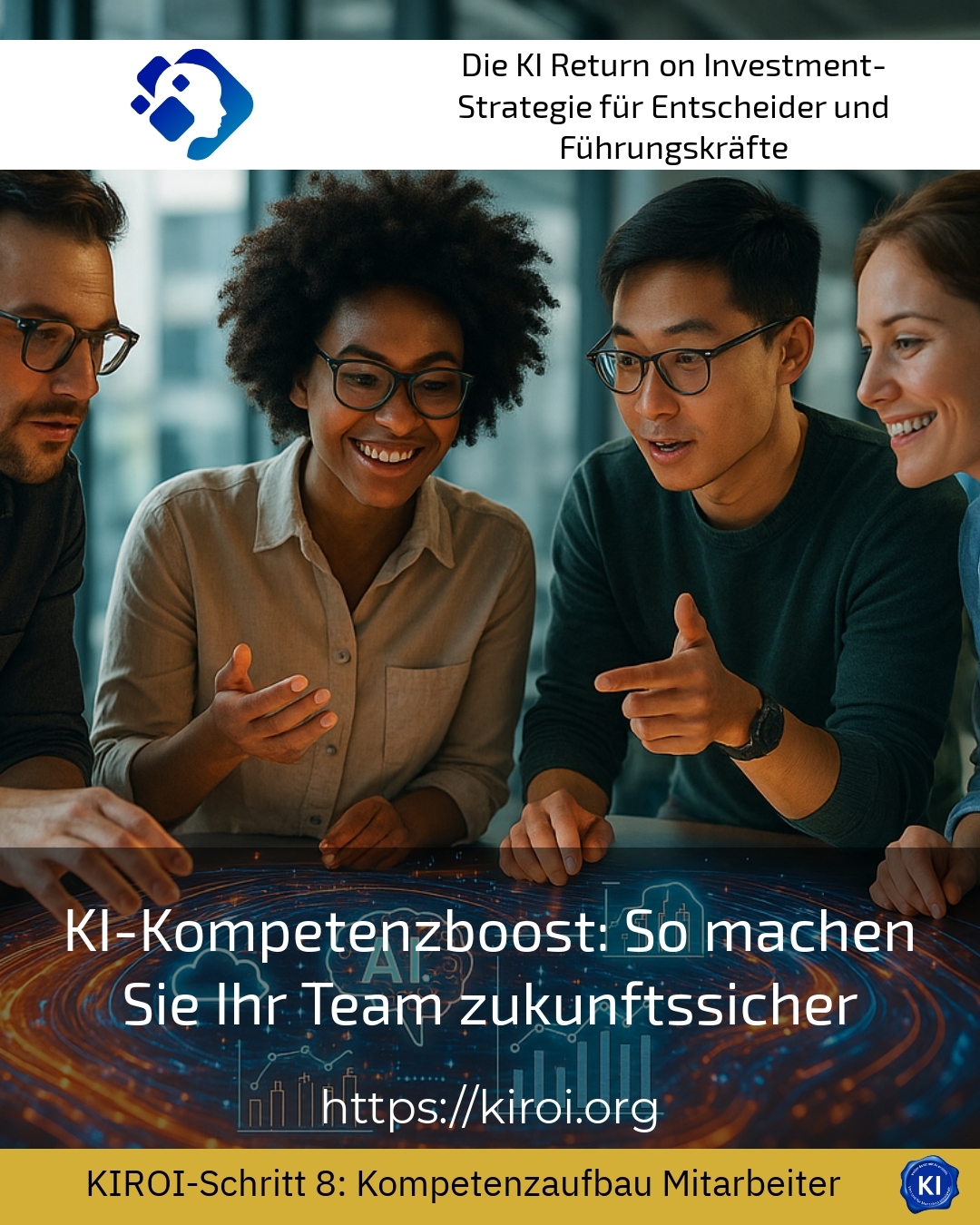
Imagine your team could tackle tasks tomorrow that still seem impossible today. Digital transformation is changing workplaces at a breath-taking pace. Companies that invest in an AI skills boost now are securing decisive competitive advantages. But how can this change be achieved in practice? How can leaders prepare their staff for a future where intelligent systems are part of everyday working life? These questions are currently occupying decision-makers across almost all industry sectors. The answers to them will determine the long-term success of entire organisations. Clients frequently report uncertainties and fears within their teams. At the same time, many recognise the enormous potential that lies in proper preparation.
Why the AI skills boost is becoming indispensable now
The world of work is undergoing a fundamental transformation. Intelligent algorithms are increasingly taking over repetitive tasks. This creates new demands on human skills. Creativity, critical thinking and emotional intelligence are gaining in importance. At the same time, employees must learn to work effectively with digital tools. For example, a medium-sized manufacturing company has optimised its quality control using image-recognition systems. As a result, the inspectors had to develop new competencies in the field of data interpretation. A logistics service provider, on the other hand, relies on intelligent route planning. There, dispatchers have learned to critically evaluate the systems' suggestions and adapt them when necessary. In an insurance company, algorithms now pre-analyse claims. As a result, case handlers are focusing more heavily on complex cases that require human judgement.
Many teams face similar challenges. They are aware of the need for change. Yet a clear roadmap for implementation is often lacking. This is where professional guidance can provide valuable impetus. transruptions coaching helps companies to tackle such transformation projects in a structured way. It supports teams in developing new ways of working. This results in sustainable changes rather than superficial training measures.
Identify skills and build them up systematically
Before organisations invest in training, they should analyse the current status. Which skills are already present? Where do critical gaps exist? This stocktake forms the basis for targeted development measures. A financial institution, for example, found that many staff members lacked basic data skills. As a result, tiered learning pathways were developed. In a retail company, the analysis showed that there was room for improvement, particularly in marketing. The department subsequently learned to make data-driven decisions and manage automated campaigns. A healthcare provider, in turn, recognised that ethical issues were being neglected within the team. The employees received training on the responsible use of algorithmic decision support tools.
Best practice with a AIROI customer
A medium-sized industrial company with around three hundred employees was facing a particular challenge. The production management had decided to introduce predictive maintenance systems in order to reduce unplanned machine downtime. The technicians on site initially reacted to this announcement with clear scepticism. They feared that their years of experience could be devalued and that the systems would endanger their jobs. The company opted for comprehensive support through transruptions coaching in order to work through these resistances constructively. In several workshops, the teams jointly developed scenarios for future collaboration between human and machine. It turned out that human expertise remained indispensable because the systems only provided probabilities and did not make definitive diagnoses. The technicians learned to interpret the data outputs correctly and to combine them with their empirical knowledge. After six months, those responsible reported a significantly increased level of acceptance within the team. Downtime decreased measurably because human intuition and machine analysis complemented each other optimally.
Designing learning formats for a sustainable AI competency boost
Traditional seminar formats quickly reach their limits with this topic. Instead, companies require flexible and practical learning approaches. Micro-learning modules enable employees to acquire knowledge in small chunks. For example, a technology company has developed an internal learning platform featuring short video lessons. Employees can access these during their working hours and apply them directly. A consultancy relies on peer-learning groups, in which experienced colleagues pass on their knowledge to others. A media company, meanwhile, is experimenting with gamified learning formats that impart skills playfully while keeping motivation high.
Crucial is the combination of theory and practice. Employees learn most effectively when they can apply new tools in real projects. Sandboxes and experimental spaces create safe environments for initial experiences. Mistakes are allowed there, and valuable insights emerge from them. Leaders should actively encourage such experiments and provide the necessary resources.
Leaders as Pioneers of Transformation
Change begins at the top of the organisation. Leaders must understand for themselves what opportunities digital tools offer. Only then can they credibly guide their teams through change. One construction company put its entire management level through intensive workshops. The managers learned to use automated planning tools and to assess their recommendations. In a pharmaceutical company, leaders regularly complete rotations in tech-savvy departments. An energy supplier, in turn, has established a reverse mentoring programme where younger employees train their superiors in digital topics.
In this context, leadership also means creating psychological safety. Employees need to feel that uncertainties and questions are welcome. Only then will they have the confidence to try new things and talk openly about failures. transruptions coaching supports leaders in establishing and embodying such a culture.
Understanding and constructively using resistance
Change always generates resistance too. Organisations should not view this as a disruption, but as a valuable signal. Legitimate concerns and unspoken needs are often hidden behind resistance. For example, a retail company encountered considerable scepticism when introducing automated ordering systems. The store managers feared losing their decision-making authority. Through intensive discussions, the company was able to address these fears and turn them into constructive solutions. A telecommunications provider experienced similar resistance when introducing chatbots in customer service. The service employees initially felt threatened and devalued. It was only when it became clear that the bots would only handle routine enquiries that the mood changed for the positive. An automotive supplier, in turn, initiated an open dialogue about anxieties regarding the future, thereby strengthening the workforce's trust.
Best practice with a AIROI customer
A large tax consultancy with multiple offices wanted to introduce intelligent document analysis systems. The software was supposed to automatically categorise receipts and generate booking suggestions. The experienced tax assistants were initially extremely sceptical about this innovation. They feared that their specialist knowledge could become redundant and that the quality of advice would decline. Management commissioned transruptions coaching to support them in shaping the change together with those affected. In moderated workshops, concerns were systematically recorded and prioritised. Mixed teams of specialists and tech experts then developed concrete application scenarios. It became clear that the systems could take over repetitive preparatory work and give the specialists more time for demanding advisory meetings. The employees recognised the added value and contributed their own suggestions for improvement. Following the introduction, they reported a significant increase in job satisfaction. At the same time, the firm was able to take on more clients and even improve the quality of its advice.
Developing long-term strategies for the AI skills boost
Skills development is not a one-off project, but an ongoing process. Companies require long-term strategies that can adapt to changing demands. For example, a food group has established a continuous learning cycle. Every six months, new technology trends are analysed and corresponding training programmes are developed. An engineering company relies on close partnerships with universities and research institutions. There, employees regularly gain insights into the latest developments. A textile company, in turn, has founded its own academy that deals exclusively with future skills.
Central to this is the involvement of employees in strategy development. They often know best which skills they lack and where support is needed [1]. Regular surveys and feedback loops help to tailor the measures to actual needs. transruptions coaching supports companies in developing such participatory processes and guides their implementation.
Performance measurement and continuous optimisation
Investments in skills development should deliver measurable results. To achieve this, companies need suitable key performance indicators and evaluation methods. A chemical company, for instance, measures how the use of new tools impacts process efficiency. A financial services provider systematically records which training formats achieve the highest transfer rate into everyday work. A logistics company, in turn, conducts regular skills assessments to make progress visible [2]. This data enables the evidence-based further development of measures. Organisations thus learn from their experience and continuously optimise their approaches.
What is important here is a realistic time horizon. Profound changes in competence require time and patience. Quick wins are tempting, but often not sustainable. Companies should therefore rely on a balanced mix of short-term impulses and long-term development programmes.
My AIROI Analysis
Guiding numerous transformation projects has shown me that success depends on several factors. First of all, an honest inventory is essential. Companies need to understand where they currently stand and which gaps need to be closed. In doing so, uncomfortable truths must not be ignored. Furthermore, it has become apparent that human factors are often more important than technical aspects. The best technology is of little use if employees do not accept it or use it incorrectly. Therefore, I recommend investing at least as much in change management as in technical training. Involving those affected right from the start significantly increases acceptance. Teams that can help shape the change demonstrate considerably more commitment and personal responsibility. In addition, I regularly observe that the exchange between different companies provides valuable impetus [3]. Organisations can learn from one another and do not have to make all the mistakes themselves. Finally, I advise viewing the AI skills boost as a strategic investment rather than a one-off measure. Only continuous learning and adaptation ensures long-term competitiveness. Guidance from experienced coaches can make all the difference here.
Further links from the text above:
[1] McKinsey: The importance of developing AI literacy
[2] Harvard Business Review: Artificial Intelligence
[3] World Economic Forum: Artificial Intelligence Insights
For more information and if you have any questions, please contact Contact us or read more blog posts on the topic Artificial intelligence here.








 Deutsch
  English (UK)