
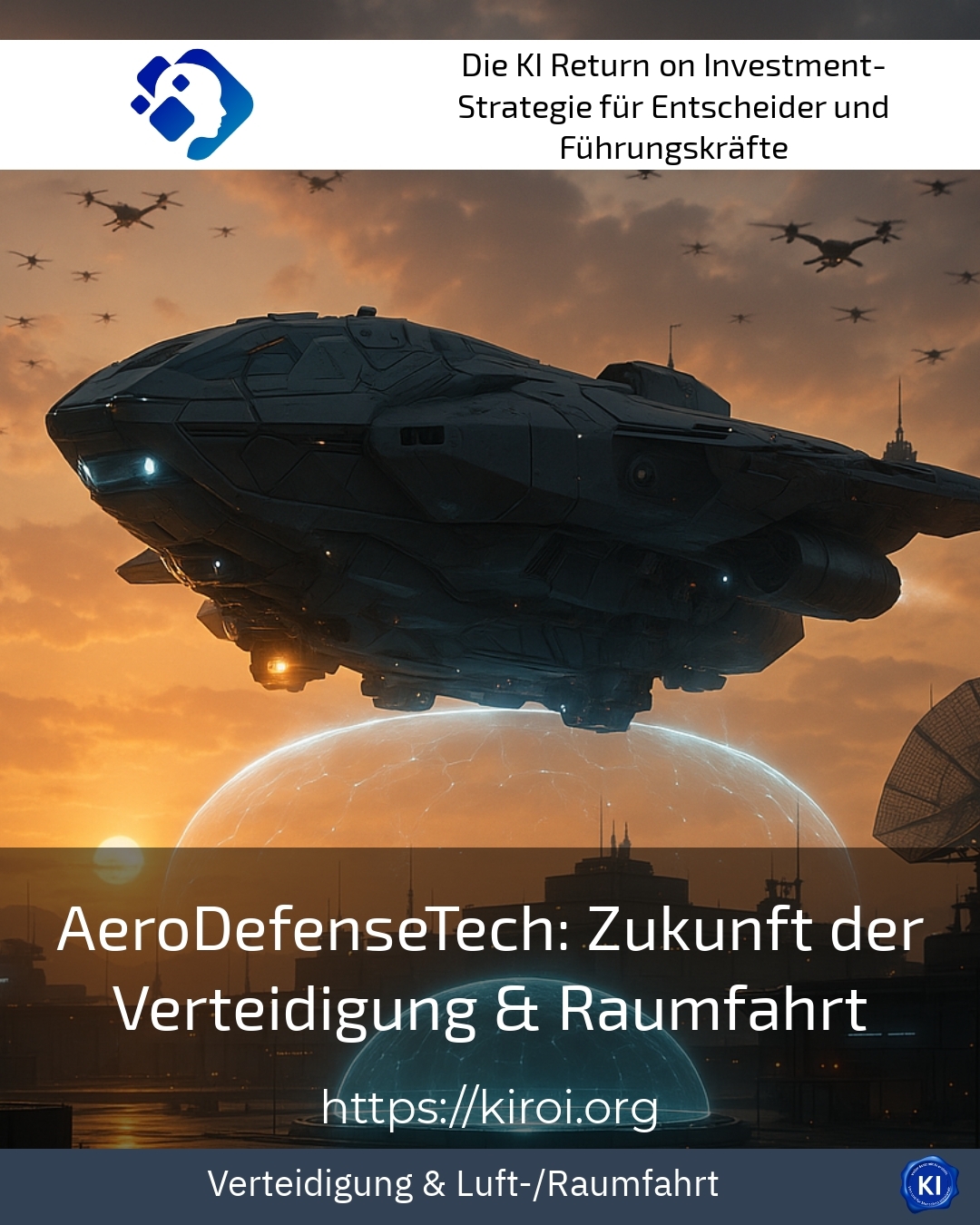
Will autonomous systems soon revolutionise the way we protect our airspace and explore the universe?
This question occupies decision-makers in companies and institutions worldwide. The fusion of advanced technology with strategic defence concepts opens up fascinating opportunities. At the same time, complex challenges arise that require thoughtful guidance. The AeroDefenseTech sector is at the heart of a profound transformation. Companies are looking for ways to strategically leverage these developments. In doing so, they often need external impetus and professional support. Transruption coaching offers precisely this guidance for demanding projects. The following sections highlight the most important developments and outline concrete fields of application.
Unmanned aircraft systems as pioneers of new strategies
The development of unmanned aerial systems has gained considerable momentum in recent years. Today, drones undertake tasks that were previously reserved exclusively for manned aircraft. They carry out reconnaissance missions and support logistical operations in hard-to-reach areas. An example of this is the deployment of long-range drones for monitoring maritime borders. These systems can patrol autonomously for many hours while continuously supplying real-time data to control centres [1].
Furthermore, various nations are experimenting with swarm technologies. In the process, hundreds of small drones coordinate themselves autonomously and carry out complex manoeuvres. Communication between the individual units takes place in a decentralised and redundant manner. Another field of application can be found in civil disaster relief. Here, emergency services are increasingly relying on unmanned systems for rapid situational assessment. They locate missing persons and transport medical supplies to crisis areas.
The integration of artificial intelligence into these systems further enhances their performance. Algorithms enable autonomous obstacle detection and adaptive route planning. Companies in the sector frequently report significant increases in efficiency through these technologies.
Best practice with a AIROI customer
A medium-sized enterprise in the sensor technology sector faced the challenge of adapting its product development to the requirements of autonomous flight systems. The existing processes were geared towards traditional applications and proved to be too rigid for the dynamic market demands. As part of a transruption coaching programme, we first analysed the existing competencies and identified strategic gaps. Together with the management team, we developed a roadmap for the technological realignment. In doing so, we placed particular emphasis on involving all relevant departments and fostered a culture of openness to change. Within eighteen months, the company successfully positioned three new product lines on the market. The employees reported a significantly improved collaboration between the technical and commercial areas. The continuous support during the implementation phase proved particularly valuable because it helped to identify resistance at an early stage and address it constructively.
Satellite-based communication and its strategic significance
The dependence of modern societies on satellite-based infrastructure is steadily increasing. Communications satellites enable global networking and support critical services. Navigation, weather data acquisition and Earth observation form the foundation of many economic activities. At the same time, awareness of the vulnerability of these systems is growing. Experts are increasingly discussing the protection of orbital infrastructure against physical and electronic threats [2].
Commercial actors like SpaceX have set new standards with their constellations of thousands of small satellites. These mega-constellations offer redundancy and increase resilience against the failure of individual units. The European Union is developing its own projects to secure technological independence. The planned IRIS² system is intended to guarantee secure communication for governmental and civilian users.
Another example of the importance of satellite-based systems can be seen in precision navigation. Military operations rely on centimetre-accurate position data. Jammers and spoofing attempts pose significant risks in this regard. Therefore, nations are investing in alternative navigation technologies and hardened receivers. The development of quantum-based sensors promises additional security here in the future.
AeroDefenseTech and the Transformation of Existing Business Models
Traditional companies in the aerospace industry are facing fundamental changes. Technological transformation requires adjustments in almost all business areas. Suppliers must build new competencies and modernise their manufacturing capacities. An example of this is the increasing importance of additive manufacturing processes. Industrial 3D printing enables the production of complex components with reduced lead times.
Airbus is already successfully using this technology for the production of structural components. Boeing is experimenting with printed titanium parts for engine components. Smaller suppliers are also recognising the potential and investing in corresponding equipment. However, the transformation does not only affect manufacturing itself. Maintenance, logistics and customer service are also undergoing profound changes.
Predictive Maintenance uses sensor data and machine learning to predict maintenance requirements. Airlines and military operators benefit from reduced downtime and optimised spare parts inventories. Lockheed Martin has implemented such systems for its F-35 fleet and reports significant savings. These examples illustrate the broad impact of technological change.
Hypersonic technology and new dimensions of speed
The development of hypersonic systems is among the most ambitious projects in the AeroDefenseTech sector. These missiles travel through the atmosphere at more than five times the speed of sound. Their manoeuvrability during flight fundamentally distinguishes them from ballistic systems. China, Russia and the United States are vigorously advancing corresponding programmes [3].
The technical challenges involved are considerable and diverse. Extreme temperatures are generated by air friction at high speeds. Novel materials and active cooling systems are required to ensure structural integrity. At the same time, communication and navigation antennae must function under these conditions. The development of appropriate protective covers requires intensive materials research.
Alongside military applications, civil perspectives are also emerging. Companies such as Hermeus are working on hypersonic passenger aircraft. A transatlantic flight could thereby be shortened to less than two hours. The economic implications would be considerable and would transform international business travel. However, commercial use still faces significant regulatory and economic hurdles.
Best practice with a AIROI customer
A research institute focusing on high-temperature materials approached us with a complex challenge. The organisation possessed excellent scientific expertise, but struggled to translate research results into marketable products. In transruptions coaching, we worked at the interface between science and industry. Together, we developed a structured process for technology transfer and identified potential industrial partners. It was particularly important to raise the scientists' awareness of commercial requirements and time constraints. At the same time, we supported communication with industrial partners and helped to formulate realistic expectations. The institute was able to sign two licence agreements with well-known companies in the sector. Since then, the staff have reported a changed perspective on their research work and feel better prepared for future collaborations.
Cyber security as a cornerstone of connected systems
The increasing interconnectivity of aerospace systems is creating new attack surfaces. Cyber threats are evolving dynamically and require continuous vigilance. A compromised navigation system or a manipulated communication link can have catastrophic consequences. Therefore, companies and government organisations are investing heavily in appropriate protective measures.
NATO has established its own centres for cyber defence in the aviation sector. These facilities simulate attacks and develop countermeasures. Private companies such as Thales and Raytheon also offer specialised solutions. They protect on-board networks and ground infrastructure against unauthorised access. The challenge lies in balancing security and functionality.
An example of the complexity of this task can be seen in the integration of systems from different manufacturers. Different security standards and protocols make end-to-end protection more difficult. The development of common standards and certification procedures is therefore gaining in importance. Organisations such as EASA are working on corresponding frameworks for civil aviation.
Space-based Earth observation and its diverse applications
Satellites today provide detailed information about almost every corner of our planet. The resolution of optical sensors has improved dramatically over past decades. Commercial providers such as Planet Labs operate constellations of hundreds of small satellites. They photograph the entire land surface daily and make the data available to customers worldwide [4].
Applications range from agriculture to environmental protection and crisis response. Insurance companies use satellite imagery for damage assessment after natural disasters. Authorities monitor illegal logging in rainforest areas and track ship movements. The verification of international agreements also benefits from this transparency. Disarmament treaties can be better verified through independent observation.
Radar satellites complement optical systems and enable observations even in cloudy conditions or darkness. The European Copernicus mission provides corresponding data for research and application. Based on this, companies are developing new services and opening up additional markets. The combination of different sensor technologies opens up particularly interesting possibilities.
Sustainable propulsion technologies in the aerospace and defence sector
The ecological footprint of aerospace is increasingly in the focus of public attention. The industry is responding with intensive research efforts into alternative propulsion concepts. Hydrogen is considered a promising energy carrier for emission-free flying. With the ZEROe programme, Airbus has presented ambitious plans for hydrogen-powered commercial aircraft.
Electric propulsion systems are already finding application in urban air mobility today. Companies such as Volocopter and Lilium are developing air taxis for inner-city transport. These systems use battery-electric propulsion and promise low-noise operation. The certification of such vehicles is progressing and initial commercial services have been announced.
Sustainable approaches are also gaining in importance in the aerospace sector. The reusability of rockets significantly reduces resource consumption. SpaceX routinely demonstrates this capability with its Falcon 9 rockets. Other providers such as Rocket Lab and Blue Origin are following this example. The reduction in costs through reuse is democratising access to space.
My AIROI Analysis
Developments in the aerospace and defence sectors show a clear direction. Technological innovation is accelerating, opening up new opportunities for companies of all sizes. At the same time, demands for agility and strategic foresight are increasing. The ability to transform is becoming the decisive competitive factor in this dynamic industry.
From my consulting practice, I know that many organisations face similar challenges. They possess excellent technical competencies, but have difficulties with strategic realignment. The integration of new technologies into existing structures requires more than just technical know-how. It also demands a change in mindsets and ways of working.
Transruption coaching offers valuable support here and provides impetus for necessary changes. It guides leaders and teams through complex transformation processes and helps with the prioritisation of initiatives. Particular importance is attached to considering the human factor alongside the technical aspects. Successful transformation can only succeed if people are brought along and empowered.
The coming years will show which players are best able to seize the opportunities presented by technological change. Flexibility and a willingness to learn will be more important than size alone. Smaller companies too can succeed in niche markets and develop innovative solutions. The AeroDefenseTech sector offers numerous starting points for this and promises exciting developments.
Further links from the text above:
[1] ESA – Earth Observation Applications
[2] EUSPA – EU Space Programme
[3] DARPA – Hypersonic Research Programmes
[4] Planet Labs – Satellite Imagery Products
For more information and if you have any questions, please contact Contact us or read more blog posts on the topic Artificial intelligence here.









 Deutsch
  English (UK)