
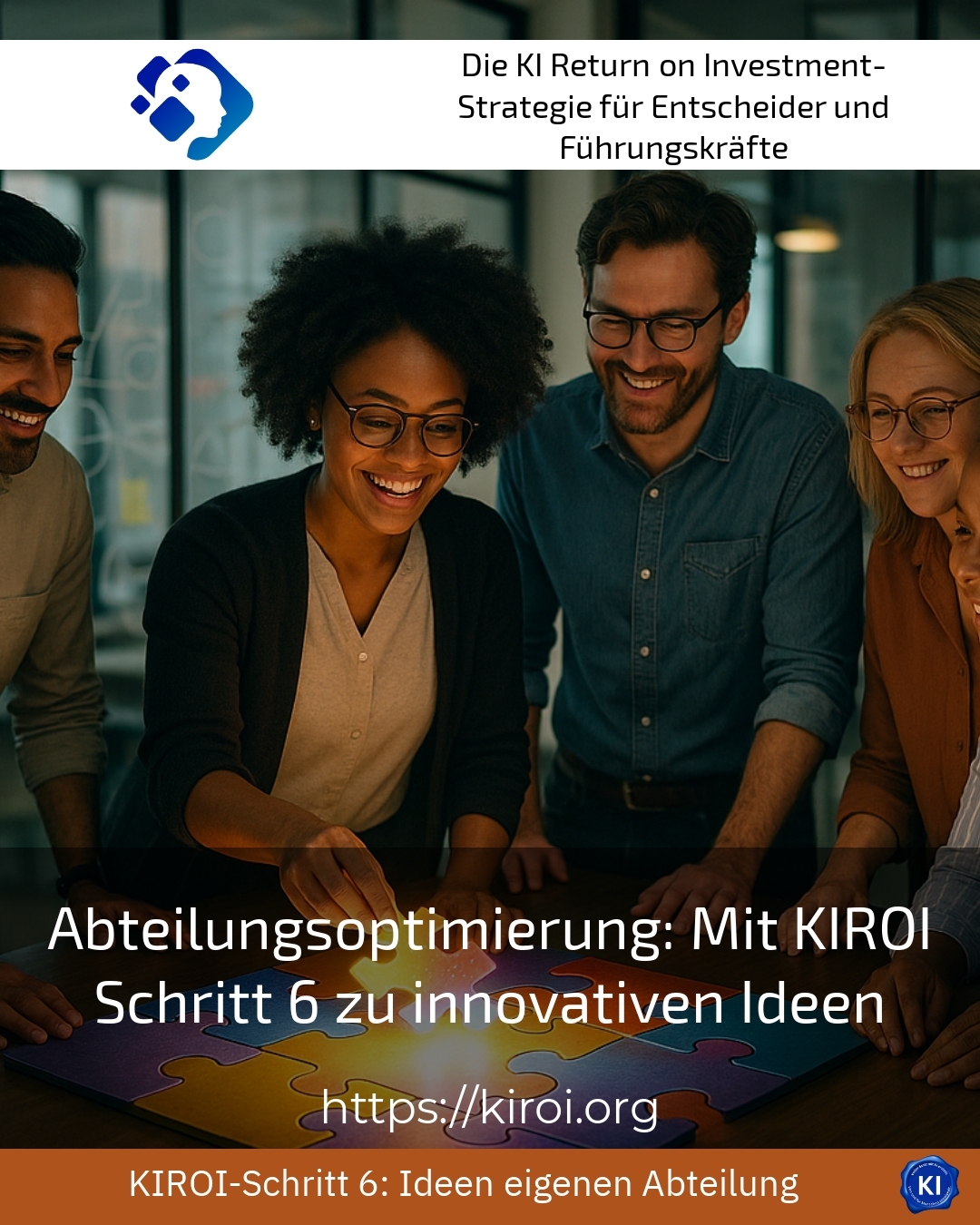
Departmental optimisation is a central building block for sustainable success in modern organisations. Many teams are looking for ways to improve their internal processes while simultaneously increasing employee satisfaction. With KIROI Step 6, you will receive concrete impulses on how innovative ideas can be generated and directly put into practice. Departmental optimisation means not only accelerating processes but also fostering the creativity and engagement of employees.
Die Optimierung von Abteilungen bezieht sich auf die Verbesserung von Prozessen, Abläufen und der Effizienz innerhalb einer spezifischen Abteilung eines Unternehmens.
Department optimisation encompasses all measures that help to increase efficiency and effectiveness within a team. Methods such as Lean Management, Six Sigma, or continuous improvement processes are often used. Employees are not just implementers, but also idea generators. They know the challenges of everyday work and can make targeted suggestions for improvement.
A practical example: A customer service team reduces response times through small, regular adjustments. The employees discuss things weekly and test new solutions. This creates a continuous improvement process that directly increases customer satisfaction.
Another example: A software company analyses its sales process and uses creative techniques like brainwriting. This results in new approaches that make sales more efficient. Employees feel valued and are more motivated.
A third example: A product management team uses the Ishikawa diagram to identify sources of error. The causes are systematically analysed and eliminated. This results in stable and reliable processes.
Departmental Optimisation with KIROI Step 6
Developing innovative ideas
KIROI Step 6 focuses on developing innovative ideas. Teams receive input on how to find creative solutions to existing challenges. The method uses targeted questions and creativity techniques to open up new perspectives.
An example: A marketing team uses the 5 Whys method to analyse the causes of low lead generation. Employees ask each other questions and discover new starting points. This leads to innovative campaigns that better reach the target audience.
Another example: A team in HR uses the morphological box to find solutions for employee retention. The parameters are systematically combined and new measures are developed. Employees feel more engaged and staff turnover decreases.
A third example: A team in the IT sector uses Design Thinking to improve the user-friendliness of a piece of software. Employees work closely with users and test new features. The software becomes more intuitive and user satisfaction increases.
Turning ideas into practice
The implementation of innovative ideas is a crucial step in departmental optimisation. Teams receive support on how to concretely plan and implement their ideas. Employees are actively involved in the process and contribute to its successful implementation.
For example: A purchasing team automates the ordering process. Employees test various tools and select the best solution. Processes become more efficient and the error rate decreases.
Another example: A team in controlling is introducing a digital time tracking system. Employees receive training and support the implementation. The data becomes more precise and planning becomes easier.
A third example: A sales team is optimising communication between departments. Employees regularly exchange information and adjust processes. Collaboration becomes smoother and projects are completed more quickly.
My analysis
Departmental optimisation is a continuous process that strengthens collaboration and efficiency within a team. With KIROI Step 6, you receive concrete impulses on how innovative ideas can be generated and directly implemented in practice. Employees are not just implementers, but also idea generators. They know the challenges of everyday life and can contribute targeted suggestions for improvement. Departmental optimisation means not only accelerating processes, but also fostering the creativity and commitment of employees.
Further links from the text above:
Process optimisation: definition, objectives, phases, procedure
Examples of process improvements
Process Optimisation: How it Works + Practical Example
Process Optimisation » 8 Methods + Tools at a Glance
Process optimisation in the company: methods and examples
Process optimisation: Everything you need to know
7 Revolutionary Process Optimisation Examples for 2025
Process Optimisation: Definition, Methods & Implementation
Process optimisation: definition, methods, examples
For more information and if you have any questions, please contact Contact us or read more blog posts on the topic Artificial intelligence here.










 Deutsch
  English (UK)