
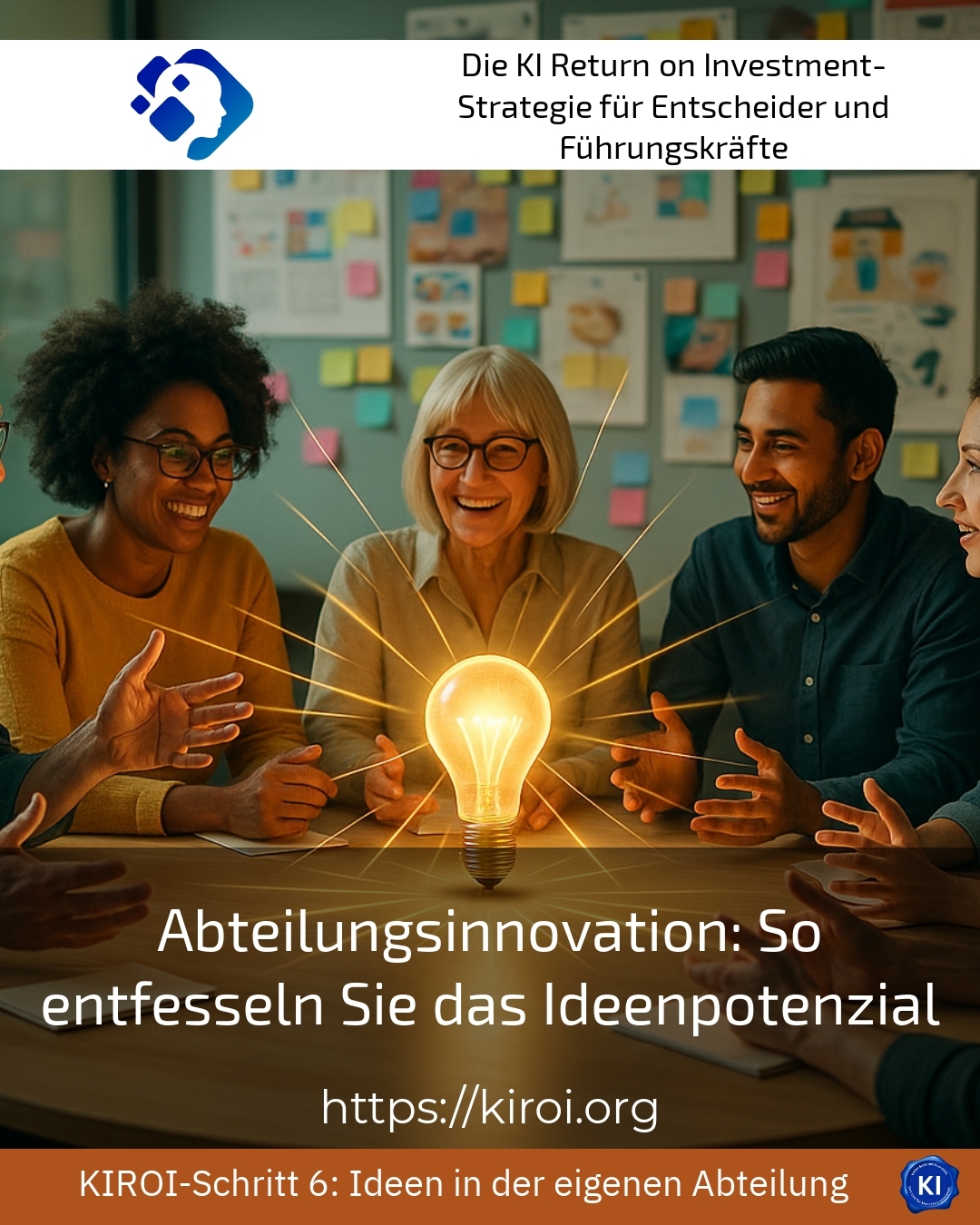
Imagine there's a vast reservoir of untapped ideas within your department, just waiting to be awakened. The Departmental Innovation is the key that can unlock this potential. Many companies give away valuable impulses from their employees every day. They fail to recognise the treasures hidden within their own ranks. Yet, practice repeatedly demonstrates impressively that systematic promotion of innovation brings measurable success. In this article, you will learn how to activate the creative potential of your teams.
Why Departmental Innovation Is More Important Than Ever
The world of work is changing rapidly. Companies face new challenges. Digital transformation, changing customer expectations, and global competition demand new solutions. In doing so, the Departmental Innovation This is of central importance. It allows for rapid reaction to changes. At the same time, it significantly boosts employee motivation.
For example, in the manufacturing industry, production teams have developed their own optimisation suggestions. These reduced lead times by significant percentages. In the retail sector, ideas from sales staff have led to improved customer experiences. In the logistics sector too, managers frequently report astonishing improvements. Employees there independently developed innovative route planning.
Transruption coaching supports companies through exactly these kinds of projects. It assists in establishing structured processes for idea development. The support helps to overcome resistance and initiate sustainable changes.
Best practice with a KIROI customer
A medium-sized manufacturing company approached us with a specific challenge. Management reported noticeable stagnation in internal improvement processes. Although the company had highly qualified specialists, innovative ideas were largely absent. Employees did not seem to actively contribute their ideas. As part of the transruption coaching, we first analysed the existing communication structures. It became apparent that formal hierarchies were significantly hindering the flow of ideas. Together, we developed a low-threshold suggestion system with digital support. Additionally, we established regular innovation workshops at the departmental level. Within six months, the company recorded a significant increase in submitted improvement suggestions. Particularly noteworthy was the increased motivation in the production teams. Employees reported a new sense of appreciation and participation. Management was able to implement several suggestions directly, achieving measurable cost savings.
The psychological foundations of successful departmental innovation
Creativity doesn't emerge from a vacuum. It requires specific conditions. Psychological safety is a crucial factor in this [1]. Employees need to know that their ideas are welcome. They shouldn't have to fear negative consequences. Only then will the floodgates open for genuine innovation.
In healthcare, studies show interesting connections. Care teams that experience psychological safety contribute more suggestions for improvement. In the finance industry, executives confirm similar observations. Employees in trusting environments more frequently develop innovative solutions. This factor also plays a central role in the technology sector.
In addition, innovation requires time and freedom. Many successful companies deliberately grant their teams creative time windows. These phases are used exclusively for idea development. This creates space for unconventional thinking.
The role of leaders in departmental innovation
Leaders are crucial catalysts for innovation processes. Their behaviour significantly shapes the innovation culture. An open attitude towards new ideas signals appreciation to teams. At the same time, leaders must also be able to constructively receive critical impulses.
Factory managers in the automotive industry have had positive experiences with innovation rounds. They established weekly meetings for open idea exchange. The construction industry reports similar successes in project meetings. In the education sector too, school principals are promoting creative approaches by providing dedicated free time [2].
Transruption coaching offers leaders concrete tools for this task. It imparts techniques for appreciative idea evaluation. Additionally, it supports the establishment of sustainable innovation structures.
Practical methods for unlocking creative potential
Various methods have proven effective in practice. Design Thinking, for example, promotes user-centred approaches to solutions [3]. This method puts the needs of those affected at the centre. This results in practical and accepted innovations.
In the insurance sector, teams use Design Thinking to develop new customer services. The tourism industry employs this method for innovative travel packages. Hospitals also report successful applications in process improvements. The results are impressive due to their high practical relevance.
Another effective method is brainwriting. In this process, all participants first write down their ideas. This prevents dominant personalities from controlling the conversation. This way, even reserved employees get a chance to voice their opinions.
Best practice with a KIROI customer
A human resources service provider was seeking ways to foster innovation. Previous idea generation processes were often one-sided and unproductive. A few employees regularly dominated discussions, while many others held back and did not contribute their thoughts. As part of our support, we introduced structured brainwriting sessions. Each person was initially given time for individual reflection and writing. Subsequently, the anonymous ideas were collected and evaluated jointly. This method fundamentally changed the team dynamics. Suddenly, previously quiet colleagues also participated actively. The quality and diversity of suggestions increased noticeably. The company was able to successfully implement several of these ideas. One idea, in particular, concerning digital process optimisation, proved to be exceptionally valuable. It originated from an employee who had never actively participated in idea sessions before.
Digital tools for fostering innovation
Modern technologies open up new opportunities for gathering ideas. Digital platforms enable collaboration across different locations. Employees can submit ideas at any time and from anywhere. This significantly lowers the barrier to participation.
In the pharmaceutical industry, research teams are successfully using digital idea platforms. The energy sector relies on specialised apps for submitting improvement suggestions. Retail companies are also reporting positive experiences with digital innovation tools. These tools support the entire process from the initial idea to implementation.
Artificial intelligence can also help with idea evaluation. It recognises patterns and connections in large datasets. This allows promising suggestions to be identified more quickly [4].
Common challenges and how to overcome them
The path to an innovative department is not always easy. Various obstacles can slow down progress. A common problem is the so-called „not-invented-here effect“. This leads to the fundamental rejection of external ideas. This phenomenon significantly hinders the open exchange of ideas.
In the chemical industry, department heads report such resistance. The media industry is also struggling with this phenomenon. Similar patterns are also emerging in the public sector. Overcoming these barriers requires targeted measures.
Another obstacle is a lack of time for creative processes. Many employees are heavily involved in day-to-day business. This leaves little room for innovative thinking. Companies need to consciously create free spaces here.
Transruption coaching supports organisations in overcoming such hurdles. It analyses existing blockages and develops tailor-made solutions. The support takes into account the specific circumstances of each department.
Ensuring the sustainability of innovation processes
One-off innovation initiatives often fizzle out ineffectively. Sustainable changes require systematic approaches. Integration into existing processes is crucial here. Innovation must become part of the company culture.
In mechanical engineering, companies have established permanent innovation circles. The food industry relies on regular, fixed-date idea competitions. Telecommunications providers also report on successful permanent structures. These examples show that continuity is crucial.
It is also important to recognise idea generators. Employees whose suggestions are implemented deserve appreciation. This can be material or non-material. The signal to the team is positive in both cases.
My KIROI Analysis
The systematic promotion of innovation at the departmental level represents a central challenge for modern organisations. From my experience in supporting numerous companies, a clear picture emerges. Many organisations considerably underestimate the creative potential of their employees. At the same time, the structural prerequisites for effective idea development are often lacking.
The KIROI methodology offers a systematic framework for sustainable change. It combines strategic planning with practical implementation support. The inclusion of all hierarchical levels proves particularly valuable. Innovation only works if it is supported by the entire organisation.
In my projects, I consistently observe similar patterns of success. Companies that create psychological safety achieve better results. Leaders who themselves model openness inspire their teams sustainably. Furthermore, it is evident that digital tools can significantly support the process.
However, the greatest progress is achieved through consistent action. Ideas must be evaluated and implemented promptly. Only then does trust in the innovation process emerge. Employees experience that their contributions truly count. This experience motivates further creative impulses.
In the future, I expect the importance of department-based innovation to continue to rise. The complexity of the challenges requires the inclusion of all perspectives. Artificial intelligence will gain importance as a supporting tool in this regard. It can recognise patterns and identify potential. However, humans will remain at the centre of all innovation processes.
Further links from the text above:
[1] Harvard Business Review – Psychological Safety
[2] McKinsey – Leadership in Innovation
[4] Gartner – Artificial Intelligence Insights
For more information and if you have any questions, please contact Contact us or read more blog posts on the topic Artificial intelligence here.











 Deutsch
  English (UK)