
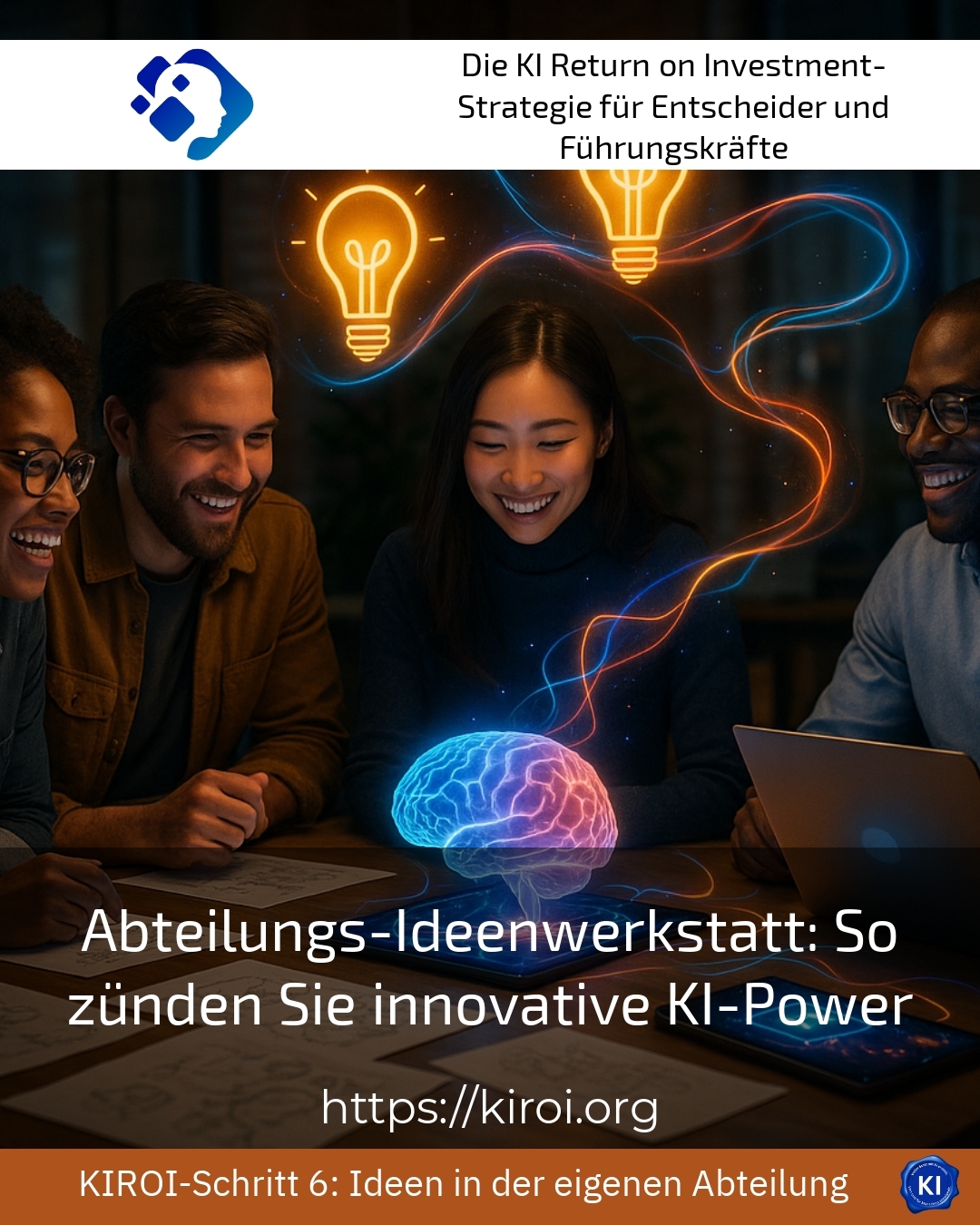
Imagine your department turning into a seething cauldron full of creative ideas that could revolutionise your company. The Departmental ideation workshop acts as the decisive catalyst that unlocks hidden potential and connects intelligent technologies with human creativity. This is precisely where the journey to groundbreaking innovations begins, which will sustainably transform your organisation. In doing so, transruptions coaching supports teams and leaders with the strategic implementation of such workshops. The following insights show you how you can unleash this power.
Why the department's ideas workshop becomes a source of innovation
In a time of rapid technological disruption, companies require structured spaces for creative thinking. A well-organised ideas workshop creates precisely this environment. It enables employees to think outside the box. At the same time, it promotes interdisciplinary exchange between different departments. Clients frequently report surprising breakthroughs after such sessions. The combination of human intuition and machine support generates unique synergies in the process.
Let us consider, for example, a medium-sized manufacturing company in the mechanical engineering sector. This company introduced quarterly creative sessions. During these, the engineers developed completely new approaches to predictive maintenance. Furthermore, an innovative concept for energy-efficient production processes emerged. Another example comes from the financial sector. There, a department used structured ideation to improve customer communication. The results clearly exceeded all expectations.
Best practice with a AIROI customer
An internationally active trading company faced the challenge of fundamentally optimising its logistics processes. The management team decided to introduce a structured departmental ideas workshop. Initially, employees from various areas were brought together. These teams jointly analysed existing workflows and identified potential for improvement. Intelligent analysis tools supported the evaluation of large volumes of data. Within a few weeks, twelve concrete proposals for innovation were generated. Three of these were implemented immediately and showed measurable results. Delivery times were reduced by an average of eighteen percent. At the same time, energy consumption in the warehouse area fell significantly. Transruptions coaching accompanied the entire process and provided important methodological impulses. The employees reported increased motivation and a higher identification with the company. The cross-departmental networking that resulted from the joint sessions was particularly valuable. Today, this project serves as a blueprint for other locations of the company.
Intelligent technologies as a turbocharger for the departmental ideas workshop
Modern algorithms can significantly accelerate the creative process. They analyse market trends and identify relevant patterns. Furthermore, they generate suggestions that complement human thought patterns. In doing so, they by no means replace human creativity. Rather, they act as inspiring sparring partners in the innovation process [1]. This technological support opens up completely new possibilities for systematic ideation.
In the healthcare sector, for example, clinics use data-driven analyses to improve processes. One hospital fundamentally optimised its patient admission process in this way. Waiting times were noticeably reduced. Similarly, educational institutions benefit from intelligent recommendation systems. These systems suggest personalised learning paths. A further education institute thereby increased the completion rates of its participants. In the field of public administration, automated evaluations significantly speed up approval procedures.
Practical tools for implementation
The selection of suitable tools significantly determines the success of an idea workshop. Digital collaboration platforms enable cooperation across different locations [2]. Brainstorming applications with built-in text generation expand the spectrum of possible approaches to solutions. Visualisation tools help to present complex relationships in an understandable way. Project management software systematically structures the implementation of promising ideas.
For example, an architectural practice integrated generative design tools into its creative processes. As a result, the architects developed unconventional building designs. These designs were characterised by exceptional energy efficiency. In the automotive industry, development teams are experimenting with virtual prototypes. These prototypes are created in a very short space of time. The teams can test and compare numerous variants. A telecommunications company uses intelligent analysis tools to identify customer needs.
Putting people at the heart of the department's ideation workshop
Technology alone does not guarantee innovation success. Humans remain the decisive factor in every creative process. Therefore, transruptions coaching always focuses on the development of individual and team-based competencies. Employees need spaces where they are allowed to experiment. A positive culture of learning from mistakes supports this process sustainably. Leaders play a central role model in this.
The pharmaceutical industry impressively demonstrates how important human intuition remains. Research teams there combine algorithmic molecular analyses with experimental expertise. A biotechnology company thus developed promising active ingredients faster than expected. In retail, innovative concepts are created through direct exchange with customers. A fashion chain revolutionised its shopping experience based on employee ideas. The energy sector benefits from creative approaches to grid stabilisation.
Best practice with a AIROI customer
An insurance group wanted to fundamentally modernise its claims handling and make it more customer-friendly. The department responsible initiated an intensive ideas workshop lasting several weeks. Claims handlers, IT specialists and customer advisors worked together on solutions to existing challenges. Intelligent text analysis helped to systematically record and categorise common reasons for complaints. The participants developed a completely new communication concept for their customers' claims notifications. Automated suggestions have significantly accelerated the processing of simple cases ever since. Complex matters continue to receive the full attention of experienced specialists and experts. Customer satisfaction increased measurably following the introduction of the new processes. Particularly noteworthy was the high level of acceptance among employees for the changed workflows. The accompanying transruption coaching addressed concerns openly and constructively throughout the entire team. The managers learned to interpret resistance as valuable feedback for improvements. Today, this department is considered an innovation driver within the entire group and inspires other areas.
Overcoming resistance constructively
Change processes frequently encounter scepticism and reservation [3]. These reactions are understandable and should be taken seriously. Transparent communication forms the basis for successful transformation. Employees must be able to experience the benefits of new methods concretely. Small successes build trust and motivate further participation.
A media organisation responded with great sensitivity to initial reservations from its editorial team. Those responsible organised workshops to demonstrate concrete possible applications. Journalists quickly recognised the added value for their research. A construction company gradually integrated digital planning tools into its processes. The foremen soon appreciated the improved material planning on the building sites. In the hospitality industry, intelligent systems support staff with reservation management.
Sustainable embedding of innovative processes
One-off creative sessions rarely produce sustainable results. Instead, organisations require continuous innovation structures for long-term success. Regular idea workshops embed creative thinking into the corporate culture. Clear responsibilities safeguard the implementation of promising concepts. Success measurement and feedback loops continually refine the processes further.
The chemical industry has been practising structured innovation management approaches very successfully for years. A speciality chemical manufacturer systematically established quarterly innovation rounds in all departments. These rounds generate hundreds of suggestions for improvement from employees every year. In transport, logistics companies continuously develop new route optimisations for their fleets. A parcel delivery service thus significantly reduced its fuel consumption compared to previously. The food industry uses networked sensor data for innovative quality control methods in production.
Success factors for the long-term impact of the departmental ideas workshop
Several factors determine the sustainable success of innovation initiatives in companies. Firstly, every initiative requires visible support from the top management level. Secondly, sufficient resources must be provided for experimentation. Thirdly, clear processes are needed for the evaluation and prioritisation of ideas. Fourthly, open communication fosters the long-term engagement of all participants.
A semiconductor technology company is consistently investing in the innovation capabilities of its teams. Every department has dedicated time for creative projects and experiments. The best ideas are shared across the company and recognised through various formats. In the renewable energy sector, ground-breaking storage solutions are emerging through cross-departmental collaboration. A wind turbine manufacturer thus significantly improved the efficiency of its turbines. The textile industry is experimenting with sustainable materials based on employee suggestions for better products.
My AIROI Analysis
Following intensive examination of numerous practical examples and theoretical foundations, key insights are emerging. The successful combination of structured ideation and intelligent technology requires above all one thing: a clear strategic direction that places people at the centre. Organisations that master this balance achieve remarkable innovation success in their respective industries. It repeatedly becomes clear that technological tools must never, and should never, be an end in themselves. They act as enablers and accelerators of human creativity throughout the entire process.
I find the observation that successful companies do not fight resistance, but can use it as a resource, to be particularly valuable. Skeptical voices frequently point to real weaknesses and potential for improvement. Transruption coaching supports teams very successfully in the constructive integration of these critical perspectives. This creates more robust and widely accepted innovation processes in the various departments.
For practical implementation, I recommend a step-by-step approach with clear milestones. Begin with a pilot project in a receptive department of your company. Document successes and challenges transparently for all stakeholders. Use these insights for scaling up to other areas of the organisation. Continuously invest in developing your employees' proficiency in using new tools. Create space for experimentation without immediate pressure on teams to deliver results. This fosters a vibrant culture of innovation that generates sustainable competitive advantages and future-proofs your organisation.
Further links from the text above:
[1] McKinsey: The economic potential of generative intelligence
[2] Harvard Business Review: Collaboration and Teamwork
[3] Prosci: Fundamentals of Change Management
For more information and if you have any questions, please contact Contact us or read more blog posts on the topic Artificial intelligence here.







 Deutsch
 English (UK)