
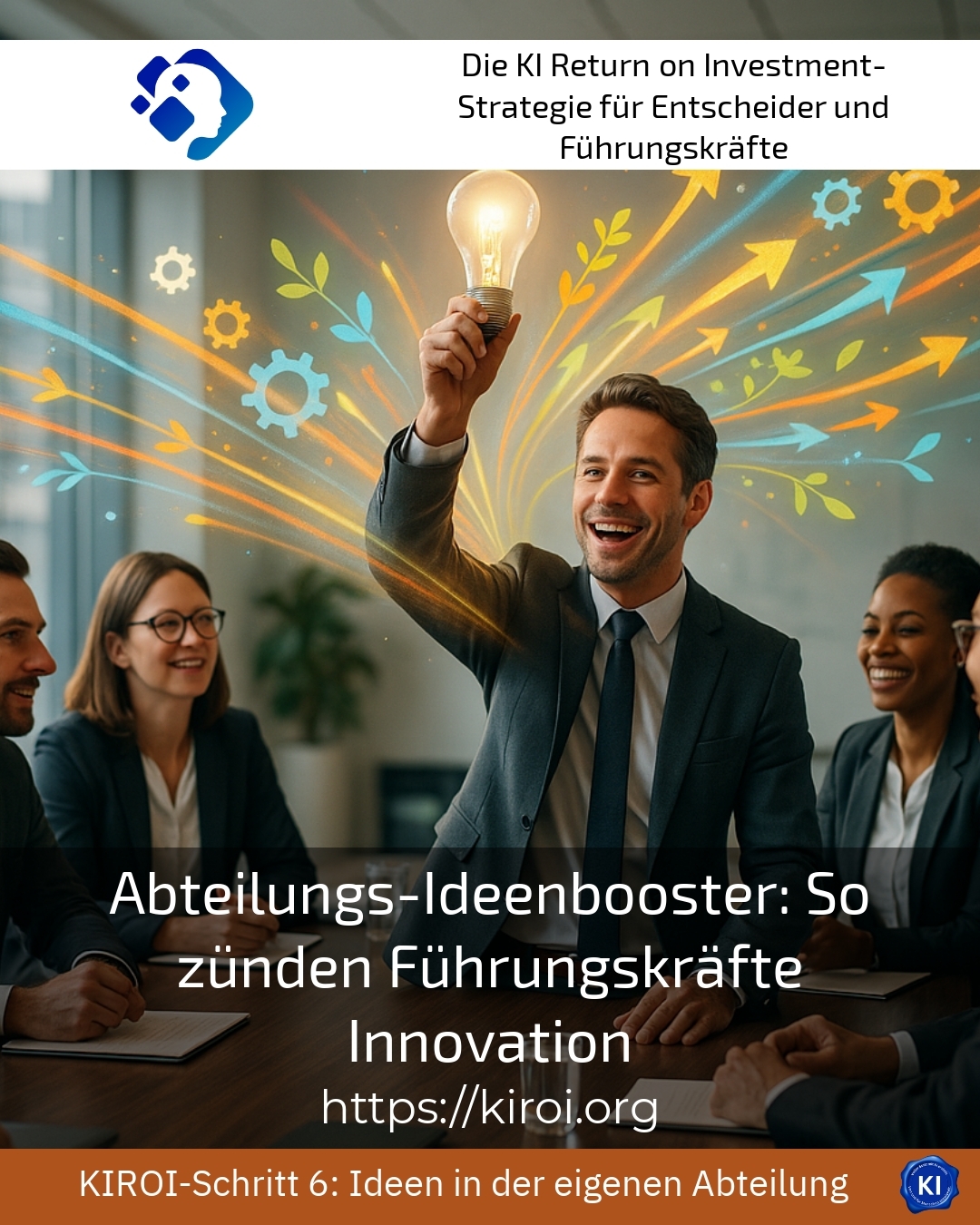
Imagine your department transforming into an innovation hub. Every morning, creative sparks fly through the corridors. Employees are eager to contribute their ideas. Does that sound like an unattainable utopia? In reality, many leaders experience the exact opposite. They struggle with stagnation and a lack of suggestions. However, there is a way to fundamentally change this situation. The Departmental Idea Booster offers you precisely this possibility. It allows leaders to systematically ignite innovation. This approach goes far beyond classic brainstorming methods. It combines psychological insights with practical tools. This creates spaces where creativity can flourish.
Why traditional innovation approaches often fail
Many companies invest significant resources in innovation programmes. Nevertheless, the results often fall short of expectations. The reasons for this are diverse and complex. Managers frequently report a sense of innovation fatigue within their teams. Employees have already experienced several failed initiatives and have become sceptical of new promises. Furthermore, psychological safety within teams is often lacking. People are hesitant to voice undeveloped ideas, and the fear of criticism permanently stifles their creativity. Added to this is the constant time pressure of day-to-day business. Operational tasks consume all available energy, leaving virtually no room for creative thinking.
A medium-sized company in the manufacturing sector tried for years without success to generate new product ideas. The established idea competitions always produced the same suggestions. A retail group set up a digital idea platform. However, after initial euphoria, it gathered dust on the virtual shelf. Even an innovative technology start-up struggled with this phenomenon. Despite flat hierarchies, the flow of ideas dried up after two years.
The department's idea booster as a transformative force
An effective Departmental Idea Booster addresses the root causes. It doesn't just change processes, but also mindsets. The key lies in the combination of several elements. Firstly, a changed attitude from the leader is required. They must become an enabler rather than a decision-maker. This transformation often requires professional support and reflection. Furthermore, teams need clear structures for creative work. Paradoxically, it is precisely structure that sustainably fosters creativity. When people know when and how they can contribute ideas, they do so more often.
In the logistics sector, a department manager implemented weekly creative slots. Every Tuesday morning, her team worked exclusively on improvement ideas. After six months, the number of implemented suggestions had tripled. A financial services provider introduced so-called innovation tandems. In these, two employees from different departments jointly developed ideas. This method produced a surprisingly large number of cross-industry solutions. Similar successes are also evident in the healthcare sector. A nursing service developed completely new service offerings through structured idea rounds.
Best practice with a AIROI customer
An international mechanical engineering group approached us with a specific problem. The R&D department hadn't produced any groundbreaking product innovations for years. The manager was desperate and looking for fresh impetus. As part of the transruption coaching, we first analysed the existing structures very closely. In doing so, we discovered several unconscious blockages that were hindering the flow of ideas. The hierarchy was too strict, and critical feedback was often given publicly in front of the entire team. Together, we developed a new communication format for submitting ideas. Employees could now initially submit suggestions anonymously and only later reveal their authorship. We also established monthly innovation retreats outside the office building. These were deliberately held in inspiring locations such as museums or nature parks. The manager learned to hold back their own opinion until everyone else had spoken. Already after four months, the number of submitted ideas continuously doubled. Two of these suggestions led to patentable product improvements with significant market potential. Employee satisfaction in the department measurably increased by eighteen percentage points.
The role of the manager in the department idea booster
Leaders significantly shape the innovation culture within their departments. Their behaviour constantly sends signals to the team. These signals can either foster or suppress creativity. Many leaders are unaware of this impact. They act with good intentions, but with counterproductive methods. A common problem is the rapid evaluation of ideas. If the boss criticises immediately, employees quickly fall silent. Instead, a phase of appreciative listening is needed. The leader should initially ask questions rather than pass judgement.
In the realm of renewable energy, a team leader experienced precisely this transformation. He learned to set aside his own ideas and let others speak. Within a year, his team developed three innovative service concepts. A department head in the automotive supply industry went a step further. He introduced so-called "failure celebrations," where failed experiments were acknowledged. This unusual measure significantly increased his team's willingness to take risks. Positive effects are also evident in the food industry. A production manager implemented regular reverse mentoring sessions with younger employees.
Practical tools for everyday innovation
The Departmental Idea Booster includes various practical methods. These can be adapted to different team sizes and industries. A particularly effective technique is idea rotation. In this method, each team member passes on an idea prompt to their neighbour. The neighbour develops the idea further and passes it on again. After several rounds, completely new combinations and perspectives emerge. Another method is the future workshop with three clearly defined phases. First, participants gather criticism of the status quo without any restrictions. Then, they design utopian future visions without regard for feasibility. Finally, they develop concrete first steps towards this vision.
A media company successfully used the persona inversion method. Employees imagined how their worst customers would think. This unusual perspective generated surprisingly valuable insights for product development. In the pharmaceutical industry, the science fiction prototyping method proved its worth. Teams designed products for a fictional future in fifty years. Many of these futuristic ideas contained the seeds for current innovations. An insurance company worked very successfully with the analogy technique. Employees looked for parallels in completely unfamiliar industries such as the hospitality sector.
Best practice with a AIROI customer
A leader from the management consultancy sector sought our support with a complex transformation project. Their team was tasked with developing innovative consulting products for digital transformation. However, there was a lack of fresh perspectives and bold ideas. In transruption coaching, we first carefully analysed the existing team dynamics. We identified several unspoken conflicts that were hindering the creative process. These were constructively addressed and resolved in moderated discussions. Subsequently, we introduced the method of silent idea generation within the team. In this approach, team members initially worked on the same questions completely independently. Only after a week did they exchange their results in structured sessions. This method prevented the typical groupthink effect, where dominant voices overpower others. Within three months, the team developed seven completely new consulting formats. Two of these were successfully launched on the market and generated significant revenue. The leader reported a significantly improved team atmosphere and higher motivation. The project exemplifies how professional support can overcome innovation blockages.
Ensuring the sustainability of innovation culture
Many innovation initiatives fail due to a lack of sustainability. After the initial enthusiasm, everyday life returns. The old patterns reassert themselves. To prevent this, systematic anchoring is needed. Departmental Idea Booster must become part of the departmental routine. Regular appointments for creative work are essential. These should be just as binding as budget meetings.
A telecommunications company consistently integrated innovation metrics into its objective agreements. Executives were now also measured by the number of implemented employee ideas. This fundamentally and permanently changed their behaviour for the better. A retail company established an internal innovation mentoring programme for new employees. This instilled a creative culture from the outset. In the construction industry, the creation of innovation sponsorships between departments proved successful. Experienced teams actively supported younger departments in building their creative processes. This collegial support significantly accelerated cultural change.
Typical obstacles and how to overcome them
When introducing an idea booster system, predictable resistance is encountered. Some employees are sceptical or feel overwhelmed. Others see no point in additional creative activities. This resistance must be taken seriously and addressed constructively. A frequent obstacle is the perfectionism of individual team members. They want to present only fully-fledged ideas. This causes them to hold back valuable raw diamonds. Explicit encouragement of unfinished thoughts helps here.
In the chemical industry, a laboratory manager introduced so-called idea sketch rounds. Employees presented deliberately unrefined concepts on Post-its. This low-threshold format significantly lowered the inhibition threshold. A software company struggled with siloed thinking between development and sales. These divides were overcome step by step through joint innovation workshops. Similar patterns were also observed in the textile industry. A design department opened up its creative processes to production employees for the first time.
My AIROI Analysis
The experiences from numerous support projects paint a clear picture. Successful innovation in departments doesn't happen by chance or isolated flashes of inspiration. It is the result of systematic work on structures and culture. Leaders play a crucial, yet often underestimated, role in this. They must be willing to critically reflect on their own behaviours. This self-reflection is significantly more successful with professional support. Transruption coaching effectively supports leaders precisely in this transformation.
The insight that creativity requires security [1] seems particularly important to me. People only express bold ideas in an environment of trust. Building this trust requires time and consistent action. Leaders must keep their promises and learn to forgive mistakes. Only then does the psychological safety that enables innovation arise [2]. The combination of structural measures and cultural change brings sustainable results. Individual methods or tools are not sufficient for this.
My analysis also shows that many organisations give up too quickly. They expect immediate results and are disappointed by slow progress. However, cultural change requires patience and perseverance. Leaders should plan with a time horizon of at least twelve months. Investing in professional support pays off many times over [3]. It accelerates the process and reliably prevents typical mistakes.
Further links from the text above:
[1] Harvard Business Review: Innovation Topics
[2] McKinsey: Psychological Safety and Leadership Development
[3] Forbes: Insights on Leadership
For more information and if you have any questions, please contact Contact us or read more blog posts on the topic Artificial intelligence here.









 Deutsch
  English (UK)