
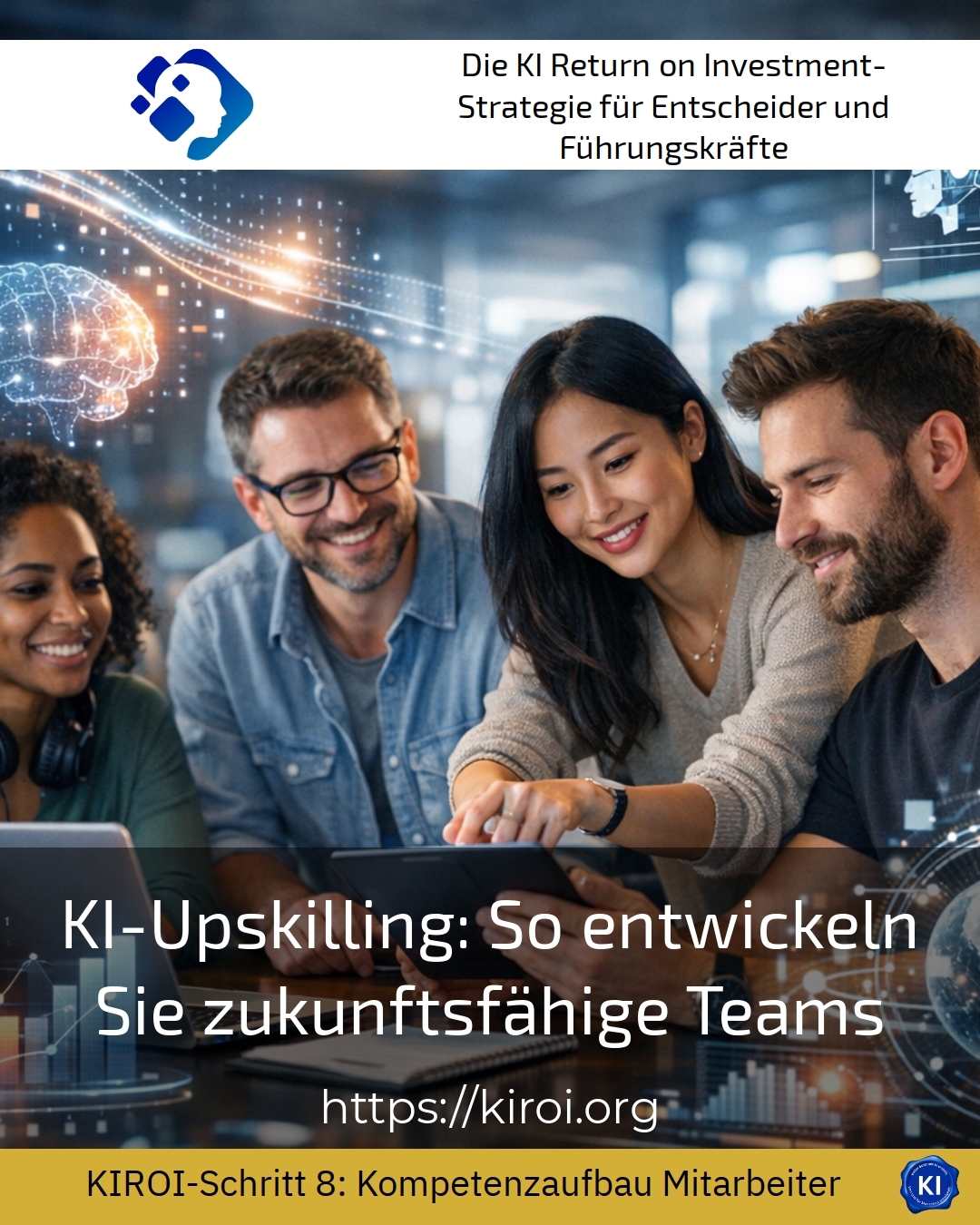
Will your company still be competitive in five years if your employees do not develop the right skills today? This question concerns executives across industries, because the technological transformation is fundamentally changing workplaces. AI Upskilling This is the key to establishing future-proof teams. The development is progressing rapidly. Anyone who does not act now risks losing out on the opportunity to keep up. In this article, you will learn how to systematically develop your workforce.
Why competence development is crucial now
The working world is undergoing a profound transformation. Technological innovations are changing job descriptions faster than ever before. Studies show that up to 40 percent of all activities could be automated [1]. This development affects almost every industry and every hierarchical level. At the same time, completely new fields of work are emerging. These require skills that were unknown just a few years ago.
Companies are facing a strategic decision point. They can either seek external professionals. However, these are scarce and expensive. Or they invest in their existing teams. The second path often proves more sustainable. Employees already know the internal processes. They understand the corporate culture. And they bring valuable experience with them.
In the manufacturing industry, this change is particularly evident. Production workers increasingly use intelligent machines. They interpret sensor data and optimize processes. A machine operator thus becomes a process optimizer. In retail, consulting activities are fundamentally changing. Sales staff uses digital assistants for product recommendations. In healthcare, algorithms support diagnosis. Nurses work with intelligent documentation systems.
Best practice with a AIROI customer A medium-sized logistics company faced the challenge of modernizing its warehouse logistics. The management recognized that new technologies alone would not be enough. The employees needed to understand and apply the systems. Together, we developed a phased qualification program. First, we analyzed the existing competencies of all team members. Then we identified the skills needed in the future. The gap between the two states formed the basis for individual learning paths. Experienced warehouse employees learned to interpret data analyses. Younger colleagues brought their digital understanding to the table. This resulted in a productive exchange of knowledge between generations. After six months, the management reported noticeable increased efficiency. The error rate during picking significantly decreased. Above all, team satisfaction increased measurably.
Understanding AI Upskilling as a Strategic Process
Successful competence development follows a structured approach. Individual training is not enough. Companies need a well-thought-out strategy. This begins with an honest assessment of the current situation. What skills already exist? Where are critical gaps? And which competencies will be indispensable in the future?
The answers to these questions vary considerably depending on the industry. A financial services provider requires different focus areas than a tradesman. A hospital has different priorities than a software company. Therefore, an individual analysis of the initial situation is recommended. One-size-fits-all approaches are too short-sighted.
In banking, for example, data analysis is becoming increasingly important. Customer advisors need to be able to classify algorithmic recommendations. They should understand how credit checks work. In the insurance industry, claims processing and risk assessment are changing. Claim handlers work with intelligent systems. They make decisions based on machine-generated suggestions. In the manufacturing sector, however, other aspects play a role. These include digital order planning and material management.
The AIROI approach for systematic AI upskilling
The AIROI approach offers a proven framework for competence development [2]. It combines strategic planning with practical implementation. The human being is at the center. Technology serves as a tool, not an end in itself. This perspective shift greatly facilitates acceptance among those involved.
In the first step, a comprehensive situation analysis is carried out. Existing processes and roles are examined. At the same time, external trends and developments are taken into account. The result is a clear overview of the areas of action. In the second step, concrete development plans are created. These take into account different learning styles and prior knowledge. Some employees prefer traditional training. Others learn better through practical application.
In the automotive industry, we are currently overseeing several transformation projects. Engineers are learning to work with generative design tools. Production planners are using predictive analysis methods. Quality inspectors understand how automated inspection systems work. In the energy sector, we are seeing similar developments. Technicians monitor intelligent networks. Customer advisors explain complex tariff models using digital support.
Best practice with a AIROI customer A large insurance company wanted to modernize its claims processing. The employees should be able to use intelligent assistance systems. Many employees initially expressed concerns and uncertainties. In workshops, we worked together to identify which tasks would change. The employees realized that routine tasks would decrease. At the same time, more demanding tasks would increase. This realization motivated the entire team. We developed a learning concept with various modules and levels of depth. Experienced claims officers were trained to become internal coaches. They supported their colleagues in practical learning. After one year, a significant improvement in competence was evident. Processing times decreased, while customer satisfaction increased. Particularly pleasing was the reduced turnover in the department.
Leaders as enablers of transformation
The success of qualification initiatives depends largely on the leadership. They must lead by example and actively support change. This starts with their own willingness to learn. Leaders who develop new skills themselves set important signals. They show that lifelong learning is part of everyday work.
At the same time, leaders must create spaces for development. This means freeing up time for further education. It also means accepting mistakes as part of the learning process. A culture of error tolerance fosters a spirit of experimentation. Employees then dare to try new things.
In retail, we are experiencing this dynamic particularly intensively. Store managers need to inspire their teams with digital tools. They explain how inventory management systems work. They show how customer analyses improve the advice provided. In the restaurant industry, similar topics play a role. Restaurant managers implement digital reservation systems. Service staff use tablets for ordering and recommendations. In the hotel industry, check-in processes are changing fundamentally.
Practical implementation of AI upskilling in teams
Practical implementation requires smart planning and patience. Not all employees learn quickly. Some require more support than others. A gradual approach has proven effective. It starts with basic concepts and gradually deepens them.
Learning formats that are applied in the concrete work routine are particularly effective. Abstract training courses are quickly forgotten. However, when employees learn through real projects, the knowledge becomes deeply embedded. Peer learning complements formal training in a meaningful way. Colleagues learn from each other. This informal knowledge is often particularly practical.
In the pharmaceutical industry, interesting application areas are emerging. Laboratory assistants work with automated analysis devices. Researchers use algorithms for molecular analysis. Quality control inspectors interpret complex measurement data. In construction, planning processes are undergoing profound changes. Architects work with parametric design tools. Site managers coordinate projects using intelligent project management software.
Best practice with a AIROI customer A company in the food industry faced a special challenge. The workforce was highly heterogeneous with different educational backgrounds. Traditional training formats only effectively reached a portion of the employees. Together we developed a multimodal learning concept with various access points. Practical workshops were held directly at the machines for production workers. Executives received strategic seminars on change management and employee leadership. For all employees, low-threshold information offerings were available in various formats. Short videos illustrated basic concepts in a clear and understandable way. Regular question sessions provided space for individual concerns and concerns. Particularly valuable was the use of learning mentors from within the company. These trusted colleagues accompanied the transformation process continuously. The acceptance of new technologies increased measurably as a result.
Overcoming obstacles and bringing about sustainable change
Every transformation project encounters resistance and obstacles. These are normal and should be taken seriously. Often, clients report fears within the team. Employees worry about their jobs. They feel overwhelmed by the changes. These emotions deserve attention and space.
Open communication is the key to overcoming resistance. Leaders should inform employees honestly about planned changes. They should also admit when not all questions can be answered immediately. Transparency creates trust. Trust enables change.
In the media sector, we are witnessing intensive transformation processes. Journalists are learning to work with research assistants. Graphic designers are using generative image tools as inspiration. Publishers are developing personalized content strategies. In education, similar changes are taking place. Teachers are integrating digital learning tools into their teaching. Administrative staff are using automated processes for routine tasks.
My AIROI Analysis
Systematic competence development is no longer an optional extra. It has become a strategic necessity for future-proof companies. Organizations that now invest in the development of their teams gain significant competitive advantages. They retain qualified employees for the long term and sustainably increase the innovation capability of their entire organization.
The AIROI approach has proven to be an effective framework in numerous projects. It consistently combines strategic foresight with pragmatic implementation orientation. At the same time, the human being remains at the center of all considerations. Technology supports, but it does not replace human judgment.
Transruptions coaching professionally and sensitively accompanies companies on this challenging journey. We provide guidance and support in the practical implementation of concrete solutions. We carefully take into account the individual circumstances of each organization. There are no one-size-fits-all solutions, but there are proven principles and methods.
AI Upskilling This is best achieved when all involved are actively involved. Employees should be able to see the change as an opportunity. Leaders must lead by example and consistently facilitate change. The management team creates the necessary framework conditions for this. Together, a learning organization for the future is created.
The coming years will certainly bring further technological disruptions. Companies with future-oriented teams will be able to master these challenges. They will not only react but also be able to actively shape them. This is the goal of sustainable competence development for all involved parties.
Further links from the text above:
[1] McKinsey Global Institute: The Future of Work
[2] AIROI Methodology for Strategic Competence Development
For more information and if you have any questions, please contact Contact us or read more blog posts on the topic Artificial intelligence here.






 Deutsch
 English (UK)