
How many hours do you spend each month comparing software solutions, only to find that the decision you made was not optimal in the end?
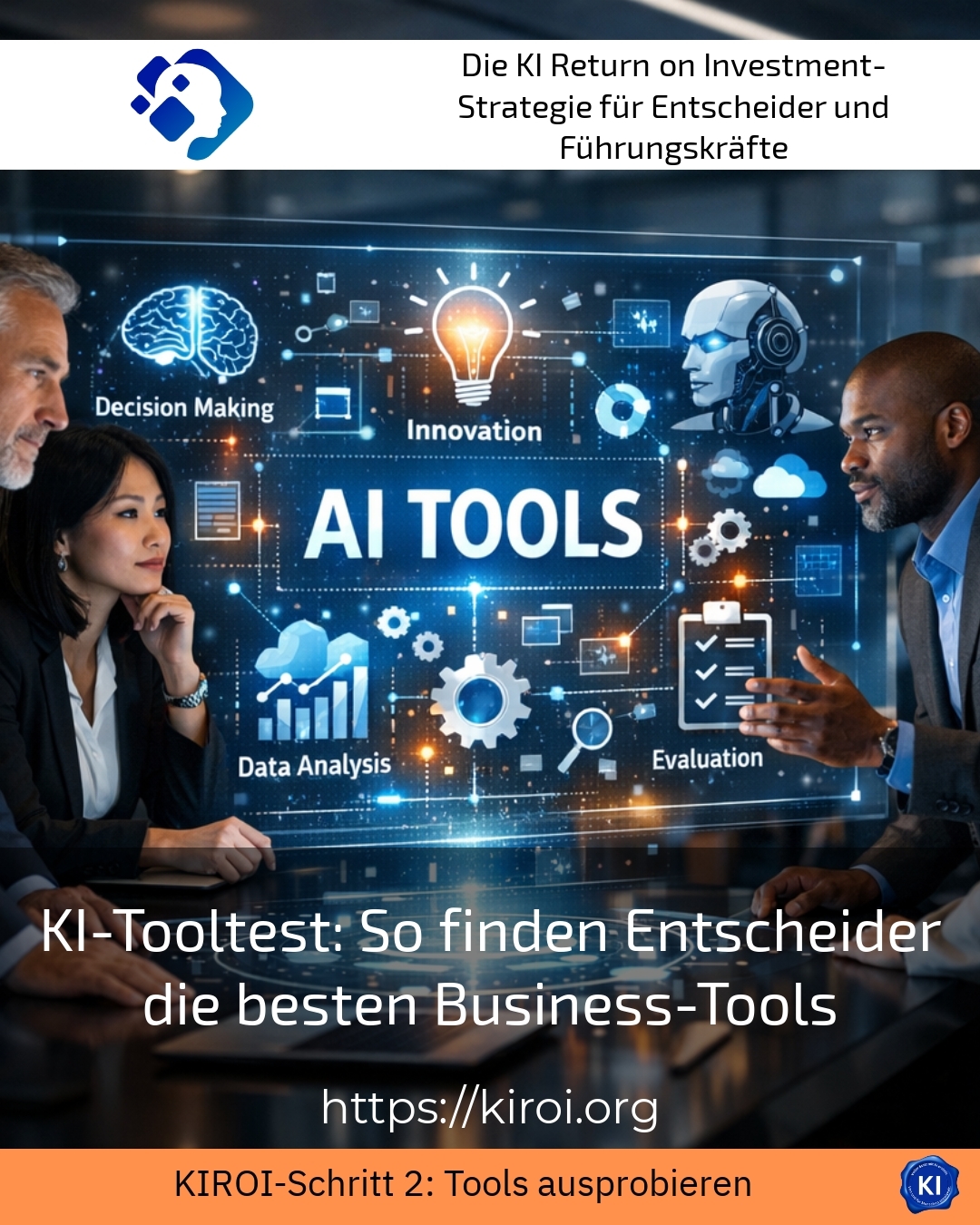
This question concerns executives and decision-makers in almost all industries. The AI Tool Test It has established itself as a crucial success factor in this context. The digital transformation is advancing relentlessly. At the same time, the number of available business applications is growing exponentially. Decision-makers face the challenge of identifying the appropriate solution from among thousands of options. A structured approach helps avoid misjudgments and efficiently allocate resources. In this article, you will learn which methods have proven effective and how transruptive coaching can support your evaluation processes.
The importance of systematic evaluation in the digital age
The market for intelligent business applications is expanding rapidly. Every day new solutions appear that promise increased efficiency. Many decision-makers report being overwhelmed by this abundance. A methodological approach AI Tool Test This creates orientation and security. It is not just about technical specifications. Rather, strategic corporate goals, existing infrastructures, and cultural factors must be taken into account. Companies that approach things systematically often make better decisions. They save significant costs in the long term through subsequent repairs.
In the field of automated text processing, the complexity becomes particularly evident. Some solutions focus on summarizing extensive documents. Others specialize in creating marketing content. Still others support the analysis of customer inquiries. A logistics company may require a combination of these functions. A law firm, on the other hand, prioritizes contract review and research support. Financial service providers, in turn, prioritize compliance-compliant data processing. This diversity illustrates why blanket recommendations are rarely effective.
Best practice with a AIROI customer
A medium-sized commercial company approached us because it was encountering significant difficulties in selecting a suitable solution for automated customer communication. The company had already tested three different providers and invested valuable time and resources in the process, without achieving a satisfactory result. As part of our transruptive coaching support, we developed a structured criteria catalog that took into account both technical requirements and organizational frameworks. It turned out that previous evaluations had overlooked an essential aspect: the integration with the existing ERP system. Through a systematic approach, the team identified a solution within six weeks that met all relevant criteria. The implementation then proceeded much more smoothly than in previous projects. Employees are now reporting noticeable relief in their daily work.
Criteria for a meaningful AI tool test
The quality of an evaluation depends largely on the underlying criteria. Superficial comparisons often lead to suboptimal decisions. Instead, a more multidimensional approach is recommended. First, functional requirements should be precisely defined. What specific tasks should the solution handle? What interfaces to existing systems are required? How large is the expected data volume?
Furthermore, non-functional aspects play a central role. Data security, for example, is becoming increasingly important in light of increasing regulation [1]. European companies must ensure that chosen solutions operate in compliance with data protection regulations. Scalability is another important factor. A solution that seems adequate today can quickly reach its limits when growth occurs. Ease of use also deserves attention. Even powerful systems only have an impact when employees accept them.
In healthcare, for example, particularly strict requirements apply to data protection. Hospitals are intensively evaluating solutions for patient communication based on encryption standards. Pharmaceutical companies are checking documentation tools for GxP compliance. Insurance companies are ensuring that decision-making processes are traceable in damage analysis systems. These industry-specific requirements illustrate why generic test reports often are not sufficient.
Technical evaluation methods in the AI tool test
Various methods are available for a thorough technical evaluation. Proof-of-concept projects enable practical testing under real conditions. Selected use cases are tested with real company data. Sandbox environments, on the other hand, provide a risk-free testing environment without production data. A/B tests compare multiple solutions in parallel using defined metrics.
A manufacturing company recently tested three solutions for predictive maintenance. The predictive accuracy was compared using historical machine data. A retail company evaluated demand forecasting tools over a period of three months. The results were compared with actual sales figures. An energy provider reviewed grid load forecasts under different weather conditions. These specific test scenarios provide reliable decision-making bases.
Organizational factors in tool selection
Technical excellence alone does not guarantee successful implementation. Organizational frameworks significantly influence whether an implementation succeeds. Involving relevant stakeholders from the outset significantly increases acceptance. Technical departments should be able to articulate their requirements. IT teams should assess technical feasibility and integration effort. Management should prioritize strategic direction and budget frameworks.
Many clients come to us with exactly this issue. They report on failed projects due to a lack of coordination. Or on solutions that work technically flawlessly but remain unused. Transruptions coaching accompanies companies in orchestrating these multifaceted processes. In doing so, we provide guidance for structured stakeholder dialogues. We support the development of governance structures. And we accompany change management processes during the implementation phase.
Best practice with a AIROI customer
A financial services provider faced the challenge of optimizing its customer advisory services through intelligent assistance systems. The IT department favored a technically sophisticated solution with extensive analytical capabilities. The consultants, on the other hand, desired an intuitive system with minimal training requirements. Management prioritized rapid implementation and demonstrable return on investment. These different perspectives initially led to a standstill in the decision-making process. As part of our guidance, we moderated a structured dialogue between all involved parties. A shared understanding of the project objectives was developed and compromises reached. The result was a solution that did not fulfill all wishes, but was accepted by all parties. The implementation took place in stages, starting with a pilot group of selected consultants. This approach enabled continuous adjustments based on practical experience. Today, the employees report significant improvements in their work.
Economic evaluation within the framework of the AI tool test
The cost-benefit analysis is a central component of any evaluation. A superficial examination of license fees alone is not sufficient. Implementation costs, training expenses, and ongoing operating costs must be taken into account. Indirect costs such as productivity losses during the introduction phase also play a role [2].
On the usability side, quantification often proves challenging. Time savings can be measured relatively easily. However, quality improvements require differentiated metrics. Strategic benefits such as increased innovation often cannot be precisely quantified. For example, an industrial company evaluated the time savings in offering creation. A media house quantified the increase in content output. A business advisory firm measured the improvement in research quality based on reduced revision cycles.
Avoiding pitfalls in evaluation
Despite careful planning, evaluation processes can lead to errors. Some typical pitfalls deserve special attention. Focusing on functionality sometimes leads to the selection of oversized solutions. Expensive enterprise systems then remain unused in their capabilities. The opposite error lies in underestimating future requirements. What seems sufficient today can become a bottleneck tomorrow.
The over-reliance on references also carries risks. Success stories from other companies cannot be automatically replicated. Different conditions lead to different results. For example, a telecommunications company failed with a solution that worked excellently for a competitor. The reason was different data structures in the legacy systems. A trading company had to abandon a pre-built solution because adapting to local business processes became too complex.
Future viability as a decision criterion
Rapid technological development requires forward-looking decisions. Solutions should not only meet current requirements; their architecture must allow for future expansion. Open interfaces and modular structures promote adaptability. The provider’s innovative strength also deserves attention [3].
An automotive supplier evaluated solutions for quality control with particular care in this regard. The chosen solution had to be compatible with future production systems. An insurance company tested damage-handling systems for their scalability. The integration of new damage types should be possible without changing the underlying infrastructure. A hotel chain focused on multilingualism and cultural adaptability in its guest service solutions.
Best practice with a AIROI customer
An internationally operating consulting firm sought a solution for knowledge-based assistance in research and documentation. The initial evaluation focused heavily on the current capabilities of the available systems. As part of our transruptive coaching support, we expanded the focus to future-proofing and adaptability. Together, we developed scenarios for possible business developments in the coming years. These scenarios were included as evaluation criteria in the evaluation process. This significantly shifted the ranking of the providers. The solution ultimately selected did not offer the highest current performance. However, its modular architecture enabled flexible extensions and adjustments. After one and a half years, this decision was confirmed when new requirements could be integrated without major changes. The company thus avoided a costly system change.
My AIROI Analysis
The systematic evaluation of intelligent business applications presents decision-makers with multifaceted challenges. A structured approach is essential to ensure the success of such projects. AI Tool Test It forms the foundation for sustainably successful technology decisions. It is no longer just about technical capabilities alone. Organizational fit, economic viability, and strategic future viability deserve equal attention. The methods and examples presented in this article illustrate the range of relevant factors.
From my experience in guiding numerous evaluation projects, several success factors emerge. The early definition of clear goals and criteria prevents subsequent course corrections. The involvement of all relevant stakeholders increases acceptance and practical applicability. Practical test scenarios provide more reliable findings than theoretical comparisons. The consideration of future developments protects against premature obsolescence.
At the same time, I observe recurring patterns in less successful projects. Too short timeframes lead to superficial evaluations. Dominant individual interests distort the criteria setting. A lack of technical expertise makes it difficult to evaluate complex systems. Unrealistic expectations result in disappointment after implementation.
Transruptions Coaching positions itself clearly as a support for projects related to these questions. We provide guidance, moderate processes, and share experience. The final decision remains always in the hands of the responsible parties in the company. Because only those who know the specific framework conditions can make a viable choice. Clients often report that the structured evaluation process already provides valuable insights about their own organization.
Further links from the text above:
[1] BSI – Information on Artificial Intelligence and Security
[2] Bitkom – Artificial Intelligence in Corporate Use
[3] BMWK – Artificial Intelligence Strategy of the Federal Government
For more information and if you have any questions, please contact Contact us or read more blog posts on the topic Artificial intelligence here.









 Deutsch
 English (UK)