
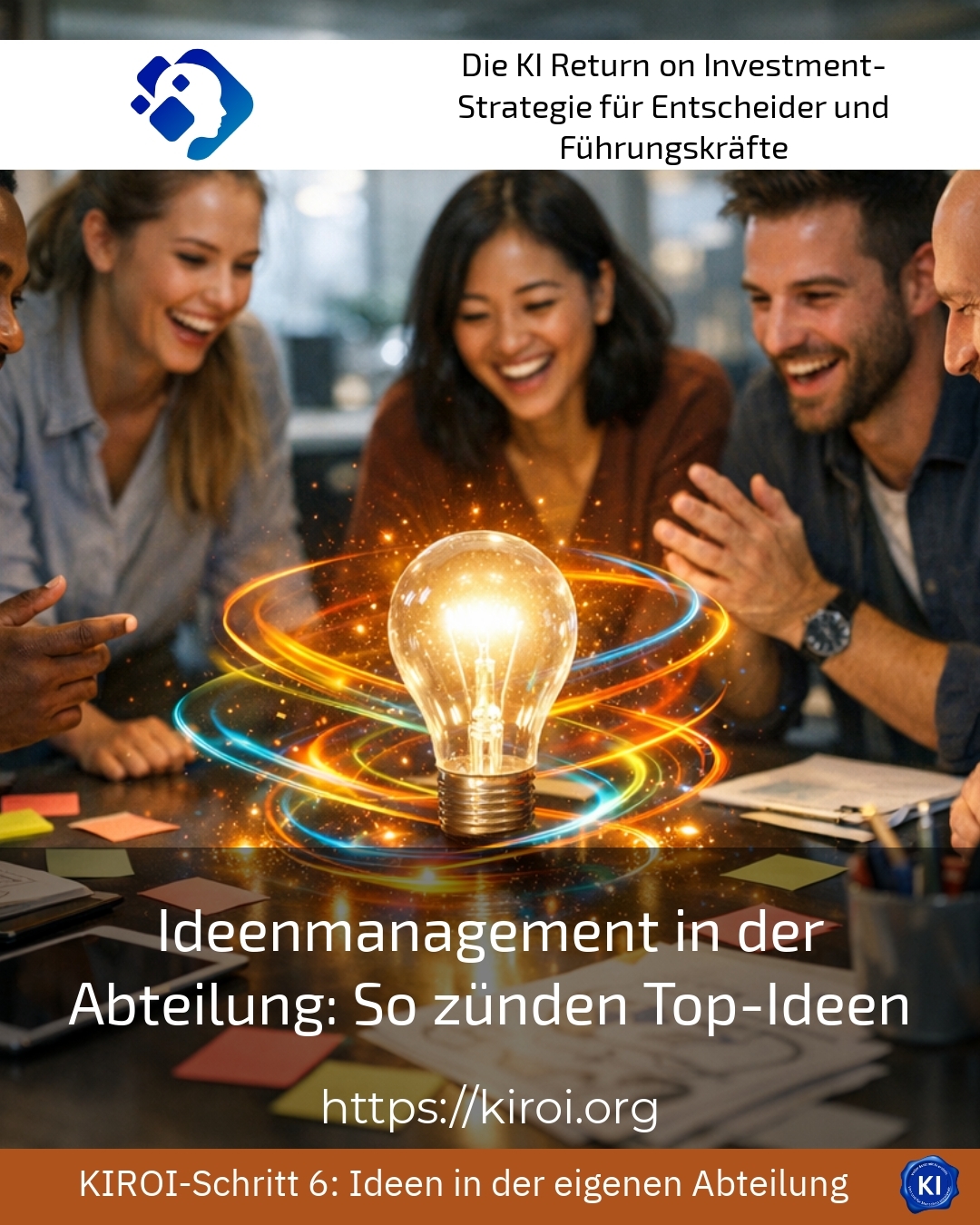
Why do most brilliant ideas in companies fail before they have even had a chance to reach their full potential? This question concerns executives and teams alike, because they intuitively sense that a huge treasure trove of untapped potential lies dormant in the minds of their employees. Idea management in the department It thus represents a crucial lever that determines whether creative impulses develop into genuine innovations or dissipate without a trace in day-to-day operations. In times of rapid change and increasing complexity, no organization can afford to leave its workforce’s intellectual capital lying dormant; therefore, a structured approach to proposals and improvement initiatives has long since ceased to be an optional pastime but has become a strategic necessity.
The hidden power of systematic creativity promotion
An effective Idea management in the department It begins with the fundamental insight that innovation is not a product of chance. Rather, it arises where favorable conditions meet dedicated people. Leaders often report that their best ideas emerged in informal conversations over coffee at the vending machine. This observation highlights the importance of psychological safety for the creative process. Employees must feel that their suggestions are welcome. They need the assurance that imperfect ideas will not be mocked.
For example, a medium-sized logistics company found that its warehouse employees were faced with small inefficiencies on a daily basis. However, these observations remained unspoken for years. Only when management introduced regular brainstorming sessions did these valuable insights come to light. Similarly, a service provider from the financial sector experienced the same thing. There, employees had long since recognized which forms were unnecessary. But no one had ever asked them about them. In the healthcare sector, on the other hand, caregivers often report practical improvement ideas. But they often simply lack the time to implement them.
Best practice with a AIROI customer A manufacturing company in the mechanical engineering sector faced the challenge that valuable improvement suggestions from production regularly went unheeded because there were no clear structures for their implementation and the employees became increasingly frustrated as a result. As part of intensive coaching support provided by transruptions coaching, the management team developed a multi-stage system that placed transparency and appreciation at the center. Each submitted suggestion received a personal response within two working days, explaining how the next process would unfold and who would serve as the point of contact. After six months, the number of submitted proposals had tripled, and the implementation rate rose from meager twelve percent to a remarkable forty percent. In anonymous surveys, employees reported that they felt truly heard for the first time and saw their expertise valued, which also had a positive effect on overall job satisfaction.
Structures create sustainable idea management within the department
The creation of suitable structures forms the foundation of any successful innovation culture. It is not about building bureaucratic hurdles. Rather, clear paths should be created that provide guidance. A retail company has appointed so-called innovation ambassadors in each branch. These individuals collect suggestions and pass them on to central departments. In the restaurant industry, some establishments have replaced idea boxes with digital tools. This also allows shift workers to submit their ideas conveniently.
The combination of analog and digital elements is particularly effective because different personality types are addressed in different ways, and some people prefer to formulate their thoughts in writing, while others prefer direct interaction. One insurance company reports that the introduction of an app has significantly reduced the barrier to adoption. At the same time, monthly face-to-face meetings for personal interaction have remained in place. In the education sector, some institutions are experimenting with hybrid formats. Teachers can submit proposals both digitally and in team meetings [1].
The role of the leader as a catalyst
Leaders take on a key position when it comes to unleashing creative energy. Their behavior sends strong signals to the entire team. A manager who openly discusses his own misperceptions encourages others to be open. Conversely, excessive criticism stifles any approach at its very inception. In the pharmaceutical industry, some department heads have begun to deliberately present incomplete concepts. By doing so, they signal that perfection does not have to be the first step.
Transruptions coaching can help leaders redefine their role and develop a mindset that promotes innovation without losing sight of operational needs. Clients often report feeling torn between day-to-day business and future-oriented planning. This tension cannot be resolved but can be constructively utilized. For example, an automotive supplier has introduced fixed blocks of time for creative thinking. During these phases, operational issues are taboo. In the craft sector, on the other hand, some businesses integrate idea generation directly into project follow-up meetings. This makes reflection a habit [2].
From idea to implementation: Overcoming obstacles
The biggest challenge often lies not in generating ideas. Rather, many organizations fail to consistently implement them. One energy provider has documented that of a hundred submitted proposals, only three were actually implemented. This discrepancy led to growing resignation among employees. The solution lay not in more ideas, but in better prioritization. Similar experiences are being experienced by companies in the telecommunications industry. Numerous improvement suggestions are generated daily from customer contact.
What is crucial for success is a transparent evaluation process that uses comprehensible criteria and whose results are made accessible to all parties, so that no one feels they are being subjected to a black box from which no response ever comes back. A media company has developed an evaluation matrix for this purpose. It takes into account factors such as feasibility, costs, and strategic fit. In the food industry, some manufacturers are using pilot projects as test fields. This allows ideas to be tested before large investments are made [3].
Best practice with a AIROI customer A service company in the field of personnel recruitment struggled with the problem that innovative approaches to process optimization were formulated regularly but rarely put into practice because middle management levels acted as invisible obstacles and perceived changes as a threat to their position. Transruptive coaching accompanied an intensive dialogue process in which these concerns were openly addressed and constructively addressed, resulting in a gradual understanding that innovation was not seen as a danger but rather a shared opportunity. The middle management team was actively involved in the evaluation and implementation, thereby acquiring a new role as an innovation driver and developing a completely different relationship with change processes. After a year, all departments reported a noticeably improved level of collaboration, and the average time from the submission of an idea to the decision had been reduced by sixty percent.
Appreciation as a driving force for Idea management in the department
People invest their creative energy where they experience recognition. This simple truth is underestimated in many organizations. A chemical company has found that financial incentives alone are not enough. Only public recognition from superiors led to greater engagement. In the fashion industry, designers experiment with collaborative formats. Instead of individuals, teams are rewarded for successful innovations. The tourism industry, in turn, is increasingly focusing on experiential rewards. For example, employees with good ideas receive travel vouchers.
It is repeatedly shown that intrinsic motivation is more sustainable than external incentives, which is why smart organizations pay attention to using both dimensions and creating an environment in which creative thinking can be experienced as part of professional identity and not as a troublesome extra task that has to be done alongside the actual job. In a technology company, successful ideators are invited to exclusive strategy sessions. They feel that these sessions are part of the company’s development. In the construction industry, polishers report that simple praise from the construction manager has a huge motivating effect. Sometimes small gestures are enough to have a big impact [4].
Using digital tools as accelerators
Modern technologies open up entirely new possibilities for systematically capturing and processing improvement suggestions. Artificial intelligence can help identify similar submissions. This avoids duplication and makes synergies visible. A bank is already using automated categorization for incoming proposals. This ensures that every idea reaches the appropriate department directly. In aviation, some airlines rely on analytics tools. They detect patterns in employee feedback and generate actionable recommendations from them.
However, digital solutions must never replace the human factor, because it is the personal encounter, the shared reflection and the emotional connection between people that generate those sparks from which genuine innovation arises and that cannot be simulated by even the most sophisticated software. Therefore, a consumer goods manufacturer has developed hybrid formats. Digital platforms complement personal workshops. In the sports apparel industry, companies organize regular hackathons. There, digital impulses meet analog creativity. The result is often surprising combinations of different worlds of thought [5].
My AIROI Analysis
The intensive focus on the topic clearly shows that successful innovation is not a matter of course; it requires conscious design that takes into account both the structural and cultural dimensions and seriously considers the individual needs of the people involved. Organizations that truly want to unlock their creative potential must be prepared to invest in multiple ways: time for reflection, spaces for exchange, and systems for transparent processing.
The analysis of numerous practical examples illustrates that the greatest leverage often lies not in spectacular programs, but in the consistent implementation of simple principles such as appreciation, transparency, and commitment, which, taken together, create an environment in which people are willing to bring their best ideas to the table and commit to realizing them. Transruptive coaching can provide valuable guidance in this regard, because it helps uncover blind spots and develop new perspectives without imposing pre-packaged solutions.
What seems particularly significant to me is the realization that middle management levels are often underestimated in their significance for innovation processes, even though they play a key role as the link between strategic intent and operational reality and can decide on their success or failure. Those who invest here lay the foundation for sustainable change. In conclusion, I would like to emphasize that every organization must find its own path. There are no patent recipes, but there are proven principles that can be adapted.
Further links from the text above:
[1] Haufe – Basics of idea management
[2] Springer Professional – Innovation management in companies
[3] Medium-sized businesses in digital transformation – shaping innovation processes
[4] DGFP – Employee motivation and recognition
[5] Bitkom – Digital innovation in companies
For more information and if you have any questions, please contact Contact us or read more blog posts on the topic Artificial intelligence here.










 Deutsch
 English (UK)