
What actually happens to leadership competence when a machine can analyse more in seconds than a board of directors in an entire quarter?
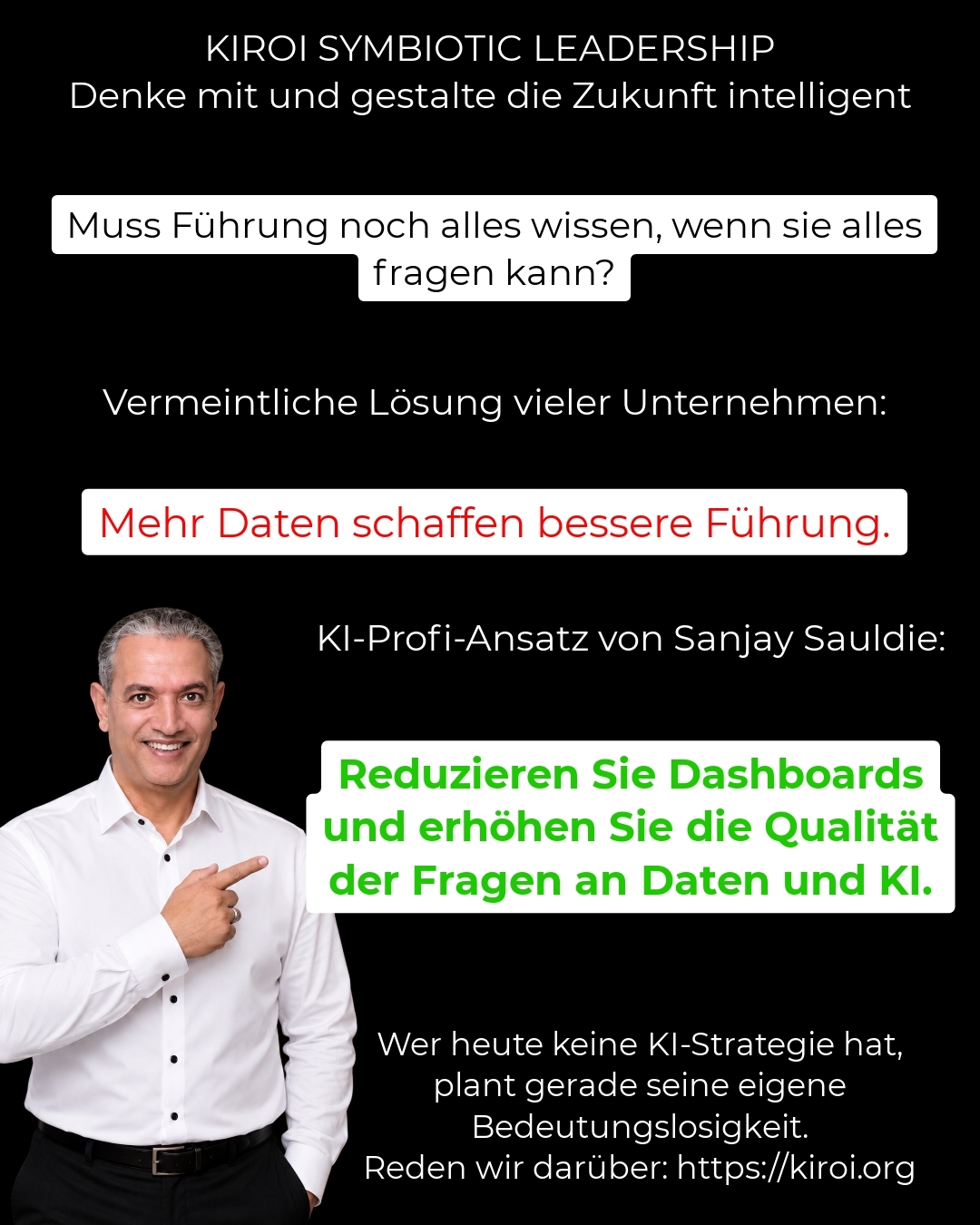
This question is currently occupying numerous decision-makers in organisations dealing with the integration of intelligent systems, and it inevitably leads to a fundamental reassessment of what Does leadership still need to know everything if it can ask anything? means. Because while previously the accumulation of information and the mastery of complex data landscapes was considered a core competency, the focus is now shifting dramatically towards a completely different skill: the art of asking the right questions. This transformation does not only affect technological aspects, but touches the very core of leadership's self-perception, because suddenly it is no longer knowledge itself, but the intelligent access to knowledge that becomes the decisive differentiator.
The illusion of data abundance: why more does not automatically mean better
In many organisations, the belief still prevails that multiplying data sources and analysis tools automatically leads to better decisions. However, upon closer inspection, this assumption proves to be a fundamental error that consumes considerable resources and, paradoxically, often leads to worse results. Average companies invest significant sums in ever-new dashboard solutions, additional reporting systems and complex business intelligence infrastructures without questioning whether these investments actually create added value.
A typical example can be seen in manufacturing plants, where machine operators are now expected to monitor up to twelve different screens, whilst error rates are not falling, but actually rising. In logistics centres, shift managers sometimes spend more time interpreting key performance indicators than actually controlling processes. And in administrative areas, department heads complain that they have to consolidate data from five different systems for a single decision, which is not only time-consuming, but also harbours significant sources of error.
The philosophy that „more data creates better leadership“ has developed into a veritable dogma that is rarely critically questioned. In doing so, many organisations overlook the fact that it is not the quantity of available information that is decisive, but the quality of the questions with which one approaches this information. An oversupply of data can even have a counterproductive effect because it overwhelms decision-makers, blurs priorities and ultimately leads to analysis paralysis that prevents swift action.
Does leadership still need to know everything if it can ask everything? The new competence
The real revolution does not lie in the technology itself, but in the fundamental change in what leaders need to be able to do. When intelligent systems are capable of analysing and presenting complex relationships in fractions of a second, pure factual knowledge dramatically loses its importance. Instead, a competency comes to the fore that was long taken for granted and therefore hardly systematically developed: the ability to formulate precise and goal-oriented questions.
This change is particularly evident in manufacturing plants. In the past, a production manager had to keep all machine performance figures in their head. Today, they can instead ask: „Which machine has the highest risk of failure over the next 48 hours?“ They receive the answer in real time. In maintenance, the role is also changing fundamentally. Technicians now ask: „Which component should I prioritise for servicing in order to minimise unplanned downtime?“ The quality of this question largely determines the value of the answer.
This shift is also manifesting itself in people management. Shift managers can ask, for example: „What skills gaps are there in my team for the upcoming product transition?“ However, this type of questioning assumes that the person asking understands the business and knows which information is actually relevant. Technology will answer any question – but only clever questions lead to valuable answers.
From the data flood to the art of questioning: A paradigm shift
The transition from a data-driven to a question-driven leadership culture requires a fundamental rethinking that goes far beyond technical training. It is about developing a completely new attitude that views not-knowing not as a weakness, but as the starting point for intelligent exploration. This transformation demands considerable humility from leaders because they have to admit that they can no longer know everything – and no longer need to.
In quality assurance departments, for example, working methods are changing fundamentally. Instead of spending hours analysing inspection reports, those responsible can now ask: „Which product batches from the last week show statistical anomalies?“ In materials management, the question is no longer „What is the inventory level?“, but rather „Which orders should I trigger early to avoid supply bottlenecks?“ This shift not only saves time, but also significantly improves the quality of decision-making.
Best practice with a AIROI customer
A medium-sized enterprise with several hundred employees faced the challenge that its managers spent an average of three hours a day preparing and interpreting key figures, without any noticeable improvement in decision-making quality. As part of a AIROI support initiative, a systematic analysis of the information actually used was first carried out, revealing that out of over 200 available dashboards, fewer than twenty were consulted regularly. Together with the managers, the transruptions coaching team developed a new approach that drastically reduced the number of dashboards and instead focused on the quality of the questions asked. The managers learned to formulate their information needs precisely and address them specifically to intelligent systems, rather than searching seas of data for relevant insights. After six months, the participants reported a significant reduction in workload and a noticeably higher level of satisfaction with their decisions, because they were now able to access truly relevant information more quickly and had more time for strategic considerations.
The AIROI solution: fewer dashboards, better questions
The AIROI approach differs fundamentally from traditional digitalisation strategies by starting not with technology, but with people and their actual information needs. The core insight is: reduce dashboards and increase the quality of questions asked of data and AI. This seemingly simple principle has far-reaching consequences for an organisation's entire information architecture and fundamentally changes the way leaders interact with data.
In practical terms, this initially means a ruthless inventory of all existing reporting structures. Clients frequently report that it is only through this analysis that they realise how many redundant and unused information sources they have accumulated over the years. One plant manager described his realisation as follows: „We had 47 different reports, but nobody could tell me which of them actually influenced decisions.“
The next step in the AIROI process is to identify the actual decision-making situations that managers face. In production environments, these are questions such as: Which orders do I prioritise in the event of capacity bottlenecks? When is the best time to schedule maintenance intervals? How do I respond to unexpected quality deviations? For each of these situations, targeted questions are then developed that precisely address intelligent systems.
Does leadership still need to know everything if it can ask anything? The practical implementation
The implementation of a question-oriented leadership culture requires both structural and cultural changes that must be carefully coordinated. At the structural level, the aim is to create the technical prerequisites so that managers can actually direct their questions to intelligent systems without first having to program complex queries or consult multiple systems. This often requires a consolidation of existing data sources and the introduction of natural language interfaces.
At the cultural level, a change of mind is required that encounters considerable resistance in many organisations. Leaders who have been valued for decades for their comprehensive expertise suddenly have to accept that this knowledge is losing significance. In workshops, for example, the experienced master craftsman who „knew everything“ was considered the ideal type. Today, the person who asks the right questions has the advantage. This shift can be perceived as threatening and requires empathetic guidance.
Transruption coaching supports leaders in embracing this new role and dealing constructively with the associated uncertainties. The aim is not to replace experienced leaders, but rather to make their expertise effective in a new way. For it is precisely deep knowledge of the business that makes it possible to formulate the truly relevant questions – questions that an algorithm would never ask on its own.
Practical ideas for everyday management
The transition to question-oriented leadership can be implemented in practical steps that can be integrated into the normal working day without creating additional burden. A first starting point is to first clarify the actual question in every decision-making situation before searching for data. This seemingly trivial exercise often reveals that the original question was formulated far too vaguely.
In warehouse areas, a typical starting question might be: „How is it going today?“ A more precise version would be: „Which orders are at the highest risk of not being completed on time today, and what measures could reduce this risk?“ The difference in the quality of information that follows both questions is enormous. The first question provides a diffuse status report. The second question enables targeted action.
It is similar in workforce planning. Instead of asking, „Do we have enough people?“, the more precise question could be: „What skills are we missing for the planned projects over the next two weeks, and which employees could close these gaps through targeted short-term training?“ This type of questioning leads directly to actionable insights, whereas the original question at best provokes a yes-or-no answer.
Best practice with a AIROI customer
In a company with multiple production sites, the question „Does management still need to know everything if it can ask anything?“ became the starting point for a comprehensive organisational development initiative that transruptions coaching accompanied over several months. The shift supervisors at the various sites had previously used completely different sources of information and therefore arrived at inconsistent decisions, which caused significant friction and made collaboration between the sites difficult. As part of the AIROI process, the most important decision-making situations were first standardised and uniform phrasing was developed for them that all shift supervisors could use. A central intelligent system was configured to process these questions and provide site-specific answers while simultaneously ensuring comparability between the sites. Following implementation, the managers reported that for the first time they felt like part of a networked team because they were using the same information base and could communicate with one another on an equal footing, which significantly improved collaboration and led to a markedly higher level of employee satisfaction.
The future belongs to those who ask clever questions
The development of intelligent systems will continue to advance in the coming years and shift the demands placed on leaders even more towards the ability to ask questions. Organisations that begin adapting their leadership culture accordingly today will secure a significant competitive advantage by deploying their human resources where they generate the greatest added value: in strategic reflection, creative problem-solving and empathetic employee management.
Even today, in technical fields, those leaders are proving to be the most successful who do not see their role as monopoly holders of knowledge, but rather as facilitators of complex decision-making processes. They use intelligent systems as tools to take routine analyses off their hands, while concentrating themselves on the questions that machines cannot ask: questions of purpose, of values, and of the long-term consequences for employees and society.
This new form of leadership requires the courage of incompleteness and the readiness to develop continuously. It demands that leaders regularly question their own assumptions and remain open to insights that contradict their previous beliefs. And it presupposes that organisations create a culture in which questions are more important than answers and in which not knowing is not punished, but valued as a starting point for learning.
My AIROI Analysis
Engaging deeply with the question of whether leadership still needs to know everything when it can ask anything reveals a fundamental shift in our understanding of leadership competence that extends far beyond technological aspects and touches the self-image of leaders at its core. My analysis shows that organisations that continue to rely on the strategy of „more data creates better leadership“ are systematically missing the actual challenges and wasting considerable resources without achieving the desired improvements. The AIROI approach, which focuses on reducing dashboards and increasing the quality of questions, proves to be significantly more effective and sustainable because it starts in the right place: with people and their actual information needs.
The support provided by transruptions coaching has proven particularly valuable in this regard, as it helps leaders to constructively process the uncertainties associated with this transformation and develop new competencies that are becoming indispensable in a working world shaped by intelligent systems. Experience from numerous projects shows that the transition to question-oriented leadership is certainly associated with resistance, but that this resistance can be overcome through empathetic support and practical successes. The end result is a leadership culture that is not only more efficient, but also more humane, as it relieves leaders of routine tasks and gives them space for what humans do better than machines: creating meaning, shaping relationships and making responsible decisions.
Further links from the text above:
[1] McKinsey: The Data-Driven Enterprise
[2] Harvard Business Review: Artificial Intelligence
[3] Gartner: AI Insights for Business Leaders
Are you a leader and would you like to learn how you can genuinely introduce AI into your company in a valuable and sustainable way, away from the hype? Take part Contact us or read more blog posts on the topic Artificial intelligence here.







 Deutsch
 English (UK)