
Which digital decisions are you making today that will make your company competitive in five years' time?
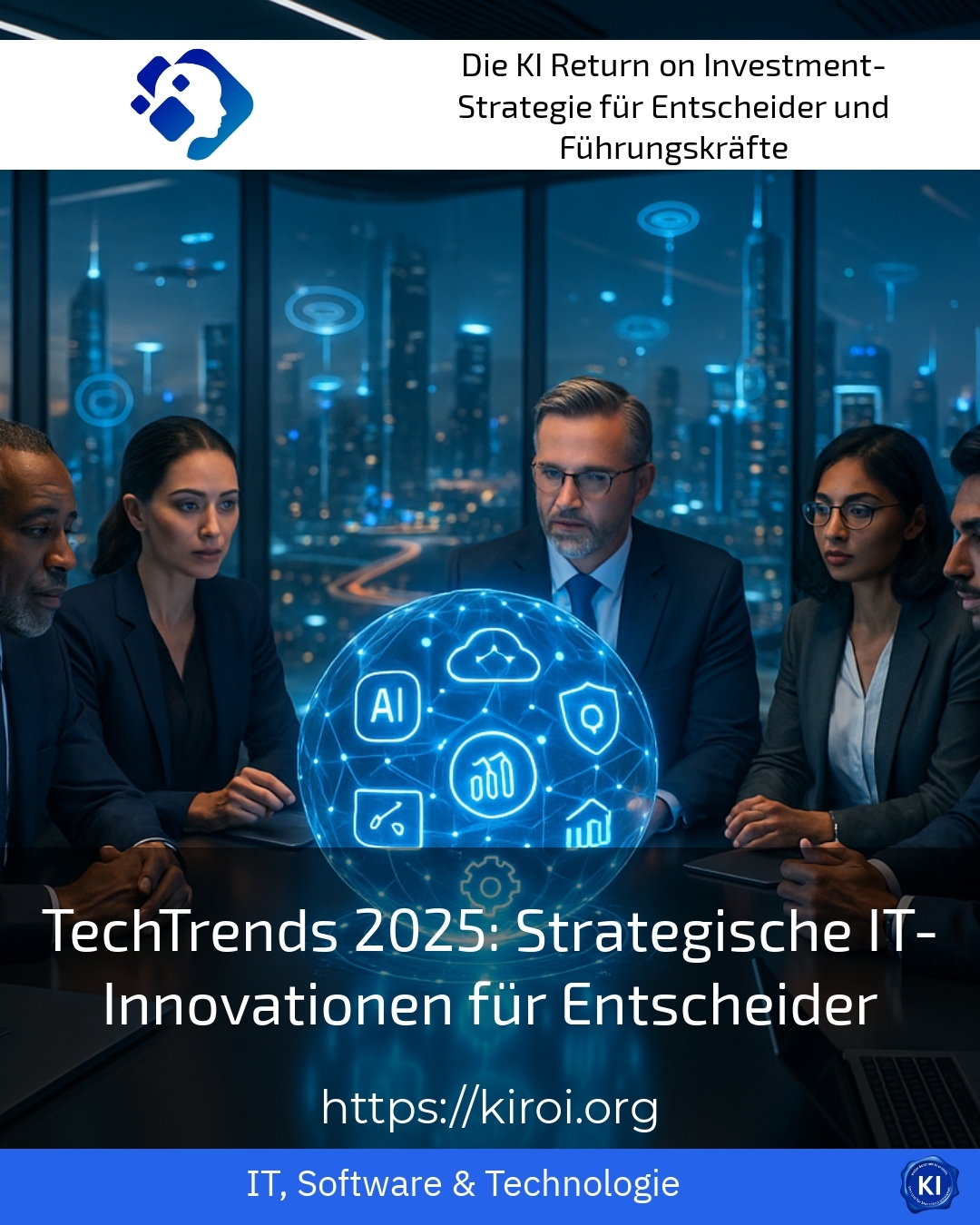
The business world is undergoing a fundamental transformation driven by intelligent systems and connected processes. Leaders face the challenge of selecting the right strategic IT innovations for decision-makers from a multitude of options. It is no longer just about technical gimmicks or short-term efficiency gains. Rather, the smart integration of modern systems determines long-term market success and sustainable growth. In this article, I will take you through the key developments and show concrete approaches for your organization.
Intelligent automation as the foundation for strategic IT innovations for decision-makers
The automation of business processes has reached a new level of quality. While earlier systems followed rigid rules, modern solutions continuously learn from data and experience. This development is fundamentally changing how companies organize their value creation. Manufacturing companies, for example, rely on self-optimizing production lines that detect and correct quality issues before any waste occurs. Logistics companies use predictive systems to manage supply chains more efficiently and identify bottlenecks early [1].
In the financial sector, intelligent algorithms support creditworthiness checks and fraud detection. Banks often report significantly reduced processing times while simultaneously improving risk assessment. Insurance companies rely on automated claims reporting, significantly accelerating customer service. Retail, in turn, benefits from dynamic pricing and personalized customer engagement.
Best practice with a AIROI customer
A medium-sized machine manufacturer approached us with the challenge of making its service department more efficient while simultaneously increasing customer satisfaction. As part of a transruptive coaching project, we supported the project team in implementing a predictive maintenance solution. The system analyzes sensor data from machines at the end customer and detects wear patterns early on. Service technicians receive automated prompts on which components should be replaced before a failure occurs. The collaboration spanned several months and encompassed both technical and organizational aspects. Particularly important was the involvement of the employees, who initially reacted skeptically to the new processes. Through targeted training and transparent communication, it was possible to gradually increase acceptance. The company reports a significant reduction in unplanned downtime for its customers and improved planning of service deployments.
Data-driven decision-making in management
Executives make decisions every day under uncertainty. Modern analytical tools support this process by providing meaningful insights into complex relationships. Dashboards visualize real-time data and enable quick responses to market changes. Pharmaceutical companies use these capabilities, for example, to plan and evaluate clinical trials more efficiently [2]. Energy providers optimize their grid utilization and integrate renewable sources better into the overall system.
The telecommunications industry is relying on data analysis to predict customer churn. Targeted measures can be initiated in a timely manner. Media companies are personalizing their content based on user behavior and preferences. The healthcare sector benefits from pattern recognition in patient data to support diagnoses.
Cloud architectures as a strategic foundation
The question of the right infrastructure is a major concern for many organizations. Hybrid models combine the advantages of different approaches and offer flexibility for different requirements. Critical data remains in controlled environments, while scalable computing power is added on demand. Automotive manufacturers use such architectures to develop autonomous driving systems that must process enormous amounts of data. Chemical companies simulate complex reactions in virtual laboratories, significantly accelerating their research.
The public sector faces special challenges regarding data protection and compliance. Special solutions enable the use of modern infrastructure while simultaneously complying with regulatory requirements. Educational institutions scale their digital learning offerings flexibly according to need. Cultural institutions digitize their collections and make them accessible to a wide audience.
Best practice with a AIROI customer
A service company from the consulting sector sought support in migrating its core processes to a modern infrastructure. The existing systems had grown over the years and significantly hampered collaboration between different locations. As part of our support, we developed a roadmap for the gradual transformation together. Special attention was paid to ensuring the continued operation during the transition. The team received guidance on selecting suitable service providers and designing contractual relationships. Employees were involved early and were able to formulate their requirements for the new tools. After successful implementation, project managers report improved collaboration and higher employee satisfaction. The flexibility in resource allocation also enables a better response to fluctuating project workloads.
Cybersecurity as an integral component of strategic IT innovations for decision-makers
With increasing connectivity, the risks from cyberattacks also continue to rise. Modern security concepts rely on multilayered defense and continuous monitoring of all systems. Behavioral detection identifies anomalies before damage occurs. Financial institutions are investing significantly in the protection of their critical infrastructure and customer data [3]. Energy providers are securing their control systems against tampering attempts.
The healthcare sector faces the challenge of protecting sensitive patient data while enabling the necessary exchange between healthcare providers. Trading companies secure payment processes and customer data against unauthorized access. The manufacturing industry protects its production secrets and prevents sabotage of interconnected systems.
Sustainable digitalization and social responsibility
The environmental impact of digital infrastructures is increasingly coming to the fore as responsible business management becomes more important. Energy-efficient data centers, resource-saving software development, and durable hardware are gaining in importance. Logistics companies are optimizing their routes, thus measurably reducing emissions. Building operators are using intelligent control systems for heating, cooling, and lighting [4].
Agriculture benefits from precise irrigation and targeted fertilizer application through connected sensors. Cities are developing smart transportation concepts and improving the quality of life for their residents. Industrial companies monitor their environmental impacts in real time and respond more quickly to deviations.
Best practice with a AIROI customer
A retail company with multiple branches approached us with the desire to support its sustainability goals through digital measures. The management had recognized that modern systems not only reduce costs but can also reduce the ecological footprint. Together, we identified areas with the greatest potential for improvement. The introduction of intelligent energy management systems in the branches was a first focus. Sensors capture temperature, humidity, and occupancy levels and control air conditioning and lighting as needed. Additionally, we optimized the ordering processes to reduce overstocking and associated food waste. The employees received training on conscious resource management and digital tools. The company reports significant savings in energy costs and positive feedback from environmentally conscious customers.
Human-machine collaboration redefined
The collaboration between humans and intelligent systems is fundamentally changing work practices. Assistive systems take on repetitive tasks and create space for creative and strategic activities. Surgeons operate with robotic support more precisely than ever before. Designers develop designs together with generative systems and achieve new design possibilities. Customer advisors receive real-time information and can respond more individually to requests [5].
The construction industry relies on digital planning tools to avoid costly errors on the construction site. Law firms use intelligent research systems to find relevant precedents faster. Creative agencies experiment with new tools for image and text generation.
My AIROI Analysis
Supporting numerous organizations in their digital transformation regularly shows me that the technological aspect is only one part of success. At least as crucial are the cultural changes and the willingness of people to take new paths. Strategic IT innovation therefore requires a holistic view of organizations, processes, and employees.
Clients often report initial resistance, which can be overcome through transparent communication and early involvement. The investment in further training and change management pays off in the long run. Successful projects are characterized by clear goals, measurable milestones, and continuous adaptation.
Transruptions coaching can help companies approach these challenges in a structured way. The coaching includes both strategic advice and practical guidance for implementation. The focus is always on the specific context of the organization. One-size-fits-all solutions rarely work, because every company has its own strengths, weaknesses, and constraints. The coming years offer enormous opportunities for organizations that are willing to act boldly while remaining calm and composed.
Further links from the text above:
[1] McKinsey Insights on automation in production
[2] Gartner analyses on data-driven decision making
[3] Federal Office for Information Security
[4] Bitkom information on sustainable digitalization
[5] World Economic Forum on the Future of Work with AI
For more information and if you have any questions, please contact Contact us or read more blog posts on the topic Artificial intelligence here.






 Deutsch
 English (UK)