
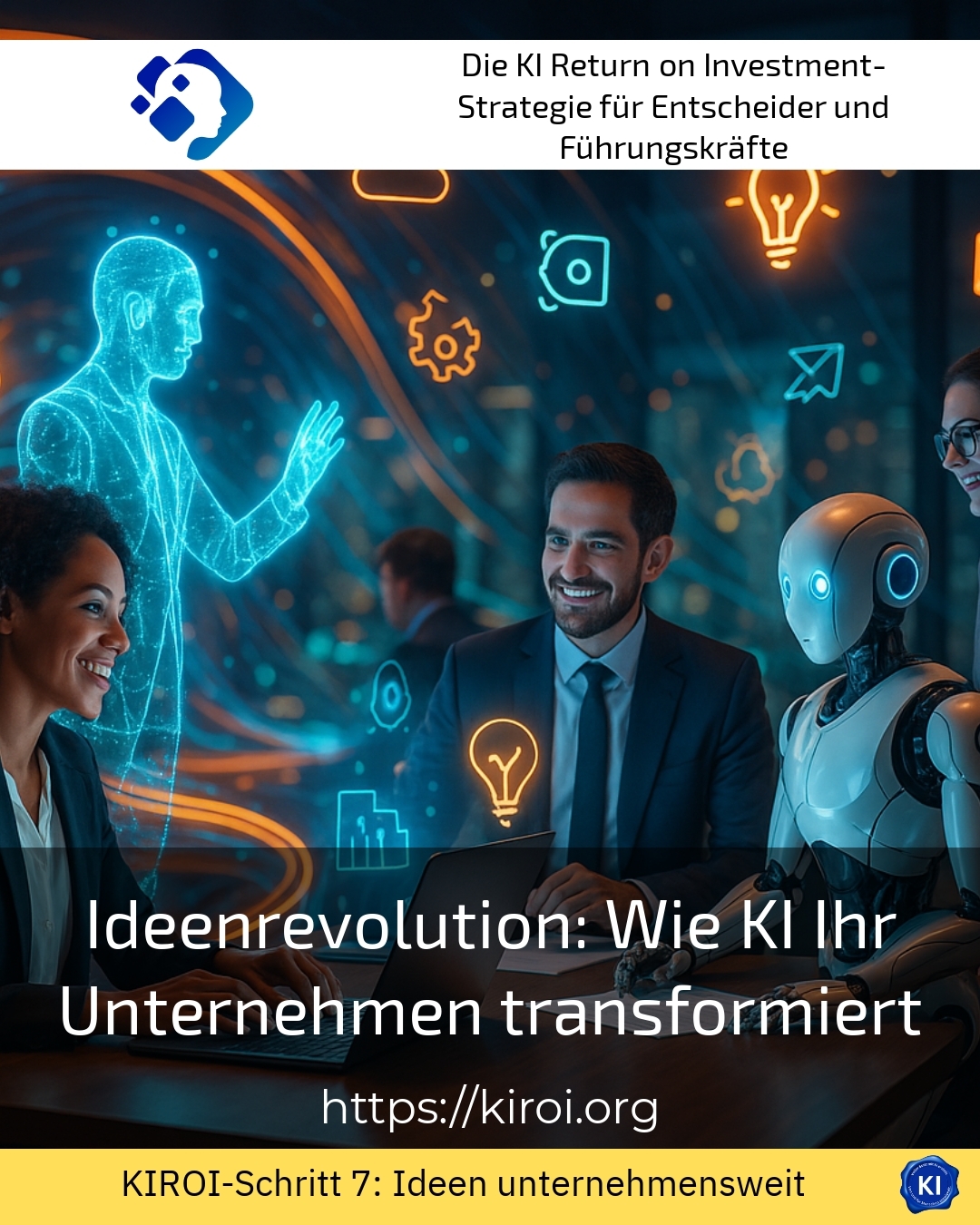
Imagine your company could make decisions before problems even arise. The Idea Revolution: How AI is transforming your business is no longer a vision of the future, but a tangible reality that is already fundamentally changing business models. In a world where data volumes are growing exponentially and markets are changing rapidly, completely new opportunities are opening up for strategic realignments. Companies that actively shape this development secure decisive competitive advantages over those that wait and see. The following sections show you concrete ways and practical examples.
Change begins in the mind: New perspectives for established structures
Many executives come to consulting with similar concerns. They feel the pressure of digitalisation and are looking for guidance. Clients frequently report uncertainties regarding the integration of new technologies into existing processes. The fear of making wrong decisions and incurring high investment costs accompanies many decision-makers along this path. At the same time, there is a desire to unlock innovation potential and bring employees along on the journey.
For example, a medium-sized logistics company faced the challenge of optimising its route planning. Manual planning took up valuable time and led to inefficient routes. Following a systematic analysis of data flows and process workflows, an intelligent solution was implemented. The result was shorter delivery times and reduced fuel costs of around fifteen per cent.
A similar picture emerges in the manufacturing industry. Production managers often struggle with unplanned machine downtime and fluctuations in quality. Predictive maintenance systems allow anomalies to be detected at an early stage. This helps to avoid expensive production stoppages and keep product quality consistent. An automotive supplier reported a reduction in unplanned downtime of nearly thirty percent.
Revolution of ideas in customer service: exceeding expectations
The way companies communicate with their customers is changing fundamentally. Modern assistance systems can process enquiries around the clock while holding natural conversations. In retail, leading providers rely on personalised product recommendations based on individual purchasing behaviour. A major online retailer was able to increase its conversion rate by eighteen percent through such recommendations. Banks use intelligent systems for fraud detection, thereby protecting their customers from financial loss.
Best practice with a AIROI customer
A long-established family-run business from the consumer goods sector approached our transruptions coaching team with a complex challenge. The company had decades of experience and a loyal customer base, but was increasingly feeling the pressure from digital competitors. As part of our accompaniment, we first analysed the existing data sources and identified untapped potential. Together, we developed a strategy that took both technological innovations and the corporate culture into account. Employees were involved in the transformation process right from the start because their expertise was crucial to success. Within eighteen months, the company was able to significantly improve customer loyalty and tap into new target groups. Particularly noteworthy was the increased employee satisfaction, as repetitive tasks were automated and more time remained for creative activities. The transruptions coaching accompanied every step of the way and provided important impetus for implementation.
How AI is transforming your business: Practical use cases
The potential applications of intelligent systems extend across almost all areas of business. In human resources, modern analytics tools assist in identifying suitable candidates and predicting staff turnover. Marketing departments use data-driven insights to optimise their campaigns and thus reach their target audiences more precisely. In financial controlling, automated forecasting models enable more accurate budget planning and risk assessment [1].
The healthcare sector benefits particularly strongly from diagnostic imaging analysis procedures. Using supporting systems, radiologists can identify anomalies in scans more quickly. A hospital group reported an improvement in diagnostic accuracy for certain conditions of up to twelve percent. Pharmaceutical companies use simulations to accelerate drug development, thereby significantly reducing the time to market.
In agriculture, intelligent sensor systems are revolutionising the management of cultivated land. Farmers receive precise recommendations for irrigation and fertilisation based on real-time data. One agricultural business was able to reduce its water consumption by twenty-five per cent through such systems. At the same time, yield increased noticeably due to optimised growing conditions [2].
The human element: employees as the key to success
Technological innovation alone is not enough for sustainable transformation. The people in a company must be able to understand and support the change. We frequently encounter fears of job loss and feeling overwhelmed by new systems. Taking these concerns seriously and communicating transparently forms the basis for successful change processes. Training programmes and clear career prospects significantly support the acceptance of new technologies.
An insurance company deliberately invested in the further training of its claims handlers. The staff learned to use intelligent assistance systems as tools rather than perceiving them as a threat. The result was a higher processing speed combined with increased employee satisfaction. Customer advisors were able to concentrate more on complex advisory discussions because routine tasks were automated.
There is also a positive trend in the trades. Master craftsman businesses are relying on digital planning tools and automated quotation generation. One plumbing and heating business reported time savings of around three hours a day through optimised scheduling. The time gained goes into customer consultations and the mentoring of apprentices [3].
Strategic implementation of the ideas revolution in your company
The path to a successful transformation begins with an honest stocktake. Which processes are currently causing the greatest friction? Where are unused data sources lying dormant? These questions form the starting point for any strategic planning. transruptions coaching supports companies through this analysis and provides valuable impetus for prioritising measures.
A building materials wholesaler identified its warehousing as a critical bottleneck. Demand forecasts were based on empirical values and regularly led to excess stock or delivery bottlenecks. Following the implementation of an intelligent forecasting system, availability improved while storage costs were simultaneously reduced. Capital tied up in stock fell by almost twenty percent within the first year.
Exciting applications are also emerging in the education sector. Universities are using adaptive learning systems for the individual support of students. One provider of continuing education was able to reduce the dropout rates of its online courses by a third through personalised learning paths. Participant satisfaction increased significantly because the content better matched their level of knowledge.
Best practice with a AIROI customer
An internationally active mechanical engineering company sought support in the digitalisation of its service business. The challenge was to proactively maintain the worldwide machine park and minimise downtime. As part of the transruptions coaching, we jointly developed a roadmap for the gradual introduction of networked sensor technology. It was particularly important to integrate the service technicians into the development process because their expertise is irreplaceable. The new systems now provide real-time data on the condition of each machine and enable precise maintenance predictions. Customers benefit from higher machine availability and predictable service intervals. The company was able to develop its service business into a differentiating feature and tap into new revenue sources. The employees particularly appreciate the improved predictability of their assignments and the reduced travel involved in emergency call-outs.
Ethical Aspects and Responsible Use
With great power comes great responsibility. The deployment of intelligent systems requires clear ethical guidelines and transparent decision-making processes. Data protection and privacy must be given the highest priority in every implementation. Companies should regularly review their algorithms for bias and unintended discrimination [4].
A recruitment agency fundamentally overhauled its applicant management system following such an audit. The original selection criteria had unconsciously disadvantaged certain groups of applicants. Following the adjustment, the diversity of the hired candidates improved measurably. At the same time, the quality of hiring decisions increased through more objective evaluation criteria.
In the energy sector, responsible algorithms play a pivotal role in grid management. Intelligent systems optimise the flow of energy and integrate renewable sources into the electricity grid more efficiently. Using such systems, one energy supplier was able to increase the share of renewable energies in its grid by ten percentage points, while security of supply remained at a consistently high level.
My AIROI Analysis
The examination of numerous transformation projects reveals clear patterns for success and failure. Companies that combine technological innovation with cultural change achieve more sustainable results. Conversely, the mere implementation of new systems without involving employees frequently leads to disappointment. The Idea Revolution: How AI Transforms Your Business is not a one-off project, but a continuous development process.
Particularly successful are organisations that start with manageable pilot projects and learn from them. The attempt to transform all areas simultaneously overburdens resources and people alike. Instead, a step-by-step approach with clear milestones and regular progress reviews is recommended. Transruption coaching offers valuable support for such projects and helps to avoid typical pitfalls.
The coming years will bring further exciting developments. Multimodal systems will be able to link different data types even better. Edge computing enables intelligent analyses directly at the point of data generation. Quantum computing promises breakthroughs in particularly computation-intensive optimisation problems. Companies that invest in building competencies and strategic partnerships today are positioning themselves favourably for these developments. The time to get started is favourable because many technologies are now mature and affordable.
Further links from the text above:
[3] Bitkom: Digital Transformation
[4] EU: Regulatory Framework for AI
For more information and if you have any questions, please contact Contact us or read more blog posts on the topic Artificial intelligence here.











 Deutsch
 English (UK)