
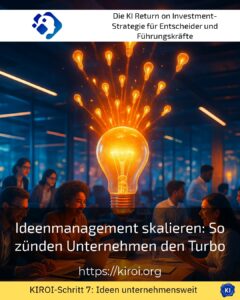
Imagine your team develops brilliant ideas every day, only for them to gather dust in drawers and never see the light of day. Countless managers know this scenario all too well. The true challenge does not lie in a lack of creative thoughts. Rather, it consists of systematically turning them into measurable successes. Departmental Innovation: How to Turn Ideas into Results – that is precisely what this post is about. It highlights ways in which teams can unlock their potential. The focus is on sustainable change processes. These require courage, structure and the right guidance.
Understanding the fundamentals of creative development processes
Before a company can successfully implement new concepts, it must first understand the mechanisms behind creative processes. Clients frequently report that while their employees submit suggestions full of enthusiasm, these get lost in day-to-day business and are ultimately forgotten. The causes for this are varied, ranging from a lack of prioritisation and missing resources to cultural barriers that make the open sharing of thoughts difficult. For example, a manufacturing company in the mechanical engineering sector realised that its engineers developed excellent optimisation proposals for production processes. However, these remained unused because clear communication channels were lacking. A financial services provider, in turn, found that its advisers had innovative product ideas. These never reached the decision-making level. A medium-sized retailer noticed similar patterns in its branches. Creative sales concepts were developed locally, but were not passed on in a standardised way.
Transruption coaching helps organisations to identify and dissolve precisely these roadblocks. There are no one-size-fits-all solutions that work for everyone. Instead, individual catalysts emerge for each context. This support assists teams in developing their own pathways to solutions [1].
Departmental Innovation: How to Turn Ideas into Reality Through Structured Processes
The transition from a spontaneous idea to a well-thought-out project requires clear structures. However, these must not be so rigid that they stifle creativity. Rather, it is about creating a framework that provides security while leaving room for experimentation. For example, a technology company introduced weekly brainstorming sessions where employees at all levels of hierarchy could present their suggestions. The results were documented and prioritised. A logistics service provider established a digital suggestion scheme. Drivers and dispatchers could submit improvements directly there. A healthcare provider set up interdisciplinary innovation circles. Nursing staff, doctors and administrative employees jointly developed new care concepts.
Best practice with a AIROI customer
An established company in the energy sector faced the challenge of better connecting its various departments and realising synergies. The management recognised that valuable knowledge lay dormant within the individual areas. However, this knowledge was not being utilised systematically. As part of the transruptions coaching support, a comprehensive stocktake was initially carried out. This revealed that the interfaces between technical development and sales were particularly problematic. The technicians developed innovative solutions for renewable energy. However, the sales team often did not know how to position them on the market. Together, a communication format was developed that included monthly knowledge-transfer workshops. There, developers presented their latest concepts in accessible language. In return, the sales team formulated specific customer requirements. After six months, both sides reported a significantly improved collaboration. The time from concept idea to market launch was considerably reduced. New products better met customer needs because market feedback was incorporated into development earlier.
Creating cultural prerequisites for sustainable change
A corporate culture that fosters creativity does not happen overnight. It requires continuous work on the fundamental attitudes of everyone involved. Managers play a central role in this. They must lead by example and view mistakes as opportunities for learning. An automotive supplier began holding regular retrospectives. There, not only successes but also failed experiments were analysed with appreciation. A software company introduced so-called 'Failure Fridays'. Teams shared their failures there and the insights gained from them. A pharmaceutical company established anonymous feedback channels. Employees could report openly there on obstacles and potential for improvement [2].
These cultural changes take time and patient guidance. Transruption coaching supports this by creating spaces for reflection and fostering dialogue. It helps teams to recognise and question their own patterns.
Measurable results through systematic implementation support
The decisive step from idea to result lies in consistent implementation. Many initiatives fail here because resources are lacking or leadership attention wanes. A systematic approach includes clear milestones, defined responsibilities and regular reviews. A telecommunications company used agile methods to quickly translate customer feedback into product improvements. An insurance group established innovation labs where prototypes were developed and tested. A construction company set up dedicated project teams. These had the explicit mandate to bring new construction methods to market readiness.
The Departmental Innovation: How to Turn Ideas into Results works especially well when different perspectives come together. Interdisciplinary collaboration brings together diverse skills and competencies. It enables more comprehensive solutions to complex challenges.
Departmental innovation: How to turn resistance into opportunities
Every change naturally provokes resistance. These should not be regarded as disruptive factors. They contain valuable information about the worries and concerns of those involved. A retail company, for example, experienced strong reservations about the introduction of digital till systems. The experienced employees feared being replaced by technology. Through open dialogue formats, these fears could be addressed. The company demonstrated how the new technology would make work easier. A chemical corporation met scepticism regarding sustainable production processes. It integrated critical voices into the development teams. A media company used the resistance to new formats as quality control. Critical editors became important advisors for product development [3].
Best practice with a AIROI customer
A medium-sized family business from the food industry approached transruptions coaching with a specific concern. The third generation had fresh ideas for new sales channels and product lines. However, the established management team was sceptical about changes. During the coaching process, a safe environment was initially created for the intergenerational dialogue. Both sides were able to articulate their perspectives and fears there without having to worry about losing face. It turned out that the older generation was by no means fundamentally opposed to innovations. Rather, they were concerned about established quality standards and long-standing customer relationships. The younger generation, in turn, deeply respected this heritage and had no intention of jeopardising it. Together, an innovation concept was developed that combined tradition and modernity. New organic product lines were introduced under a separate brand. The core products remained untouched. This solution found broad acceptance throughout the company. Cooperation between the generations improved significantly. Today, both sides report a deeper mutual understanding and a shared vision for the future.
Using technological tools as enablers
Modern technologies can significantly accelerate the innovation process. However, they never replace the human factor. Collaboration platforms facilitate exchange across departmental boundaries. Data analytics tools help to identify trends early on. A consumer goods company used social media monitoring to identify customer desires. These fed directly into product development. An industrial company deployed simulation software. Engineers tested new concepts virtually there before costly prototypes were built. A service company used artificial intelligence to analyse customer inquiries. This generated ideas for new service offerings [4].
When introducing such tools, guidance is important. transruptions coaching supports teams in integrating technologies sensibly. It helps not to lose sight of the human aspect.
Develop and embed long-term perspectives
Sustainable success requires stamina. Short-term initiatives quickly fizzle out if they are not transformed into permanent structures. For example, a textile company firmly integrated sustainability aspects into its development process. Every new product had to meet ecological criteria. A financial institution anchored customer-oriented product development in its corporate guidelines. All new offerings were tested with real users. An educational institution established continuous further training formats. Employees were able to develop and test new teaching methods there.
The Departmental Innovation: How to Turn Ideas into Results thus becomes a natural part of everyday company life. It no longer requires separate programmes because it is anchored in the DNA of the organisation.
My AIROI Analysis
The review of numerous projects and support processes clearly shows that the path from an idea to a measurable result cannot follow a rigid pattern. Every organisation brings its own history, culture and initial situation. What works in one context may fail in another. That is why individual support is so valuable. It enables tailored solutions instead of one-size-fits-all recipes. The AIROI methodology considers various levels of the organisation. It takes into account both structural and cultural factors. It is particularly important to involve all participants right from the start. Resistance is thus not used as an obstacle, but as a valuable source of information. Experience shows that companies are successful when they bring patience. Quick wins are possible, but sustainable change takes time. Transruption coaching clearly positions itself as support rather than an all-knowing consultant. It provides impulses, asks questions and opens up new perspectives. The actual work is done by the people in the organisations themselves. They know their contexts best and develop the appropriate solutions. This form of support assists with projects relating to change, digitalisation and organisational development. It creates spaces for reflection and promotes open dialogue. Clients often report that these very reflection spaces make the decisive difference. That is where the insights emerge that ultimately lead to viable solutions [5].
Further links from the text above:
[1] Harvard Business Review – Innovation Management
[2] McKinsey – The Eight Essentials of Innovation
[3] Forbes – Innovation Insights
[4] MIT Sloan – Research and Innovation
[5] AIROI Blog – Artificial Intelligence and Transformation
For more information and if you have any questions, please contact Contact us or read more blog posts on the topic Artificial intelligence here.








 Deutsch
 English (UK)