
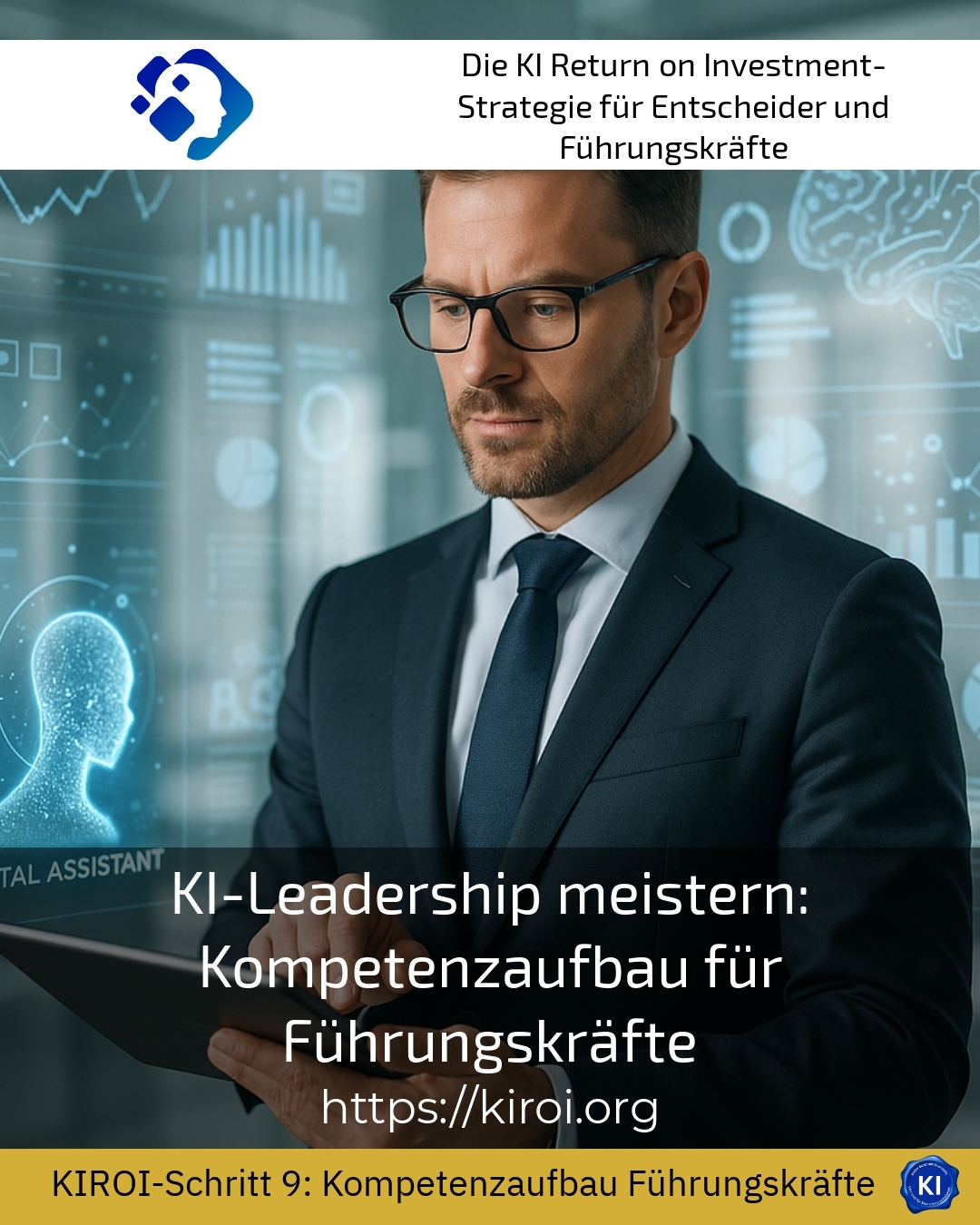
Imagine your decisions are guided by insights no single human mind could grasp. The business world is changing at a rapid pace. Leaders are facing an unprecedented transformation. This is about far more than technical understanding. Mastering AI Leadership: Competence Building for Executives means developing a completely new way of managing a company today. This development requires courage, openness, and strategic thinking. Many decision-makers report uncertainty. They wonder how to guide their teams through this change. This is precisely where professional support comes in. Transruption coaching supports leaders on this demanding journey. It offers guidance in an increasingly complex landscape. The following sections outline concrete approaches.
Understanding the new reality in boardrooms
The demands on modern leaders have fundamentally changed. Previously, business knowledge and people management were sufficient. Today, a deep understanding of data-driven processes is also required. The managing director of a medium-sized company recently faced a difficult decision. He had to choose between traditional analysis methods and automated forecasting systems. He opted for a hybrid approach. This combined human intuition with algorithmic precision [1]. The results far exceeded his expectations. Many executives across a wide range of industries are having similar experiences.
The importance of new leadership skills is particularly evident in the financial sector. Banks have long been using automated risk analyses for their lending. Those in charge must be able to understand these systems and place them in an ethical context. A department head at a regional bank spoke about his learning curve. Initially, he perceived the new tools as a threat to his expertise. Later, he recognised them as a valuable addition to his skills. This shift in perspective shapes the successful leadership style of tomorrow.
The logistics sector is also undergoing a profound transformation. Route optimisation, warehouse management and supply chain management are benefiting from intelligent systems. Managers here need a new skillset. They must assess technical possibilities and consider human factors. The balance between efficiency and employee well-being is becoming a core task.
Best practice with a KIROI customer
An internationally operating logistics service provider faced the challenge of qualifying its executives for digital transformation. Management recognised early on that technical training alone would not suffice. Consequently, they opted for comprehensive support through the KIROI programme. In several workshops, participants initially developed a shared understanding of the changes. It became clear that many fears were based on a lack of knowledge. The executives learned to view intelligent systems as tools. They developed strategies for communicating with their teams. The practical exercises on decision-making were particularly valuable. Participants simulated scenarios from their daily work, combining machine recommendations with human judgment. After six months, the executives reported increased confidence. Team turnover measurably decreased. Employee satisfaction rose significantly. This example illustrates the importance of holistic approaches in executive development. Technical knowledge and emotional competence must go hand in hand.
Mastering AI Leadership: Competency Development for Healthcare Executives
The healthcare sector offers particularly impressive examples of the necessary development of expertise. Hospital managers face enormous challenges. They must introduce diagnostic support systems while simultaneously maintaining patient trust. The chief physician of a large clinic described her experiences in detail [2]. Initially, she met imaging analysis systems with scepticism, but after intensive engagement, her attitude fundamentally changed. She recognised the potential for more precise diagnoses while keeping the human dimension of medicine in view.
Care facilities are experimenting with resource planning systems. These analyse occupancy data and forecast staffing requirements. Management must use such tools sensibly. Individual care must not suffer due to algorithmic optimisation. A nursing director reported initial resistance within the team. The staff feared a dehumanisation of their work. Integration was achieved through transparent communication and gradual implementation. Today, the nurses appreciate the relief from administrative tasks.
Pharmaceutical companies use intelligent systems for drug development. Research leadership must distinguish between promising and misleading results. Leadership competence here means critically questioning automated recommendations. A lab director described his strategy as „informed scepticism“. He trusts the analyses but always checks the underlying assumptions. This attitude protects against wrong decisions and promotes innovation.
Practical steps for building competence
The path to new leadership skills requires a systematic approach. First, leaders should honestly assess their current knowledge. This self-reflection forms the basis for targeted learning. Many decision-makers overestimate or underestimate their abilities. A professional assessment can provide valuable impetus here. Transruption coaching offers corresponding analysis formats.
The next step involves industry-specific knowledge. A production manager requires different expertise than a marketing director. The context determines the relevant areas of application. In the manufacturing industry, predictive maintenance systems play a central role. Managers must understand how these systems reduce downtime. They should be able to assess the economic impact. At the same time, sensitivity to employee concerns is necessary.
Retail provides further illustrative examples. Here, intelligent systems optimise purchasing and staffing. Store managers must interpret and implement these recommendations. A district manager for a supermarket chain described her learning journey. Initially, she largely ignored the automated order suggestions. Later, she learned to use them as a starting point for her own decisions. The combination of system recommendations and local knowledge led to better results.
Emotional intelligence as a key competence
Technical understanding alone does not make a good leader. Emotional intelligence is even gaining in importance. Employees need guidance in times of change. They are looking for meaning and security. Leaders must take these needs seriously. Clients often report feeling overwhelmed by the pace of change. Transruption coaching supports the development of empathetic leadership styles.
The insurance sector is a particularly clear example of this dynamic. Claims handlers fear for their jobs. Automated claims assessment is replacing human tasks. Department heads have to address these fears. At the same time, new perspectives need to be presented. An insurance manager described his approach as „accompanied transformation“. He actively involved his employees in the system implementation [3]. This participation significantly reduced resistance.
New challenges are also arising in human resources. Applicant tracking systems filter candidates. HR managers need to understand and question the criteria. Algorithmic pre-selection carries risks of discrimination. Managers bear the ethical responsibility for fair processes. A Director of HR reported on her critical examination. She discovered hidden biases in the system. Her intervention led to adjustments in the selection criteria.
Best practice with a KIROI customer
A medium-sized mechanical engineering company wanted to systematically develop its management team. The company leadership recognised that isolated training sessions would not have a sustainable effect. Instead, they opted for a long-term mentoring programme based on the KIROI approach. Managers met monthly for moderated workshops. There, they exchanged experiences and developed joint strategies. A particular focus was placed on the ethical dimension of automated decisions. Participants discussed specific cases from their daily work. They developed guidelines for dealing with system recommendations. These guidelines were later communicated company-wide. Employees appreciated the transparency and comprehensibility. The managers gained confidence in their new roles. They learned to combine technical possibilities with human values. After one year, there was a clearly improved company culture. The willingness to innovate increased measurably. At the same time, trust between the workforce and management remained intact. This example illustrates the importance of continuous support during transformation processes.
Mastering AI Leadership: Building Competence for Executives Through Continuous Learning
Technology is developing at a rapid pace. Leaders therefore need to embrace lifelong learning. One-off training is far from sufficient. Instead, a culture of curiosity and openness is required. Successful leaders regularly invest time in their own development. They read trade publications and attend conferences. They exchange ideas with colleagues from other industries.
The media industry illustrates this aspect impressively. Editorial managers work with automated text generation systems. They need to know their capabilities and limitations. One editor-in-chief described her initial reservations. She feared a devaluation of journalistic work. Through targeted further training, she gained a more nuanced perspective. Today, she uses automated tools for routine tasks. Creative work remains the domain of humans.
Intelligent grids are playing an increasing role in the energy sector. Managers need to oversee and control complex systems. A plant manager at an electricity provider shared his learning experiences. The transition to automated load management required completely new competencies. He completed several further training courses and benefited from peer consulting. Today, he feels confident in his changed role.
My KIROI Analysis
The transformation of the leadership role represents one of the biggest challenges of our time. My analysis shows that successful leaders combine several qualities. They combine a basic understanding of technology with pronounced emotional intelligence. They remain curious and open to change. At the same time, they maintain a critical view of automated recommendations. The examples presented from various industries illustrate common patterns of success. Employee participation proves to be a crucial factor. Transparency in decision-making processes builds trust and acceptance. The ethical dimension deserves special attention. Leaders bear responsibility for fair and understandable processes. The KIROI framework offers valuable guidance here. It combines strategic planning with operational implementation. Individual support through transruption coaching supports leaders on this journey. They receive impulses for their personal development. At the same time, they benefit from exchanging ideas with like-minded individuals. The future belongs to leaders who can connect people and technology. They shape organisations that are both innovative and humane. This development cannot be delegated. It requires personal commitment and a willingness to change. Those who embark on this path not only gain professional competence. He or she also develops a new form of leadership authority.
Further links from the text above:
[1] Harvard Business Review – AI and Machine Learning
[2] World Health Organization – Digital Health
[3] McKinsey – Insights on People and Organisational Performance
For more information and if you have any questions, please contact Contact us or read more blog posts on the topic Artificial intelligence here.






 Deutsch
  English (UK)