
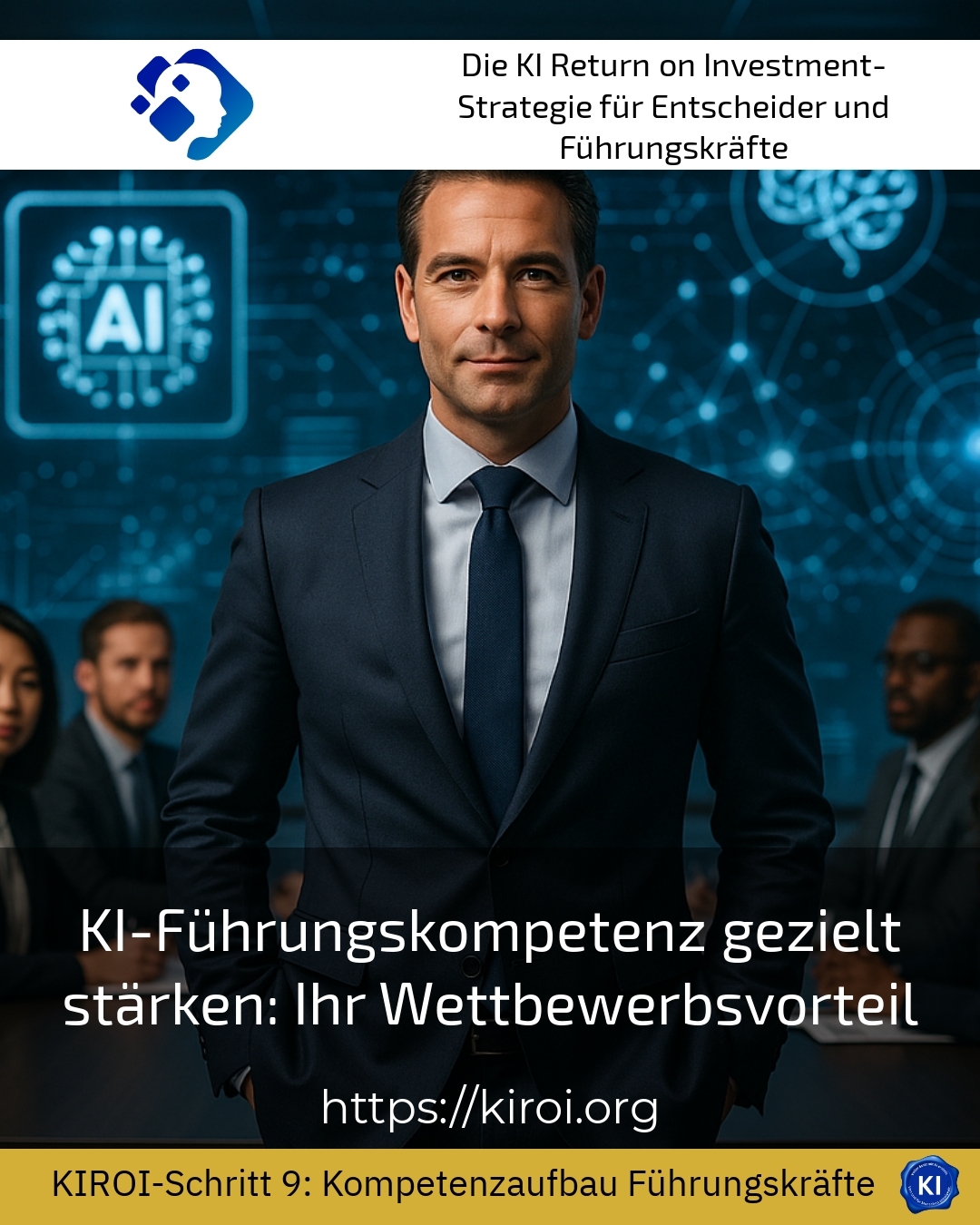
The ability to not only understand technological change but also actively shape it is crucial for the long-term success of companies and their leaders in almost all economic sectors. Those who actively shape their Strengthening AI leadership skills deliberately wants to tackle one of the most significant developmental challenges of our time. This is because intelligent systems are now permeating all business processes and changing the way teams collaborate, make decisions, and drive innovation. Leaders who actively guide this transformation not only create a measurable competitive advantage for their organisation but also position themselves as indispensable shapers of the digital future. This article shows you concrete ways to systematically develop these crucial competencies.
The strategic dimension of modern leadership in the digital age
Leaders today face entirely new challenges. They must be able to understand and evaluate technological developments. At the same time, it is important to support employees through change processes. Many clients report uncertainty in dealing with automated decision systems. They wonder how they can prepare their teams for upcoming changes. Others, in turn, want to understand which tasks will be taken over by intelligent systems in the future. These questions are justified and show the need for structured support.
In retail, for example, store managers are seeing algorithmic systems take over assortment planning. These managers need to learn how to work with data-based recommendations. They face the task of combining their experience with machine analysis. In the logistics industry, shift managers are increasingly coordinating with autonomous transport systems. Their role is fundamentally changing from operational control to strategic orchestration. In healthcare, intelligent diagnostic systems are supporting medical staff. Managers in clinics must understand how to use these tools responsibly.
transruptions-Coaching supports leaders precisely with these complex transformation projects. The coaching provides impetus for confident handling of new technologies. Clients often report strengthened self-confidence after working together. They feel better prepared for upcoming changes in their area of responsibility.
Best practice with a KIROI customer
A medium-sized manufacturing company in mechanical engineering faced the challenge of preparing its managers for the introduction of intelligent manufacturing systems. The plant management recognised early on that technical training alone would not be sufficient to support the cultural change within the organisation. Over a period of several months, we worked together on developing a new understanding of leadership, combining technological competence with emotional intelligence. The production managers learned to integrate data-based insights into their decision-making processes without devaluing the expertise of their long-standing employees. The work on concrete communication strategies, which the managers used to guide their teams through the change, was particularly valuable. After the project was completed, participants reported a significantly increased acceptance of the new systems in their departments. Employees felt taken seriously and involved in the transformation process. The company was able to implement the planned transition much more smoothly than originally anticipated.
Targeted strengthening of AI leadership competence through systematic competence development
Developing leadership skills in a technological context requires a holistic approach. It is not enough merely to understand how algorithms work. Rather, leaders must learn to recognise and contextualise strategic implications. They need the ability to reflect on and discuss ethical issues. Furthermore, it is important to guide employees through phases of uncertainty. All these aspects are interconnected and form a complex skill profile.
In the finance industry, team leaders in credit departments are experiencing how automated assessment systems are changing their work. They need to learn to interpret and communicate algorithmic decisions. Customer advisors in insurance companies are increasingly working with intelligent analytical tools. Their managers face the task of establishing new workflows. In human resources, HR managers are using automated systems for the initial screening of applications. HR management must ensure that these processes are fair and transparent.
The targeted strengthening of these competencies begins with an honest assessment. Where do your own strengths lie in dealing with technological change? Which areas require additional development and support? This self-reflection forms the basis for an individual development plan. transruptions-Coaching supports this analysis and offers structured guidance on the development path.
Practical approaches for daily leadership
The integration of new technologies into daily leadership requires concrete action strategies. Successful leaders establish regular learning routines within their teams. They create spaces for open discussion about technological developments. It is important to take fears and concerns seriously. At the same time, it is essential to highlight opportunities and possibilities. Finding this balance is a central leadership task.
In customer service, for example, employees are increasingly working with intelligent assistance systems. Team leaders need to understand how these systems can influence service quality. They support their employees in adapting to new ways of working. In marketing departments, automated systems are increasingly generating texts and images. Managers face the task of defining quality standards for this content. In sales, intelligent analysis tools support customer segmentation and offer design. Sales managers need to learn to use these insights profitably.
The human factor in technological transformation
Despite all technological advances, the human factor remains crucial for success. Leaders who their Strengthening AI leadership skills deliberately, recognise this central truth. They understand that technology only becomes effective when people accept and use it [1]. Supporting employees through change processes requires emotional intelligence and empathy. These skills cannot be replaced by algorithms.
In architectural firms, generative design systems support the creative work of professionals. Office owners need to understand how these tools can change collaboration. They guide their teams in integrating them into existing workflows. In law firms, intelligent systems are increasingly taking over research tasks. Partners face the question of how the professional profiles of their employees are evolving. In education, teachers use adaptive learning systems for individualised instruction. School leaders must create frameworks for responsible use.
Clients often report resistance within their teams towards new technologies. This resistance often has deeper causes than mere scepticism about technology. It's about fears of losing relevance and concerns about their professional future. Leaders who take these emotions seriously build trust and openness. They can shape change processes much more successfully than those who ignore such concerns.
Best practice with a KIROI customer
A logistics management executive approached us with a specific challenge. The company had begun implementing intelligent route optimisation systems, and experienced dispatchers felt devalued and threatened by the technology. The decades of expertise these employees possessed suddenly seemed less relevant, leading to a noticeable decline in morale within the department. In our joint coaching process, we developed a communication strategy that explicitly acknowledged and integrated the dispatchers' expert knowledge into the transformation process. The executive learned to build bridges between established professional competence and new technological possibilities. We devised concrete formats in which experienced employees could contribute their knowledge to improve the algorithms. This appreciation fundamentally changed the department's dynamics for the better. The dispatchers became active drivers of change rather than passive recipients. The executive reported significantly improved collaboration and higher team motivation.
Specifically strengthening AI leadership competence as a continuous development process
The development of leadership skills in a technological context is not a one-off project [2]. Rather, it is an ongoing learning process that requires openness and curiosity. Technologies are developing rapidly, and with them, the demands are changing. Leaders who want to stay on the ball establish regular reflection routines. They exchange experiences with other leaders. They use professional support to identify and work on blind spots.
For example, in journalism, automated text generation systems are fundamentally changing the work of editorial teams. Editors-in-chief must develop ethical guidelines for the use of these tools [3]. They support their teams in realigning journalistic working methods. In the pharmaceutical industry, intelligent systems are accelerating the research and development of new active ingredients. Research managers face the task of meaningfully combining traditional and new methods. In the construction industry, automated planning systems are significantly optimising project management. Site managers must learn to effectively use and monitor these tools.
transruptions-Coaching sees itself as a long-term companion on this development path. The impulses that arise from working together often have an effect far beyond individual coaching sessions. Clients frequently report that they have been able to discover new perspectives and courses of action. These insights help them to master future challenges with greater confidence.
Creating organisational frameworks for successful leadership
Individual leaders can only act effectively if the organisational framework is right. A company culture that promotes learning and experimentation is needed. Mistakes must be able to be seen as learning opportunities, not as failures. Leaders need time and resources for their own development. Creating these prerequisites is a task for company management.
In trading companies, for example, automated warehouse systems are revolutionising entire logistics operations. Site managers need to develop and be able to apply entirely new competencies. They require support in transforming their leadership role. In energy supply companies, intelligent systems are increasingly controlling complex grids and facilities. Managers in control rooms are experiencing a fundamental shift in their responsibilities. In the hospitality industry, automated systems are significantly optimising booking processes and staff scheduling. Hotel managers face the challenge of combining technology and hospitality.
Whoever their Strengthening AI leadership skills deliberately One should also consider the organisational framework. What support does the company offer for leadership development? What learning formats and exchange spaces already exist within the organisation? Where is there potential for improvement for everyone involved? These questions help to better understand and actively shape one's own development context.
My KIROI Analysis
A systematic consideration of the developments described clearly shows that technological competence alone is not sufficient for successful leadership in transformation contexts. Rather, a combination of technical understanding, emotional intelligence, and strategic foresight is needed as an integrated competence profile. Leaders who can establish this connection become indispensable designers within their organisations and beyond.
The KIROI methodology offers a structured framework for this holistic development of leadership skills. It uniquely combines technological analysis with a human-centric perspective. The central question is always how technology can support and relieve people’s burdens. This orientation helps leaders set meaningful priorities and make sustainable decisions.
My analysis also shows that the need for qualified support will continue to rise in the coming years. The pace of technological developments is overwhelming for many leaders and their organisations. Professional support can help to maintain an overview and remain capable of action. transruptions-Coaching offers precisely this support for leaders who want to actively shape change.
Finally, I would like to stress that every development path is and must be individual. There are no one-size-fits-all solutions for successful leadership in transformation contexts. However, there are tried-and-tested approaches and methods that can make the journey easier. The willingness to learn continuously and openness to new perspectives are the most important prerequisites.
Further links from the text above:
[1] McKinsey – AI Adoption Hinges on Human Factors
[2] Harvard Business Review – AI Leadership Development
[3] World Economic Forum – AI Ethics and Leadership Responsibility
For more information and if you have any questions, please contact Contact us or read more blog posts on the topic Artificial intelligence here.







 Deutsch
  English (UK)