
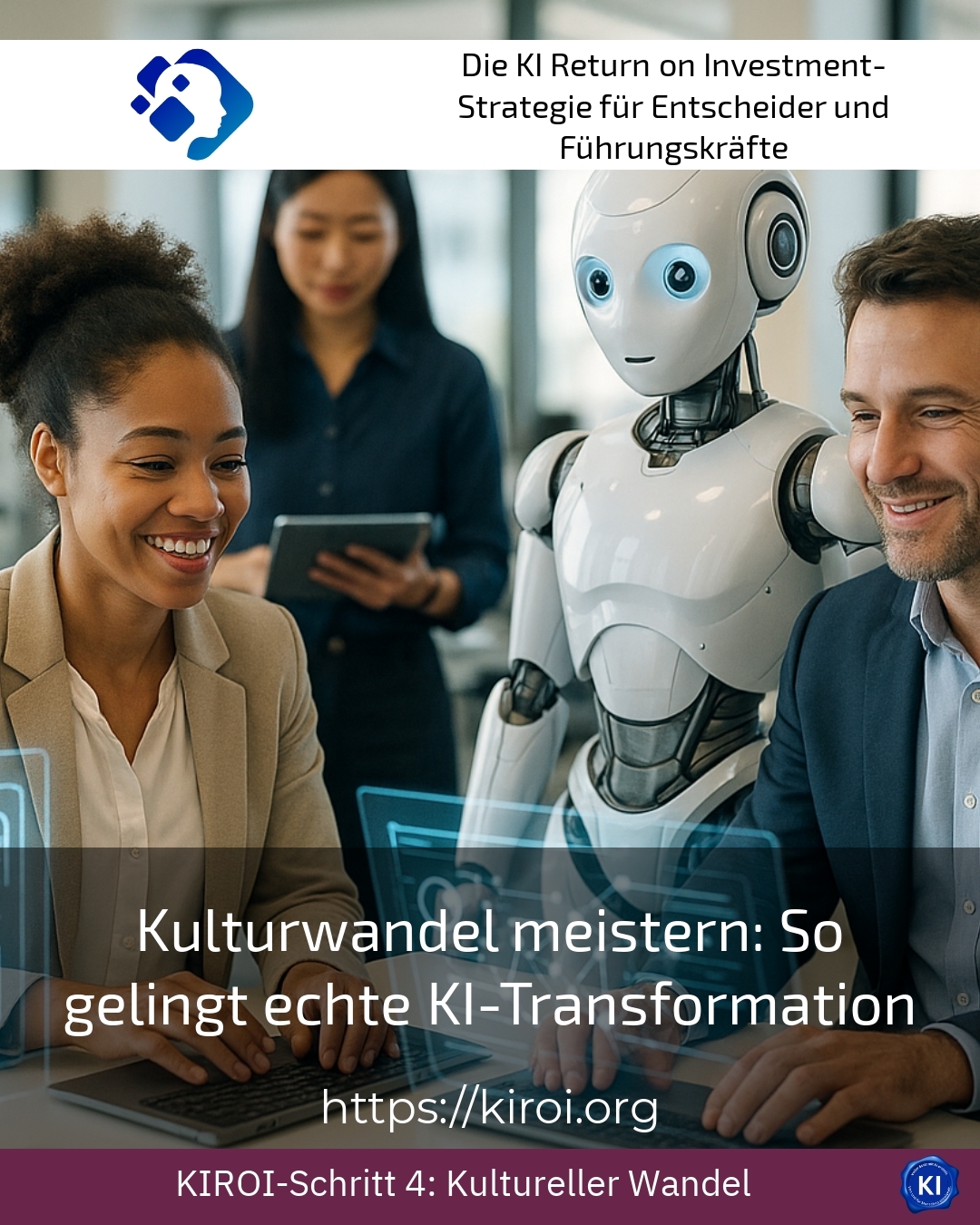
Imagine your entire organisation waking up one morning and realising that the way of working, thinking and deciding fundamentally needs to change – not because it's dictated by a trend, but because technological reality demands it. The Mastering cultural change is becoming the central challenge of our time. Many companies are investing significant amounts in new technologies. Nevertheless, they fail at the actual hurdle: people. In the following sections, you will learn how real transformation succeeds and why change begins in people's minds.
Why technological progress alone is not enough
The introduction of intelligent systems rarely fails due to the technology itself. Rather, practice shows a recurring pattern. Managers considerably underestimate the human component. Employees feel overlooked and develop resistance. This resistance manifests in subtle behaviours. Some quietly ignore new processes. Others unconsciously sabotage progress. Still others fall into paralysing fear of change. The result always remains the same: expensive investments fizzle out ineffectively.
We are seeing this phenomenon particularly clearly in the automotive industry. Traditional manufacturers are struggling with established structures. Decades-old hierarchies hinder agile decision-making processes. Development departments often work in silos. At the same time, new competitors are entering the market with fully digitised processes. A large German supplier recently invested in state-of-the-art production analytics. The technology worked flawlessly. Nevertheless, the plant employees hardly used it. The reason was not a lack of training. The fundamental understanding of the added value was missing.
Similar patterns are also evident at a South German engine manufacturer. The company introduced predictive maintenance systems. However, the engineers continued to rely on their experience. They viewed the system recommendations as an infringement on their expertise. It was only through intensive support that this attitude gradually changed. An international tyre producer also reported comparable challenges. Quality assurance was to be supported by intelligent image analysis. The inspectors initially felt replaced rather than supported. These examples highlight the necessity of systematic cultural work.
Mastering cultural change through strategic guidance
Successful transformation begins with an honest look at the current situation. Many organisations overestimate their willingness to change. At the same time, they underestimate the emotional dynamics within the team. This is where professional support comes in. Transruptions Coaching supports companies with precisely these complex projects. It is not about quick fixes. Rather, the focus is on the sustainable development of the entire organisation. External impulses can break down entrenched thought patterns. External perspectives often provide surprising insights.
The executive floor of a car body manufacturer approached us with a specific concern. The workforce showed clear signs of fatigue after numerous digitalisation initiatives. Confidence in further projects was low. Through targeted workshops and individual discussions, we identified the core blockages. Clients often report similar symptoms of exhaustion. The solution rarely lies in even more technology. It lies in the mindful design of change processes. A component supplier from North Rhine-Westphalia impressively confirmed this experience. After intensive support, acceptance of new systems measurably increased.
Best practice with a KIROI customer
A medium-sized automotive supplier with over two thousand employees was faced with a decisive decision. The management had formulated ambitious automation targets. The workforce reacted with noticeable scepticism and in some cases open rejection. In joint analysis meetings, we identified several critical factors that were hindering progress. Middle management did not feel sufficiently involved in the decision-making processes. Many team leaders feared a loss of importance of their role in the company. We developed a multi-stage participation concept that actively involved all levels of the hierarchy. Fears could be addressed openly in moderated dialogue rounds. The employees themselves developed suggestions for integrating new technologies into their day-to-day work. This participatory approach had a lasting effect on the general mood. After six months, those responsible reported a significant increase in commitment. The pilot projects were more successful than originally expected. The company permanently established an internal transformation team. This team has been supporting all further digitalisation projects ever since. The initial resistance turned into constructive participation.
Mastering cultural change begins with leadership.
Transformation cannot be delegated. Leaders must lead the way and embody change themselves. This sounds obvious. However, practice shows a different picture. Many managers expect change from their teams. They themselves remain in their usual patterns. We observed this discrepancy particularly clearly at a gearbox manufacturer. The management communicated innovative visions convincingly. In everyday life, however, classic control mechanisms dominated. The employees recognised this contradiction immediately. Their motivation for change consequently decreased.
An electronics supplier from Baden-Württemberg took a different approach. The managers themselves first went through intensive development programmes. They confronted their own fears and reservations. This honesty spread throughout the entire organisation. A manufacturer of driver assistance systems also reported positive experiences. There, managers were trained as internal ambassadors for change. They actively supported their teams through uncertain phases. Turnover in critical departments then noticeably decreased.
Communication as the key to successful change
A lack of communication undermines any transformation process. People need direction in times of uncertainty. They want to understand why changes are necessary. They want to know what role they will play in the future. Many companies communicate too late and too little. Rumours then fill the resulting information gaps. These rumours further reinforce fears and resistance. Transparent communication, on the other hand, builds trust.
A chassis manufacturer established regular dialogue formats at all levels. The management answered questions directly and openly. Even critical questions were not brushed aside. This openness paid off. Acceptance of new processes increased significantly faster than with previous projects. A comparable experience was had by an interior specialist from Saxony. So-called "transformation surgeries" were introduced there. Employees could ask questions and voice concerns at any time. These easily accessible offerings considerably reduced the perceived distance to management.
A manufacturer of braking components chose a particularly creative approach. The company produced internal podcasts on the topic of change. Employees from various departments shared their perspectives. These authentic voices were more credible than official announcements. The reach of these formats exceeded all expectations. The workforce felt taken seriously and involved.
Utilising resistance as a valuable resource
Resistance to change is often viewed as a problem. However, this perspective is too limited. Resistance contains valuable information about unresolved issues [1]. It points out where communication has failed. It reveals legitimate concerns of those affected. Smart organisations use these insights constructively. They do not suppress resistance. They invite it and listen carefully.
At a supplier of exhaust systems, we encountered massive resistance. The manufacturing process was to be optimised through intelligent control systems. Experienced skilled workers felt their expertise was being devalued. Instead of ignoring this resistance, we organised discussion rounds. The skilled workers contributed valuable practical knowledge. Their objections led to important system adjustments. The end result was significantly better than the original plan. A manufacturer of car seats had similar experiences. There, critical voices were specifically integrated into development projects. This integration transformed sceptics into committed supporters.
Mastering cultural change through sustainable structures
Individual measures are not enough. Genuine transformation requires permanent structures. Organisations need spaces for continuous learning. They need mechanisms for regular reflection. Without such structures, any initial impulse quickly fizzles out. Everyday life catches up with people. Old habits return. Change then becomes an episode rather than development.
A manufacturer of air conditioning systems for vehicles established internal learning circles. These groups meet regularly to exchange experiences. They reflect on successes and failures alike. This practice has noticeably increased the organisation's learning speed [2]. A provider of automotive electronics also followed this path. So-called "experimentation rooms" were created there. Employees can try out new approaches risk-free. These free spaces promote innovation and reduce fear of failure.
A security systems specialist built an internal network of change agents. These individuals were specifically trained and supported. They act as points of contact in their respective areas. This decentralised structure significantly increases the reach of transformation efforts. This embeds change throughout the entire organisation.
Best practice with a KIROI customer
An international supplier of drive components found itself in a critical phase. The switch to electromobility-related products required extensive changes across the entire organisation. Many long-standing employees had expert knowledge that was in danger of being lost in the transition. At the same time, completely new skills had to be developed in a relatively short space of time. The HR department reached its limits with traditional training concepts. Together, we developed a cross-generational mentoring programme with a clear focus. Experienced specialists passed on their knowledge to younger colleagues. In return, they gained insights into digital working methods from the younger ones. This cross-fertilisation significantly strengthened cohesion within the workforce. The initial scepticism towards the change gave way to a shared sense of optimism. After one year, an internal survey showed significantly improved satisfaction levels. Identification with the company reached record levels despite the uncertain market situation. The programme has since been extended to other locations. It is now an integral part of the corporate culture at all locations.
My KIROI Analysis
The experiences from numerous support projects show a consistent picture. Technological transformation only succeeds in tandem with cultural transformation. Organisations that address both dimensions simultaneously achieve more sustainable results. They avoid costly resistance and delays in their projects. They create a foundation for continuous development and innovation.
The automotive industry is a prime example of this challenge in our time. The shift to new drive technologies and digitised processes affects every area. From management to manufacturing, familiar patterns of thought and action must be rethought. This process cannot be accelerated by even more pressure from above. It requires patience, empathy, and systematic support from experienced partners.
The insight into the role of resistance appears particularly important to me. Organisations that use criticism as a resource develop better solutions overall. They achieve greater acceptance among those affected throughout the company. They avoid blind spots that can arise from purely top-down thinking.
The importance of sustainable structures cannot be overstated in this context. One-off workshops or training sessions are not enough for real change. Transformation must be institutionalised through permanent formats and offerings. Learning circles, mentoring programmes, and internal networks create the necessary continuity in the long term. They make change a normal part of the organisational culture.
Finally, I would like to highlight the central role of leaders in this process. Their role as role models is crucial for the success of any transformation. Authenticity and honesty are more powerful than any communication campaign could be. Leaders who admit their own uncertainties create psychological safety for everyone. This safety is the foundation for a genuine willingness to change within the organisation.
Further links from the text above:
[1] Harvard Business Review – Change Management
[2] McKinsey – Future of Work Insights
For more information and if you have any questions, please contact Contact us or read more blog posts on the topic Artificial intelligence here.






 Deutsch
  English (UK)