
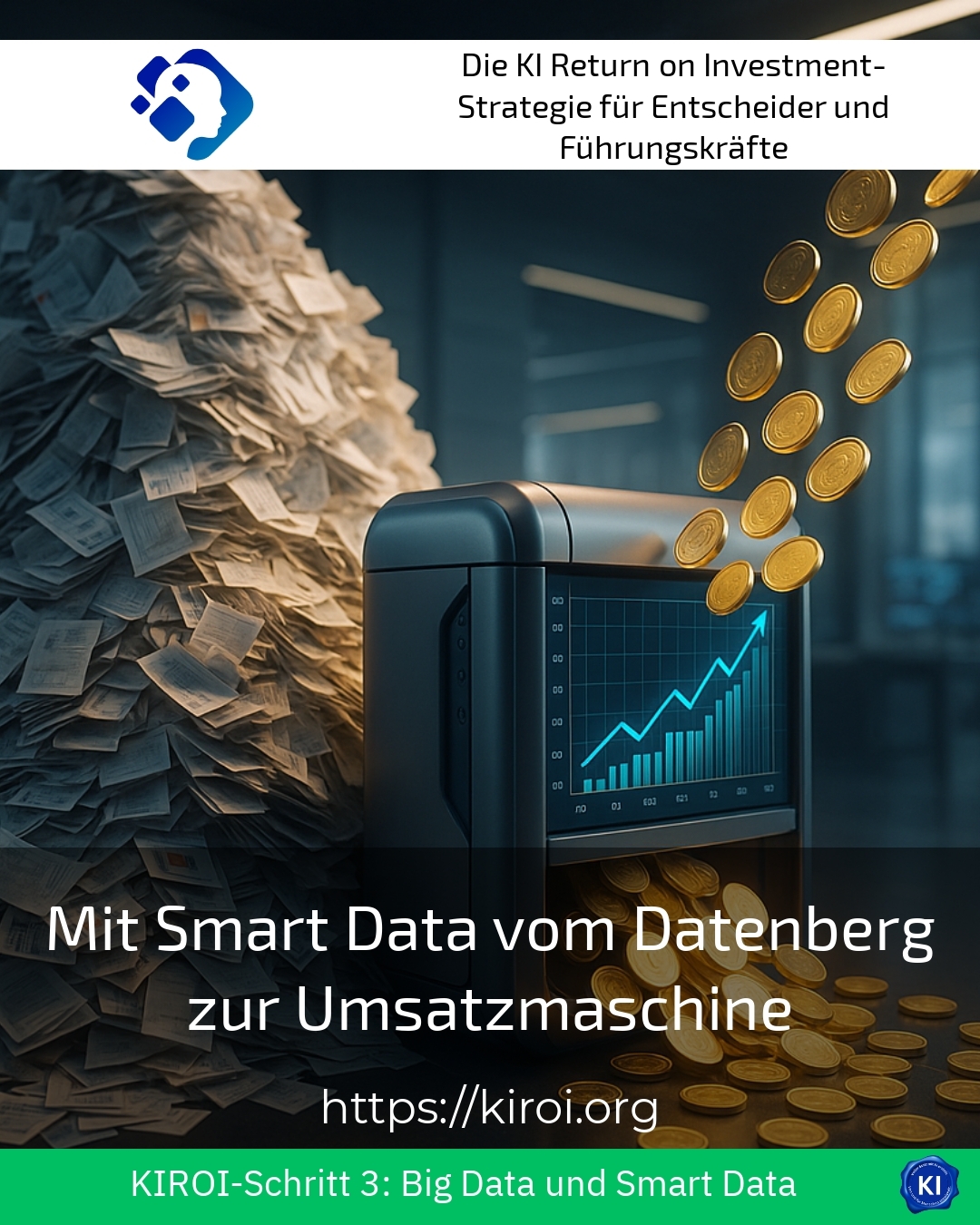
Imagine your company is sitting on a gigantic treasure that it hasn't yet unearthed. This treasure isn't made of gold or precious stones, but of something far more valuable in our modern economic world: data. But how do you transform this often unmanageable mountain of data into a real revenue machine? The answer lies in the intelligent use of Smart Data, i.e. the targeted preparation and analysis of information that is actually relevant to the business. Many companies today collect enormous amounts of data without even beginning to tap into their true potential. However, getting from a mountain of data to a revenue machine with Smart Data requires more than just technical solutions – it needs a well-thought-out strategy and competent support during this transformation process.
Why data volumes alone do not yet create value
In many organisations, there is a misconception that more data automatically means better decisions. However, this assumption often leads to a phenomenon that experts refer to as the data graveyard. Information is collected, stored and then forgotten. A medium-sized production company, for example, had been collecting machine data for years without ever systematically analysing it. The hard drives filled up, but no insights were gained. It was only through a structured analysis process that the team discovered unused optimisation potential. Another case shows a retail group that stored customer data in various silos. Marketing, sales and customer service worked with different data sets. The result was a fragmented view of the customer base. A third example comes from the financial sector, where an institution collected transaction data but did not link it to behavioural patterns. As a result, cross-selling opportunities remained untapped and fraud patterns unrecognised.
The real problem lies not in the collection, but in the understanding of the data. Quality always trumps mere quantity. Companies that adhere to this principle create a real competitive advantage. They focus on relevant data points and consciously ignore the noise. This focus initially requires a clear definition of what is business-relevant. And that is precisely where professional consulting comes in.
Smart Data from Data Mountain to Revenue Machine: The Path to Intelligent Data Utilisation
The transition from Big Data to Smart Data is akin to refining crude oil into high-quality fuel. Both resources hold potential, but it's the processing that makes them usable. For example, a logistics company realised that route optimisation requires more than just GPS data. Only by combining it with weather information, traffic forecasts, and delivery time windows could real efficiency gains be achieved. A retailer, in turn, linked till data with weather data and local events. This allowed them to dynamically adjust their inventory and reduce overstocking. A healthcare provider used anonymised patient data to optimise treatment pathways. The results spoke for themselves: shorter waiting times and more satisfied clients.
However, this transformation rarely succeeds without external impetus and professional support. Transruption coaching helps companies to rethink their data landscape. It's not about presenting ready-made solutions. Instead, companies develop individual strategies together with experienced consultants. The external perspective helps to identify blind spots within the company and make potential visible.
Best practice with a KIROI customer
An international manufacturing company was facing an enormous challenge. The amount of data had quadrupled in just three years, but the acquisition of knowledge was stagnating. The management reported a feeling of being overwhelmed by the sheer flood of information. As part of a transformation coaching project, we first analysed the existing data infrastructure. It turned out that ninety per cent of the information collected was irrelevant for strategic decisions. Together, we defined key indicators that were actually relevant to the business. The company then implemented a dashboard that visualised only these critical key figures. This gave the management level a tool for quick and well-founded decisions. From then on, the sales department used predictive analyses for its customer approach. Within twelve months, the company increased its turnover in a core segment by eighteen per cent. At the same time, data storage costs fell by forty per cent. The key was not more technology, but smarter use of data.
The role of algorithms and machine learning
Modern analysis tools provide insights that would remain hidden from human analysts. For example, an insurance company used machine learning to identify claims patterns. The algorithms identified correlations between place of residence, vehicle type, and claims frequency. Another example shows a telecommunications company predicting cancellation probabilities. This allows them to proactively engage at-risk customers and reduce churn. A manufacturing company, in turn, uses sensor data to predict machine failures. This predictive maintenance saves considerable costs and prevents expensive production downtimes.
However, technology never replaces human intellect and strategic positioning. Algorithms deliver results, but their interpretation requires experience and contextual knowledge. This is precisely why professional coaching accompanies companies not only in technical implementation. It also supports the establishment of a data-driven corporate culture. This cultural transformation is often more challenging than the technical implementation.
Practical steps for implementing a Smart Data strategy
The first step is an honest assessment of existing data resources. What information does your company currently collect? Where is this data stored? Who has access to it? An energy supplier discovered during this inventory that valuable consumption data was dormant in a forgotten archive. A pharmaceutical company found that research data from different departments had never been consolidated. A media company realised that usage statistics were not linked to advertising revenue. These insights form the basis for all further steps.
In the second step, companies define their concrete business objectives and derive data requirements from them. What do you want to achieve with your data? Which questions should be answered? This clarity prevents analysis projects from ending in a fog. The third step involves selecting suitable tools and methods. Not every company needs the latest technology. Often, tried-and-tested solutions, used wisely, are sufficient.
Smart data as a driver for customer satisfaction and revenue growth
Intelligent data utilisation enables significantly improved customer engagement. A fashion company personalised its recommendations based on purchase history and browsing behaviour. The conversion rate increased measurably because customers received more relevant suggestions. A travel provider analysed booking patterns and identified optimal times for marketing campaigns. This meant that offers reached the target audience precisely when booking intent was highest. A car manufacturer used service data to proactively offer maintenance services. Customers appreciated this foresight and developed stronger brand loyalty.
Clients frequently report that data-driven decisions allow them to react more quickly to market changes. This agility provides a significant competitive advantage. Companies that use their data intelligently identify trends earlier and can act accordingly. They waste fewer resources on ineffective measures. And they create experiences that delight and retain customers.
Best practice with a KIROI customer
A retail company with numerous branches was struggling with falling visitor numbers in its bricks-and-mortar shops. At the same time, online sales were only growing moderately. The management was looking for ways to better integrate both channels. During the coaching process, we developed an approach for integrating online and offline data. First, the company implemented a customer loyalty programme that recorded purchases across all channels. The data obtained revealed interesting patterns that had previously remained invisible. Many customers researched online but preferred to buy in-store. Others favoured the reverse order. Based on these findings, the company redesigned its customer journey. Online customers were incentivised to visit shops, while in-store customers discovered digital services. The result exceeded all expectations: Total sales increased by twenty-two per cent. Customer satisfaction also improved significantly. The company had successfully made the transition from a mountain of data to a sales machine with smart data.
Challenges and how to overcome them
Implementing a smart data strategy is not without its obstacles. Data protection requirements pose complex legal questions for many companies. For instance, a healthcare provider had to carefully consider which analyses were permissible. A financial institution invested heavily in anonymising sensitive customer data. A technology company implemented strict access controls to prevent data misuse. These measures require resources, but they also build trust with customers and partners.
Another challenge lies in data quality. Many companies find that their datasets are incomplete or inconsistent. Outdated information distorts analyses and leads to incorrect conclusions. Therefore, data cleansing is one of the most important preliminary steps for any analysis project. Investments in data quality pay off in the long term through better results.
Ultimately, the transformation also requires a rethink within the organisation. Employees must learn to view and use data as a resource. Leaders must demonstrate and promote data-driven decision-making processes. This cultural change is best achieved with professional support and continuous coaching.
My KIROI Analysis
Transforming unused data into a genuine value-adding factor is one of the most pressing tasks in modern business management. My experience from numerous consulting projects shows that success depends on three factors: firstly, a clear strategic alignment, secondly, the right technology, and thirdly, a data-literate corporate culture. Companies that consider all three factors achieve sustainable results. They leverage their information assets not just sporadically, but systematically for better decision-making.
Particularly important to me is the realisation that more data does not automatically mean better. The focus on relevant information distinguishes successful companies from less successful ones. Smart Data ultimately means asking the right questions and finding the appropriate answers. This process requires patience, expertise, and often a fresh perspective from the outside. Transruption coaching offers precisely these impulses and supports companies on their individual journey.
The examples described show that enormous potential exists across sectors. From manufacturing and retail to the service sector, organisations benefit from intelligent data utilisation. The key lies not solely in complex algorithms, but in their sensible application. Those who consistently pursue this path will indeed transform their mountain of data into a powerful revenue machine. [1] [2] [3]
Further links from the text above:
[1] Bitkom – Data and Analyses in Business
[2] McKinsey – Insights on Data Analytics and AI
[3] Gartner – Data Analytics Research and Trends
For more information and if you have any questions, please contact Contact us or read more blog posts on the topic Artificial intelligence here.










 Deutsch
  English (UK)