
Imagine your most experienced leaders are suddenly facing challenges that no management handbook in the world has ever described. The rapid development of intelligent technologies is not only changing business models, but also the way people want and need to be led. In the area of Leadership training: How AI truly makes leaders future-ready it becomes clear that traditional development programmes are reaching their limits. Those who bear responsibility today require completely new skills. These skills can no longer be acquired exclusively in seminar rooms. Instead, a profound transformation of one's own patterns of thought and action is needed.
Understanding the new reality in executive suites
The demands placed on leaders have fundamentally changed. Previously, it was enough to manage budgets and coordinate staff. Today, leaders must make complex technological decisions. They must understand the impact of algorithmic systems on their teams. At the same time, they are expected to shape a corporate culture that fosters innovation.
In numerous organisations, we are currently witnessing a remarkable shift. Established leaders often report a degree of uncertainty. They question whether their tried-and-tested methods are still relevant. Younger employees expect entirely different leadership approaches. Finding the balance between tradition and innovation is proving to be a genuine challenge.
This is particularly evident when introducing new digital tools. A manager from a medium-sized business recently described their situation very accurately. They said that they suddenly have to make decisions about technologies that they themselves can barely understand. We hear such statements regularly during transruption coaching. They show how urgently guidance and orientation are needed.
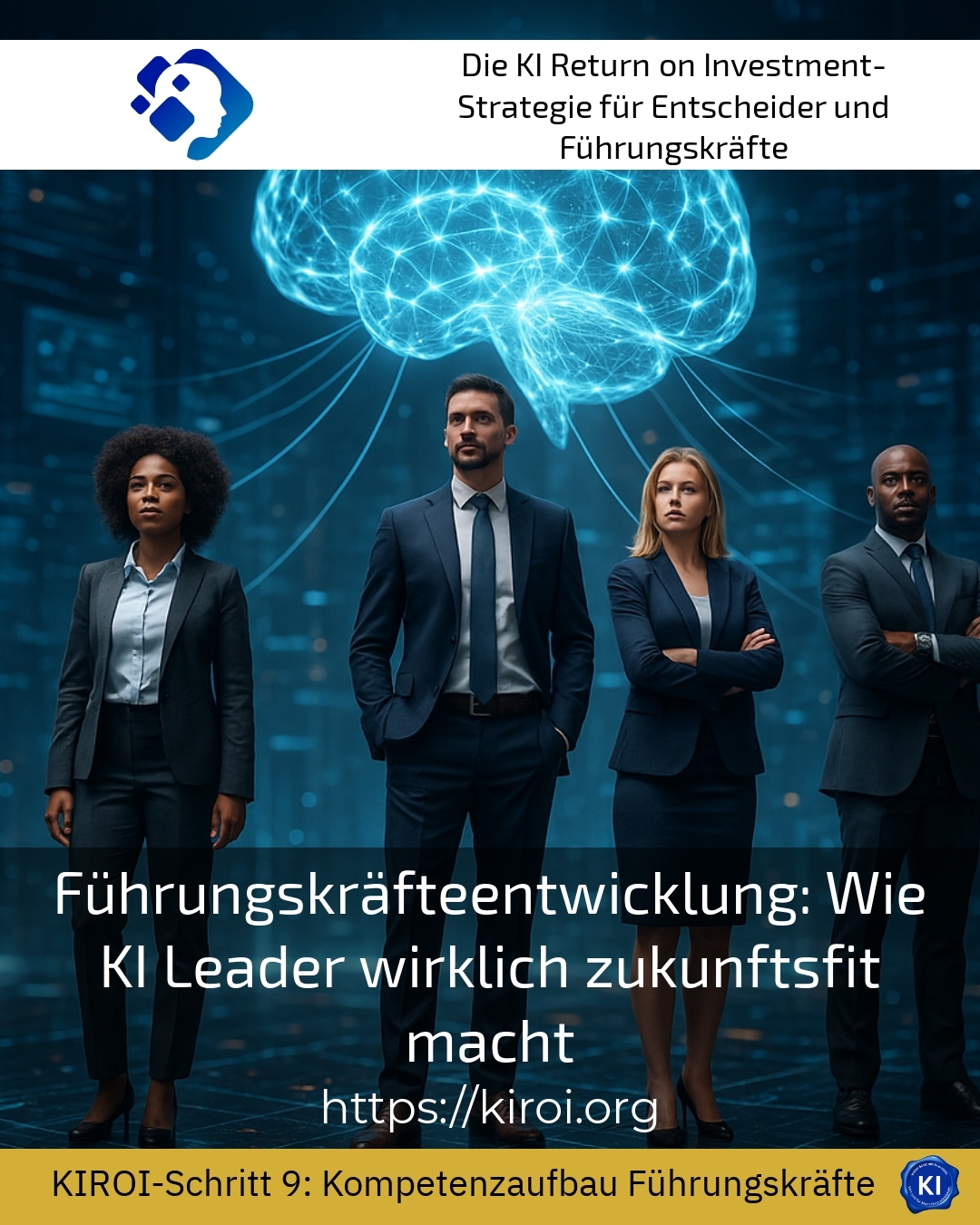
Leadership Development: How AI Truly Makes Leaders Future-Ready Through New Learning Formats
Traditional leadership programmes often rely on standardised curricula. All participants go through the same modules in the same order. However, this approach is no longer sufficient. Every leader brings different prior knowledge and challenges. Personalised learning paths enable much more effective development. They take into account individual strengths and areas for development.
Modern development concepts therefore integrate adaptive elements. These adapt to learning progress and specific needs. A sales manager requires different stimuli than a production manager. An experienced managing director has different questions than an aspiring junior executive. This differentiation makes the crucial difference.
We are also observing a trend towards experience-based learning formats. Leaders learn best through practical application and reflection. Simulations and practical projects effectively complement theoretical foundations, leading to significantly better transfer into daily leadership practice. Many clients report immediately noticeable changes in their leadership approach.
Best practice with a KIROI customer
A medium-sized company with around four hundred employees was faced with a particular challenge in the area of leadership development. The existing management team had decades of experience in the industry and had achieved remarkable things. However, resistance to new technologies and changing ways of working was becoming increasingly apparent. The management recognised that a transformation was necessary, but did not want to lose anyone in the process. As part of the transruption coaching programme, we developed a multi-stage support process for the entire management team. First, we jointly analysed the individual strengths and development areas of each person. We then drew up personalised development plans based on specific practical situations. The introduction of peer learning groups within the management team was particularly valuable. The experienced managers learnt new digital skills from younger colleagues. In return, they passed on their valuable industry knowledge and management experience. This cross-fertilisation created a completely new dynamic within the company. After twelve months, ninety per cent of participants reported increased confidence in dealing with technological issues. The fluctuation in the management team fell significantly and the willingness to innovate increased measurably.
Emotional intelligence in times of algorithmic decision-making
The more routine tasks that are taken over by intelligent systems, the more important human qualities become. In the future, leaders will need to excel, above all, in areas where machines reach their limits. This particularly concerns the realm of emotional intelligence and empathetic leadership. In uncertain times, employees are looking for direction and meaning.
A departmental manager from the financial sector vividly described his observations. He noted that his employees were reacting with increasing uncertainty to technological changes. His role had shifted from controller to enabler and motivator. This observation aligns with what many of our clients describe. The role of the manager is fundamentally shifting.
At the same time, the new world of work requires the ability to lead hybrid teams. People and intelligent systems are increasingly working hand in hand. A leader must understand how this collaboration can be optimally designed. They must be able to alleviate fears while at the same time clarifying opportunities.
Developing ethical competence as a core qualification
The integration of intelligent systems raises numerous ethical questions. Who bears responsibility if an algorithm gives problematic recommendations? How transparent must automated decision-making processes be? Leaders require a clear ethical compass. Only then can they make responsible decisions.
These questions become particularly apparent and pressing in personnel management. Can application processes be fully automated? Is it justifiable to conduct performance evaluations based on algorithmic analyses? These questions do not have simple answers. They require careful consideration and clear value stances.
We observe that leaders with a strong ethical foundation navigate transformation more effectively. They can provide direction to their teams and build trust. This trust is the foundation for successful change processes in organisations.
Leadership Development: How AI truly makes leaders future-fit in everyday practice
Theory is one thing, the day-to-day realities of leadership are another. Many development programmes fail to translate into practice. That's why, at transruptions Coaching, we focus on intensive support for specific projects. Leaders aren't learning for hypothetical situations, but for real challenges. This approach significantly increases the effectiveness of development measures.
A typical example is the introduction of new digital tools within a team. Many managers underestimate the resistance that can arise during this process. They focus on the technical implementation and neglect the human aspect. Our support addresses this precise point. We provide impetus on how the change process can be managed communicatively.
Another common topic is the design of new collaboration models. Remote work and flexible working hours require different leadership approaches. The classic presenteeism culture is giving way to results-oriented management. This change challenges many experienced leaders. They have to relinquish control while simultaneously providing direction.
Best practice with a KIROI customer
A manager from the healthcare sector came to our coaching programme with a very specific request. She was asked to lead a team that was increasingly working with intelligent assistance systems. The employees expressed concerns about their future role and job security. The manager felt unsure how to address these fears. In transruptions coaching, we jointly developed a communication strategy for the entire team. We worked out which competences would become even more important in the future. The manager learnt to frame the technological change as an opportunity for her team. She established regular dialogue formats in which concerns could be addressed openly. The introduction of an internal training programme was particularly effective. Team members were able to acquire specific skills that they needed for the new collaboration. After a few months, the manager reported a significantly improved team atmosphere. The fear of change gave way to constructive curiosity about new possibilities. This example shows how important the right support is in such transformation processes.
Networks and exchange as development accelerators
Leadership development doesn't happen in a vacuum. Peer exchange is an essential development factor. Leaders who regularly exchange ideas with others develop faster. They benefit from different perspectives and experiences. This collegial exchange ideally complements individual coaching measures.
We therefore actively promote networking among our clients. In protected spaces, they can share challenges and develop solutions together. These peer-learning formats prove to be extremely valuable. Managers often report that exchanging ideas with like-minded individuals helps them to progress particularly well.
Cross-industry networks also offer great value. Sometimes the best ideas come from completely different contexts. A manager from manufacturing can learn from approaches in the service sector. This cross-pollination greatly enriches one's own management practice.
Sustainable change through continuous support
One-off training sessions rarely bring about lasting changes in leadership behaviour. Real development takes time, reflection, and continuous support. That's why we focus on long-term coaching relationships rather than isolated interventions. This allows managers to grow and learn at their own pace.
Technological development is progressing rapidly. What is considered innovation today is already standard tomorrow. Leaders must therefore adopt a stance of lifelong learning. This willingness to learn is a fundamental prerequisite for sustainable future viability. We support our clients in cultivating this attitude.
Regular reflection loops help to recognise and appreciate one's own progress. At the same time, we identify new areas for development together. This iterative approach corresponds to the dynamics of today's working world. It enables flexible adjustments to changing conditions.
Leadership Development: How AI Truly Makes Leaders Future-Proof Through Mindset Work
Technical competence alone does not make a future-proof leader. The right mindset is at least as important as technical knowledge. An open and curious attitude helps to see change as an opportunity. Fear and resistance, on the other hand, block necessary developments.
We therefore work intensively on our clients' mental models and beliefs. Often it is unconscious assumptions that hinder development. A leader who believes they have to know everything will hardly learn from the team. Another who interprets mistakes as failures will not encourage a spirit of experimentation.
Working on mindset requires time and trust within the coaching relationship. It needs a safe space for honest self-reflection. In this space, leaders can recognise and question their patterns. New ways of thinking and acting can be tried out and established.
My KIROI Analysis
The analysis of numerous development projects with executives reveals clear patterns and success factors. Firstly, it is noticeable that the greatest progress is achieved where development is understood as a process rather than an event. Executives who commit to long-term guidance show more sustainable changes than those who only complete ad-hoc training. The integration of theoretical knowledge and practical application proves to be crucial for learning success.
The significance of social learning in this context is also noteworthy. Leaders who exchange ideas with peers and learn from each other develop a broader repertoire of possible actions. They gain new insights into their own leadership practice through different perspectives. This collegial reflection complements individual coaching work in a valuable way.
The KIROI methodology [1] offers a structured framework for these development processes. It combines analytical elements with practical applications and reflective loops. This allows leaders to experience holistic development that considers all relevant dimensions. The combination of competence building, mindset work, and practical transfer creates the foundation for genuine future viability. Organisations benefit from leaders who can not only manage change but actively shape it.
Further links from the text above:
[1] KIROI Methodology for Strategic AI Implementation
For more information and if you have any questions, please contact Contact us or read more blog posts on the topic Artificial intelligence here.











 Deutsch
  English (UK)