
Departmental Optimisation: Innovative Impulses for Greater Team Efficiency
The targeted improvement of internal processes – often referred to as department optimisation – is currently more than ever a focus for modern companies. More and more teams are turning to us because they sense that traditional approaches are no longer sufficient to keep up in a dynamic market environment. Many describe that collaboration is faltering, tasks are piling up, and motivation is suffering. At the same time, the desire to make their own department future-proof is growing. This is where transruptions coaching comes in, providing targeted support to teams in process changes and opening up new avenues for department optimisation.
Innovative methods for departmental optimisation
Department optimisation begins with analysis: where are there frictions? Which tasks take longer than necessary? Which ideas are dormant? Only in the next step is it about implementing targeted improvements. Many successful companies rely on proven methods such as CPI (Continuous Improvement Process) or Kaizen – i.e. constant optimisation in small, manageable steps[1][3]. These approaches thrive on the involvement of all team members, thereby creating genuine innovation. The Japanese 5S principle – sort, straighten, shine, standardise, sustain – also brings more structure to everyday work and sustainably supports department optimisation[5].
The combination of analogue and digital tools is particularly effective. Digital time tracking systems, new communication platforms or automated ordering processes relieve the team and create scope for important projects[2]. In workshops and coaching sessions, we develop concrete measures together with the teams to unlock this potential.
Practical examples from everyday life
For example, an international car manufacturer specifically introduced new meeting rules to increase productivity. Large, time-consuming meetings were reduced, unnecessary jargon was avoided, and direct communication between departments was encouraged. The result: decisions are made more quickly and employees feel taken seriously[2].
A second example is the increased use of process analyses in mechanical engineering. Here, targeted investigations were carried out to identify where quality deviations occurred. By jointly evaluating measurement data and regularly involving all interfaces, relevant tolerances could be defined and the complaint rate significantly reduced[6].
Another company completely digitised its order processing by introducing automated ordering processes. This minimised errors, reduced processing times, and allowed employees to concentrate on their core tasks again.
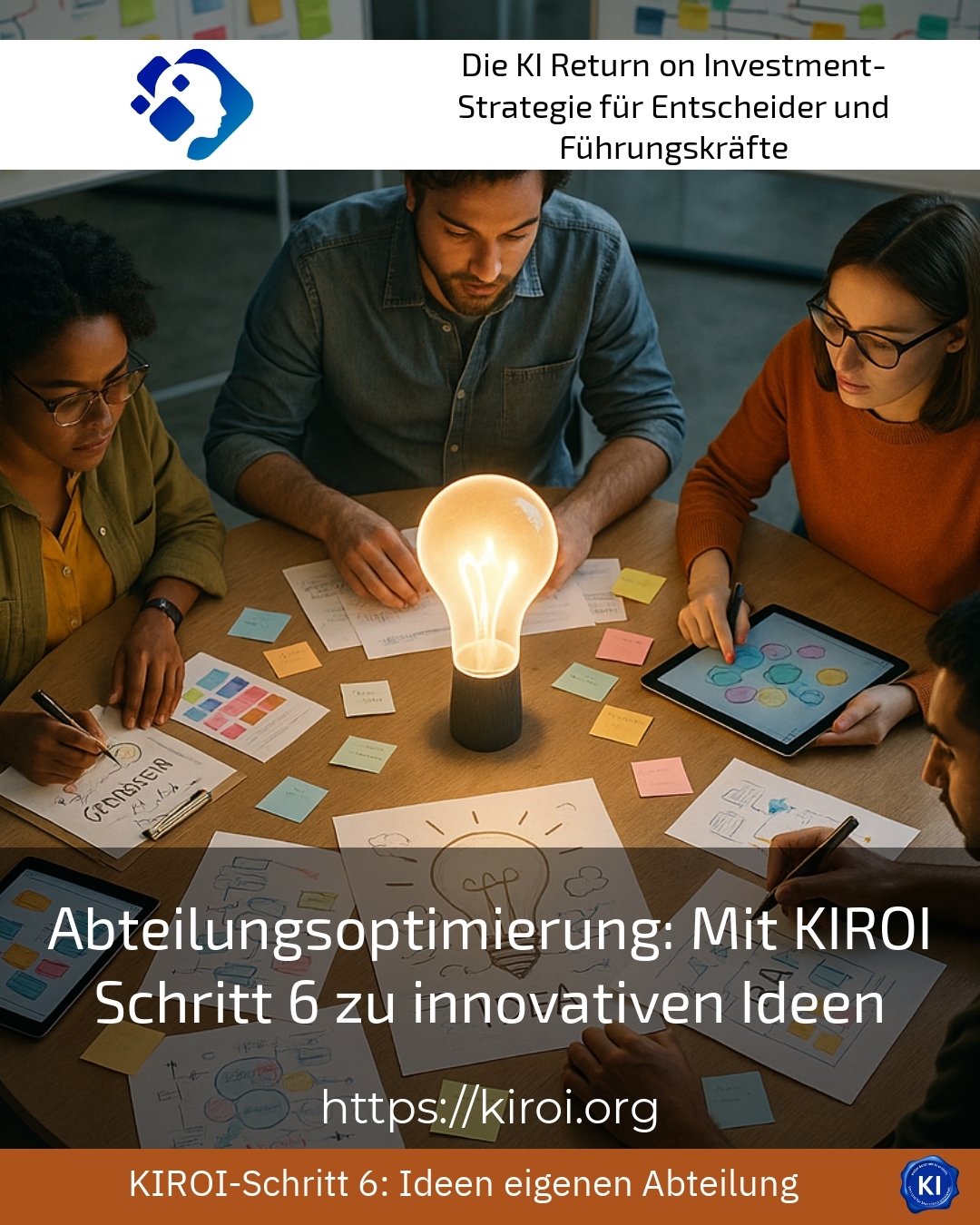
KIROI Step 6: Activate Innovative Ideas
At the heart of departmental optimisation, the question of how innovative ideas can be generated and sustainably implemented repeatedly arises. This is precisely where KIROI Step 6 comes in. This model supports teams in developing concrete practical impulses from the analysis phase. In structured workshops, all participants jointly develop solutions that are tested in the next step and, if successful, permanently established.
In transruptions coaching, we actively support this process. We offer a safe space where teams can overcome inhibitions, gain new perspectives, and thus develop innovative approaches to departmental optimisation. We ensure that the measures are not imposed top-down but arise from the team itself. Because only then will change be accepted and sustained in the long term.
Best Practice with a Client (Name withheld due to NDA agreement)
BEST PRACTICE with one customer (name hidden due to NDA contract) In a medium-sized company, we carried out step 6 of the KIROI process together with the team. The starting point was the desire to improve internal communication, as important information often did not reach the right recipients. In two moderated workshops, we identified the main communication barriers and, in collaboration, developed a digital platform where all team members could share central updates, tasks, and questions. Additionally, we introduced weekly, short jour-fixes to clarify open points directly. After just a few months, employees reported fewer misunderstandings and more clarity in their collaboration. Transparency within the team increased, and satisfaction visibly grew – a real step towards sustainable departmental optimisation.
Active tips for more innovation in the department
For departmental optimisation to succeed, it is advisable to observe a few fundamental principles. Firstly: involve all team members from the outset. Idea generation works best when many perspectives come together. Secondly: make use of regular feedback rounds to identify and tackle challenges together early on. Thirdly: experiment with small, manageable measures before implementing major changes. Fourthly: rely on visualisation – whether a whiteboard, digital tools or classic flipcharts. Fifthly: document your successes and continuously adapt your measures as needed. Only then will true sustainability be achieved in departmental optimisation.
Many teams also approach us with the question of how they can increase motivation for change. One approach involves so-called „experimentation rooms“ where new ideas can be tried out without pressure. Clients often report that such rooms significantly boost creativity and engagement. Regularly identifying "lessons learned" also promotes a constructive culture of error, which favours innovation.
Best Practice with a Client (Name withheld due to NDA agreement)
BEST PRACTICE with one customer (name hidden due to NDA contract) In a logistics company, the team introduced an experimental phase for a new shift schedule after KIROI step 6. The aim was to reduce employee workload and increase flexibility. During a three-month trial run, the team was able to try out various models and regularly reflect on the results. The outcome was a new shift model that was not only supported by the workforce but also boosted productivity. Management actively supported the process by providing freedom and resources. The feedback was consistently positive – a successful example of how departmental optimisation and employee involvement can go hand in hand.
My analysis
Department optimisation is not a one-off project but an ongoing process that involves the entire team. The best results are achieved by teams that dare to break new ground and actively shape innovation processes. Methods such as KIROI Step 6, CIP, or Kaizen support this path because they create space for creative solutions and simplify implementation. Furthermore, the practical examples show that small changes often have a big impact – especially when all stakeholders are involved.
Transruptions-Coaching professionally supports teams with departmental optimisation by providing impetus, sharing knowledge, and outlining concrete steps. Those ready to embark on this journey can increase efficiency, improve quality, and sustainably strengthen team motivation.
Further links from the text above:
Methods of Process Optimisation: KVP and More[1]
Practical examples of process optimisation[2]
Definition Und Methodik Der Prozessoptimierung[3]
Lean Management and the 5S Method[5]
Practical examples for quality and process optimisation[6]
For more information and if you have any questions, please contact Contact us or read more blog posts on the topic Artificial intelligence here.











 Deutsch
  English (UK)