
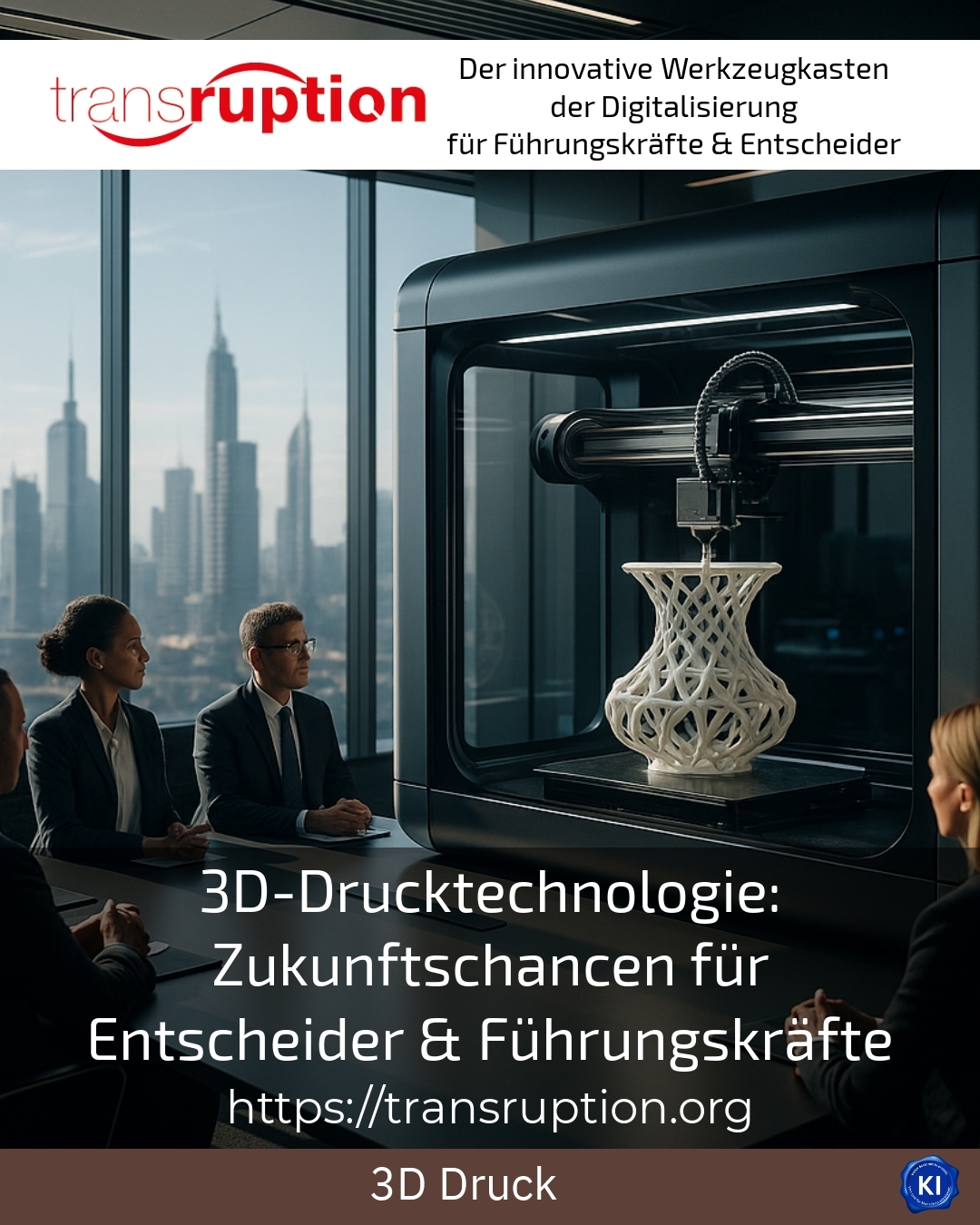
Additive manufacturing is revolutionising industries worldwide, presenting decision-makers with new opportunities. 3D printing technology is growing significantly faster than previously anticipated and is fundamentally changing production processes.[1] Companies that adopted this technology early are reporting significant savings. At the same time, entirely new business models are emerging. However, many managers do not know how to strategically deploy 3D printing technology. This article outlines concrete approaches.
Why 3D printing technology is becoming relevant now
The market for additive manufacturing processes is expanding rapidly. The annual growth rate is around 24.3 percent until 2030.[3] This is significantly higher than in many traditional industries. However, companies in Germany are lagging behind. Only 9.4 percent of companies engaged in additive manufacturing worldwide are located in Germany.[5] This means: Now is the perfect time to act.
Why should you as a decision-maker pay attention? The answer lies in three factors: cost savings, flexibility, and innovation. Already, 70 percent of companies printed more parts in 2023 than the previous year.[1] This shows a clear trend. But it also shows: The majority of companies have not yet fully understood this development.
Practical Application Areas of 3D Printing Technology
3D printing technology is no longer just interesting for prototypes. While 68 percent of companies still primarily use it for prototyping, this is changing rapidly. The following industries are already benefiting massively:
Automotive industry: Light and stable components
The automotive industry uses 3D printing technology for several purposes. It manufactures prototypes, tools, and even final products, which significantly saves time and costs. [2] A major advantage is that printed parts are lighter, improving fuel efficiency. At the same time, complex shapes that would be impossible with traditional methods can be realised.
A practical example: a leading car manufacturer is utilising 3D printing technology for interior components. This has reduced development time by 40 percent. Spare parts are now also manufactured digitally and produced locally when needed [4]. This eliminates expensive warehousing.
Aerospace: Precision and Lightweight Construction
The aerospace industry relies heavily on 3D printing technology. Fuel tanks, engine components and other critical parts are produced here. [4] The requirements are extremely high. Tolerances must be in the micrometre range. Nevertheless, additive manufacturing enables massive cost savings here.
A space company is now printing complex brackets for aircraft systems. Manufacturing takes days instead of weeks. Up to 60 percent of material is saved. This is not only economically sound, but also ecologically relevant.
Medical technology and healthcare
The medical industry is named as the sector with the greatest potential for 3D printing technology.[1] And for good reason. Doctors require individualised implants, prosthetics, and dental replacements. 3D printing technology creates bespoke solutions for every patient. This significantly improves treatment outcomes.
A dental laboratory is using 3D printing technology for crowns and bridges. The manufacturing time has dropped from two days to two hours. Quality has improved at the same time. Patients receive their dental prostheses faster. This is a real differentiator in the market.
Mechanical Engineering: Complex Components Efficiently
In mechanical engineering, 3D printing technology significantly reduces the manufacturing costs of complex components.[2] Especially for small to medium batch sizes, the investment quickly pays for itself. Tooling costs are eliminated. Production time is dramatically reduced.
A mechanical engineering company traditionally produced pump parts using injection moulding. This required expensive moulds. With 3D printing technology, these costs were eliminated. At the same time, the design could be optimised. Weight was reduced by 30 percent with the same performance.
Strategic opportunities for leaders
Revolutionising supply chains with 3D printing technology
The traditional supply chain could fundamentally change. Instead of producing and transporting globally, parts could be printed locally. [5] This saves on transport costs and time. At the same time, it reduces dependence on distant suppliers. This is particularly attractive after the crises of recent years.
A large industrial group is already testing decentralised production. With 3D printing technology, spare parts are being created where they are needed. This means: factory downtimes are falling significantly. Availability is increasing. At the same time, long delivery routes are eliminated.
Individualisation as a competitive advantage
3D printing technology enables customisation without a price premium. Customers increasingly desire personalised products. With traditional methods, this is expensive and complex. With additive manufacturing, it becomes economical.
A jewellery maker is using 3D printing technology for bespoke pieces. Customers design them online, and the printing happens a few days later. Upselling works better. Customer loyalty increases. This is real value creation.
Sustainability and resource conservation
3D printing technology significantly reduces waste products. Traditional milling can produce up to 90 percent waste, whereas additive printing produces minimal waste. This is not only economically sensible but also ecologically necessary.
An aviation company saves hundreds of tonnes of material annually through 3D printing technology. This reduces raw material costs and improves its carbon footprint. At the same time, the brand benefits: sustainability attracts customers and investors.
Challenges and realistic perspectives
Not everything is euphoria. 3D printing technology also has limitations. Material and costs are not yet competitive for all applications. Many prints require post-processing. Quality standards need to be established. But these problems are being solved.
Artificial intelligence will play a key role. Automatic print optimisation, improved slicer software and AI-generated CAD will simplify the technology. Design for additive manufacturing will be revolutionised by topology optimisation.
An important point: multi-material printing will gain massive importance. Almost a third of the industry sees it as the biggest future influence.[1] This opens up completely new possibilities for complex components.
What decision-makers should do now
Step 1: Identify Potential
Look at your production. Where are there long delivery times? Where do expensive tools arise? Where do high transport costs occur? These are potential areas for the application of 3D printing technology. An honest inventory is the first step.
Step 2: Launch pilot projects
Choose a manageable project. Perhaps spare parts or prototypes. With 3D printing technology, you can test quickly. Results provide concrete data. ROI becomes measurable.
A medium-sized company started with tools. The results were impressive. It then rolled out 3D printing technology into several areas. The investment paid for itself in 18 months.
Step 3: Build Expertise
Train your team. 3D printing technology requires different thinking. Design must be done differently. Processes need to be restructured. With competent staff, the transformation will be faster.
Step 4: Form partnerships
You don't have to do everything yourself. Service providers with 3D printing technology can help. External experts can assist with strategy and implementation. This significantly reduces risks.
Different industries, different opportunities
3D printing technology does not offer the same opportunities everywhere. In the automotive industry, the focus is on lightweight construction and cost reduction. In medical technology, the focus is on individualisation. In aerospace, it is about precision and reliability.[4] Each sector must develop its own strategy.
The consumer goods industry is only just discovering the possibilities. Personalised products, faster time-to-market, and better customer experiences are possible. Those who act quickly here will have a competitive advantage.
In construction, 3D printing technology could produce houses and bridges. [7] This sounds like science fiction, but it's becoming a reality. Modular, fast, cost-effective – these are the new standards.
The Role of Artificial Intelligence
AI and 3D printing technology are mutually reinforcing. Automatic print optimisation makes processes more efficient. Improved slicer software reduces errors. AI-generated CAD develops optimal designs.[1] These synergies are far from being exhausted.
Expect massive advances in the coming years. Non-planar prints will become standard. Design processes will become fully automated. Quality control through computer vision will be established. The technology will be democratised – smaller companies will also be able to use it.
Germany in an international context
Germany has strengths in the metal industry. That's a foundation. But it's not enough. The USA and Japan are leading. Germany risks falling behind. That's why the federal government is investing millions in the Industry 4.0 initiative. But it needs to be faster.
Decision-makers should not wait for politicians to act. Those experimenting with 3D printing technology now will have a head start in terms of experience. This is crucial. Early movers have a competitive advantage. They know the pitfalls. They have best practices. They are more readily scalable.
BEST PRACTICE at the customer (name hidden due to NDA contract)A large industrial company from Baden-Württemberg introduced 3D printing technology across three departments simultaneously. This was ambitious but paid off. After 24 months, the company saved €2.3 million annually. At the same time, the time-to-market for new products was reduced by 35 percent. Employee satisfaction increased because routine tasks were eliminated and creative work increased. This shows that 3D printing technology is not just about cost reduction; it's about transformation.
Financial Profitability and Business Case
Profitability depends on the use case. For prototypes, the investment often pays off in months. For spare parts, it takes longer, but is secure. For series production of complex parts, it can take 12-24 months.[12] But then the advantage is permanent.
Think long-term. 3D printing technology is not just about cost. It's about speed, flexibility, and competitiveness. Businesses that understand this will be future-proof. The others will fall behind.











 Deutsch
  English (UK)