
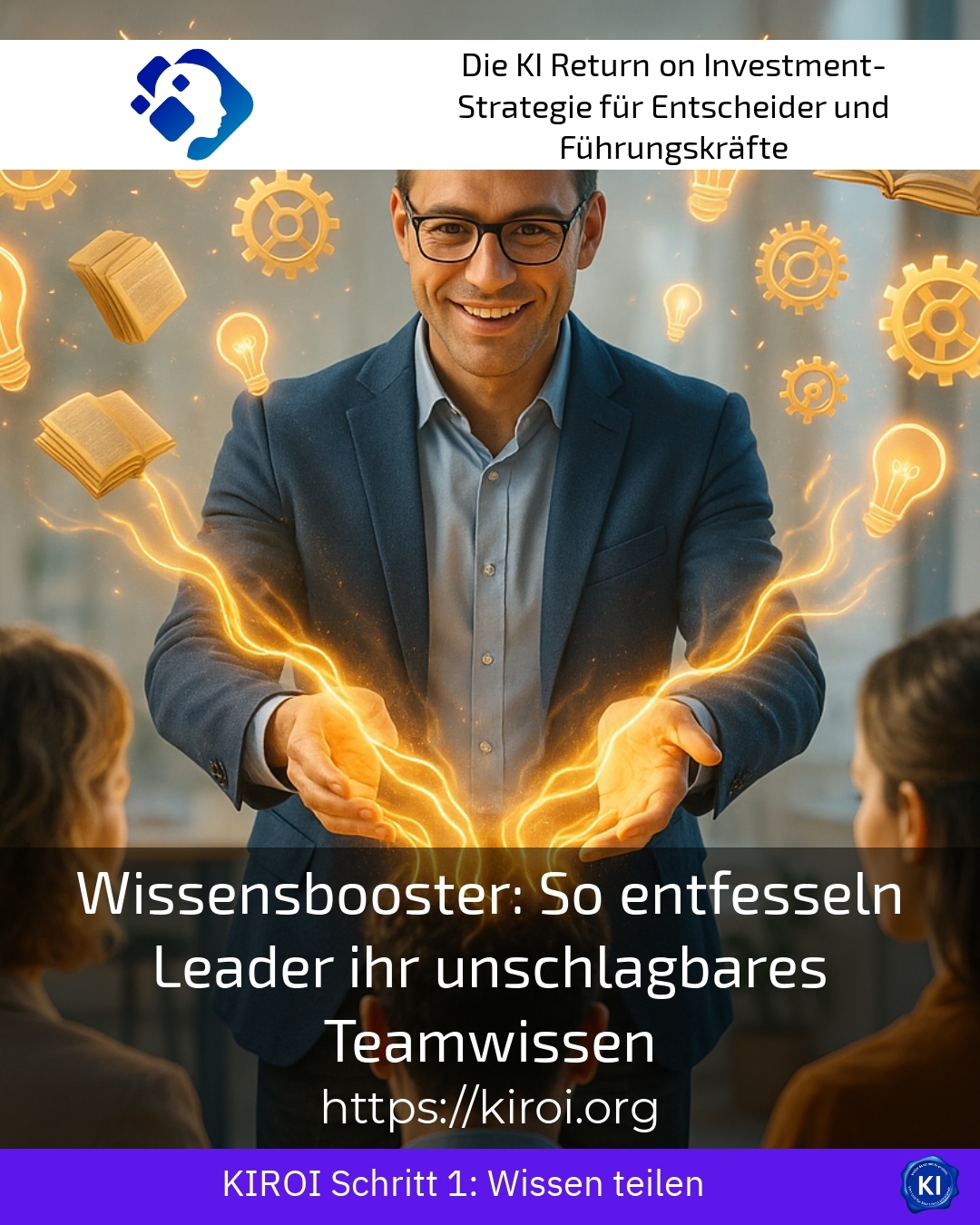
Imagine your team has a hidden treasure trove of experience, insights, and solutions just waiting to be tapped. Many leaders significantly underestimate the collective potential of their staff. They seek external consultants, invest in expensive training, and overlook the most valuable resource right under their noses. Knowledge booster lies not in foreign concepts. It slumbers in the minds of those who work on the front line every day. But how can leaders systematically and sustainably unleash this unbeatable team knowledge? This question occupies numerous organisations in a time of rapid change. The answer requires a fundamental rethink in the way we understand and practice leadership.
Recognising the hidden power of collective knowledge
In almost every organisation, a remarkable phenomenon exists that experts refer to as tacit knowledge. This knowledge completely eludes traditional documentation methods and databases. It manifests in the intuitive decisions of experienced employees. It is evident in the small tricks that speed up processes. And it reveals itself in informal networks that solve problems before they escalate [1].
For example, a manufacturing company in mechanical engineering realised that a long-serving technician could diagnose faults on the assembly line solely by their sounds. He had developed this ability over two decades. It was not documented anywhere. As his retirement approached, there was a risk that this valuable knowledge would be lost forever. Financial service providers experience similar situations when experienced customer advisors leave the company. Their relationship networks and their intuition for customer needs are not transferable. Software companies also struggle with this phenomenon. Developers often carry critical knowledge about legacy systems exclusively in their heads.
The first step in unleashing this potential is to acknowledge its existence. Leaders must understand that formal knowledge is merely the tip of the iceberg. The far greater part lies hidden beneath the surface. Only this realisation allows for systematic approaches to knowledge extraction.
The Knowledge Booster: Creating Structures for Knowledge Flow
Knowledge doesn't flow through an organisation on its own. It needs channels, incentives, and a supportive culture. Leaders who act as Knowledge booster If you want to act, you must consciously design this infrastructure. This is less about technical systems and more about human connections.
Consultancies long ago recognised that structured knowledge transfer represents a competitive advantage. They use after-action reviews after every project. These reflection sessions capture what worked and what didn't. Hospitals implement interdisciplinary case conferences where doctors from different specialisms contribute their perspectives. This leads to holistic treatment approaches. Retail companies establish regular feedback loops between branch employees and headquarters. Insights from direct customer contact are incorporated into strategic decisions.
Best practice with a KIROI customer
A medium-sized logistics service provider faced the challenge that critical process knowledge was distributed among a few key individuals. Management requested support for a transruption coaching project, which was to systematically map the knowledge landscape. In several workshops, we jointly identified the most important knowledge carriers and their specific expertise. Subsequently, we developed a mentoring program that paired experienced employees with junior staff. These pairs worked closely together for six months. They solved real problems together and documented their findings in a dynamic wiki system. In parallel, we introduced regular learning circles where teams exchanged their experiences. The results exceeded all participants' expectations. Within a year, problem-solving speed improved significantly. New employees reached their full productivity considerably faster. And staff turnover in the company noticeably decreased. Clients often report similar positive developments when knowledge transfer is systematically promoted.
Psychological Safety as the Foundation of the Knowledge Booster Approach
People only share their knowledge when they feel safe. This insight comes from extensive research on high-performing teams [2]. Psychological safety refers to the trust that one will not be punished for questions, mistakes, or new ideas. Without this foundation, all structural measures remain ineffective.
Technology companies in Silicon Valley learned this lesson early on. They cultivate a culture of failure that encourages experimentation and views setbacks as learning opportunities. Advertising agencies create spaces for wild brainstorming where no idea seems too crazy. Only later is critical evaluation carried out. Construction companies establish safety committees where employees can point out risks without fear of repercussions. This prevents potential accidents.
Leaders decisively shape this atmosphere through their own behaviour. They must model vulnerability by admitting their own mistakes. They should actively seek out and value dissenting opinions. And they must consistently punish anyone who demeans others for their knowledge or their questions.
Breaking down knowledge silos through targeted networking
Organisations tend to lock knowledge away in departments. Marketing doesn't know what sales is doing. Development barely communicates with customer service. Finance remains a black box for everyone else. These silos don't arise from malice. They are the natural outcome of specialised structures.
Pharmaceutical companies break down these barriers through cross-functional project teams. Researchers, regulatory experts and marketing professionals work together from the outset. This ensures that different perspectives are incorporated into product development. Insurance companies systematically rotate junior managers through different departments. These managers develop a holistic understanding of the business. Car manufacturers organise internal innovation competitions where mixed teams develop new ideas. The best concepts receive resources for implementation.
The Knowledge booster-Impact often arises at the interfaces between different fields. This is where different ways of thinking meet. This is where innovative solutions are created. And this is where knowledge that previously existed in isolation is linked.
Technology as an enabler, not a replacement
Modern tools can significantly support knowledge sharing. However, they never replace the human factor. A knowledge base remains useless if nobody populates it. An internal social network withers away if the culture does not reward sharing.
Telecommunications providers use intelligent search systems that automatically tap into expert knowledge. Employees quickly find out who can help with a specific problem. Law firms rely on knowledge management platforms that suggest relevant precedents. This allows junior lawyers to benefit from the experience of the entire team. Energy suppliers implement digital twins of their facilities, into which technicians' experiential knowledge flows. These virtual models support maintenance and fault diagnosis.
The choice of the right technology depends heavily on the respective organisational culture. Some teams prefer structured systems with clear categories. Others prefer to work with open platforms that allow for organic growth. Guidance from experienced consultants can provide impetus and help avoid incorrect decisions [3].
Enhancing the knowledge booster effect through leadership behaviour
Leaders are the most important multipliers for knowledge sharing. Their behaviour sends strong signals to the entire organisation. If a leader cannot find time for knowledge sharing themselves, employees will feel the same way. If, on the other hand, they regularly ask, listen, and learn, they inspire others to follow suit.
Hotel chains train their managers to speak with employees of all levels daily. These conversations promote the direct flow of information and identify areas for improvement. Media companies organise regular town hall meetings where management communicates transparently and answers questions. Craft businesses maintain the tradition of a shared breakfast break, where all employees informally exchange knowledge.
Best practice with a KIROI customer
A family-run business with a long tradition in the food industry sought support with succession planning. The current generation of management possessed decades of experience that should not be lost. As part of transruptive coaching, we developed a multi-stage concept for knowledge retention and transfer. Initially, we conducted structured interviews with senior management, which made their implicit knowledge explicit. We then shaped these insights into case studies, which are used in internal training sessions. In parallel, we established a reverse mentoring programme, where younger employees shared their digital expertise with older colleagues. In return, they gained insights into established business relationships and industry knowledge. The introduction of storytelling sessions, where experienced employees recounted their most formative professional experiences, proved particularly valuable. These stories conveyed values and behavioural patterns that cannot be found in any manual. The company now reports significantly improved intergenerational collaboration and a stronger sense of belonging.
Designing incentives and recognition for knowledge sharing
People act according to the incentives they perceive. If organisations only reward individual performance, knowledge sharing does not happen. After all, shared knowledge could diminish one's own competitive advantage. Clever leaders therefore design incentive systems that make sharing attractive.
Management consultancies explicitly assess employees on how much they contribute to the company's knowledge base. Sales organisations reward not only individual deals but also support for colleagues. Research institutions recognise scientists whose work is cited and further developed by others.
Financial incentives are not always the most effective. Visible recognition from management often suffices. Some companies give internal awards for particularly helpful knowledge contributions. Others grant access to exclusive development programmes. Still others allow presentations to top management. The appropriate form depends on the specific culture.
Sustainable integration of the knowledge booster principle
One-off initiatives quickly fizzle out. The Knowledge boosterThe effect only unfolds its full power with permanent anchoring. This requires patience, consistency and continuous adaptation.
Industrial companies incorporate knowledge sharing into their standard processes. Every project concludes with a lessons-learned documentation. Educational institutions establish peer observations as a permanent component of staff development. Teachers visit each other during lessons and provide feedback. Retailers use daily short meetings where teams share successful sales strategies.
Anchoring is more successful when knowledge sharing is understood not as an additional burden, but as an integral part of the work. This often requires a redesign of processes and time budgets. Leaders must create spaces where exchange is possible. And they must protect these spaces from the pressures of day-to-day business.
My KIROI Analysis
The systematic development and utilisation of team knowledge represents one of the greatest opportunities for modern organisations. In my consulting practice, I repeatedly experience how underestimated this resource is. Companies invest millions in external expertise while internal know-how lies fallow. They implement complex IT systems without addressing the underlying cultural barriers. And they expect quick results where sustainable change requires time and perseverance.
From my experience of numerous projects, I can report that the most important success factor is always leadership. Leaders must exemplify what they expect from others. They must show genuine interest in their employees' perspectives. And they must be willing to have their own assumptions challenged. Only then does the psychological safety arise that enables knowledge sharing.
The technical and structural measures are comparatively easy to implement. The cultural transformation is the real challenge. It requires patient support, repeated impulses, and the willingness to see setbacks as learning opportunities. Transruption coaching can offer valuable support here by guiding leaders on this path and creating reflective spaces for change. The investment is worthwhile. Organisations that successfully mobilise their collective knowledge are more innovative, resilient, and attractive to talent.
Further links from the text above:
[1] Harvard Business Review: Knowledge Management
[2] Google re:Work: Guide to Understanding Team Effectiveness
[3] McKinsey Insights: People and Organisational Performance
For more information and if you have any questions, please contact Contact us or read more blog posts on the topic Artificial intelligence here.











 Deutsch
  English (UK)