
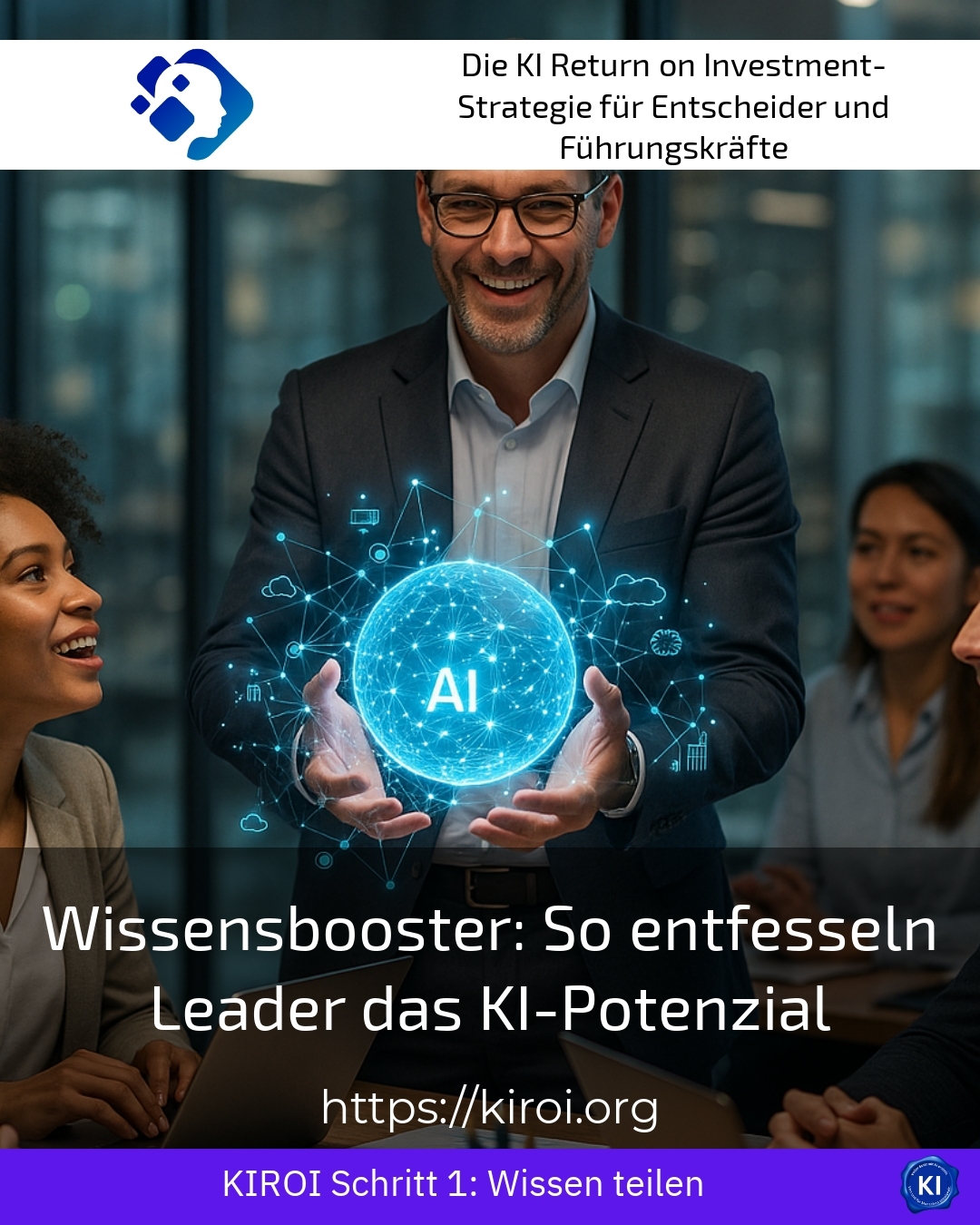
In a world rapidly changing through technological innovation, leaders face the crucial question of how to unlock the full potential of intelligent systems for their organisations. The Knowledge Booster: How Leaders Unleash AI Potential describes a fundamental shift in the way companies generate, process, and strategically deploy knowledge. It’s no longer just about implementing new technologies, but rather a profound transformation of corporate culture and leadership philosophy. Decision-makers who actively shape this change often report surprising synergies and entirely new possibilities for value creation.
The strategic dimension of knowledge management in modern organisations
Executives are increasingly recognising that knowledge is their companies' most valuable resource. This insight has far-reaching consequences for the way organisations are structured and managed. Particularly in knowledge-intensive industries, the added value of a well-thought-out strategy is clearly apparent. For example, a medium-sized consulting firm has redesigned its internal processes to systematically capture expert knowledge and make it accessible to all employees. Furthermore, financial service providers use intelligent systems to conduct real-time market analyses and make informed investment decisions. In the healthcare sector too, automated analyses support diagnosis by drawing on an enormous pool of medical expertise [1].
The Knowledge Booster: How Leaders Unleash AI Potential demonstrates itself particularly impressively in the pharmaceutical industry. Here, intelligent analysis tools significantly accelerate the development of new active ingredients. Research teams can evaluate millions of molecular combinations in a very short time. This leads to insights that would have taken years with conventional methods. At the same time, logistics companies benefit from predictive planning systems that optimise supply chains and identify bottlenecks early on. These examples show that the strategic use of knowledge technologies creates cross-industry competitive advantages.
Best practice with a KIROI customer
An internationally active technology company faced the challenge of systematically capturing the implicit knowledge of its experienced engineers and making it available for subsequent generations of specialists, as many long-standing employees were nearing retirement. As part of the transruption coaching support, we jointly developed a multi-stage strategy that took both technical and cultural aspects into account. First, the management, together with their teams, identified the critical knowledge domains and prioritised them according to strategic relevance for the company. Subsequently, they implemented a hybrid system that combined structured interviews with automated text analysis, thereby creating a searchable knowledge database. Employees were actively involved in the process, which significantly increased acceptance and established a sustainable learning culture. After six months, those responsible for the project reported a significant reduction in the onboarding time for new colleagues by approximately forty percent, as they could now access structured experiential knowledge. Furthermore, cross-departmental collaboration improved noticeably, as silo structures were broken down by the shared knowledge pool.
Knowledge Booster: How Leaders Unleash AI Potential Through Cultural Transformation
Technological implementation is only part of the equation. Developing a learning-oriented corporate culture is crucial for sustainable success. Leaders who neglect this cultural dimension often fail due to resistance within their organisations. In the automotive industry, for example, it is evident that successful transformation projects must always be accompanied by strong change management. Plant managers report that the introduction of intelligent production systems only succeeds if the workforce understands the added value and actively participates in shaping it. Insurance companies are having similar experiences, retraining their clerks to become process designers and entrusting them with new, more demanding tasks [2].
The media industry impressively illustrates how cultural changes and technological innovations can go hand in hand. Editorial offices now use intelligent research tools that bring together relevant information from thousands of sources. This allows journalists to concentrate on creative and analytical work, while routine tasks are automated. However, this shift demands a fundamental rethinking of professional roles. Law firms are also undergoing similar transformation processes, as intelligent systems accelerate document analysis and contract review. This enables lawyers to dedicate more time to the strategic advising of their clients.
The role of the leader as a knowledge moderator
Modern leaders increasingly see themselves as facilitators of knowledge processes rather than all-knowing decision-makers. This role transformation has a lasting impact on successful organisations across all sectors. In retail, for example, store managers use data-based insights to support their teams in decisions about product range design and staffing. They provide impetus and ask the right questions, rather than issuing directives from above. In the telecommunications industry, leaders guide their teams to learn from customer interactions and continuously improve service processes. The banking sector, in turn, shows how department heads can break down silos and foster innovation through transparent knowledge sharing [3].
Best practice with a KIROI customer
A leading energy provider wanted to fundamentally modernise its leadership culture and systematically harness the potential of data-driven decision-making without marginalising human intuition and experience. The transruption coaching support initially focused on the senior leadership level, as cultural change must always start at the top to have a sustainable effect. In several workshops, participants developed a shared understanding of how their role as leaders changes through the use of intelligent systems and which new competencies are required. A particularly important insight was that technological tools can support decision-making but never replace it, because complex strategic questions always require human judgment. The leaders developed concrete guidelines for dealing with automated recommendations and established regular reflection sessions within their teams. After one year of intensive support, participants reported a noticeably improved quality of decisions and increased employee satisfaction, as teams felt more involved and valued. The energy provider is now considered a pioneer in its industry for modern leadership culture.
Practical implementation strategies for Knowledge Booster
Successful implementation of a knowledge-oriented strategy requires a structured approach in several phases. Firstly, managers must conduct an honest assessment of existing knowledge resources and technological capabilities. In the chemical industry, such projects often begin with identifying critical processes where expert knowledge is particularly valuable. Mechanical engineering companies typically analyse their maintenance and repair processes because there are enormous savings potential to be unlocked. The food sector often focuses on quality assurance and traceability to better meet regulatory requirements while simultaneously achieving efficiency gains [4].
The Knowledge Booster: How Leaders Unleash AI Potential unfolds its full effect only through consistent scaling of successful pilot projects. Experienced practitioners recommend starting with manageable use cases and making quick successes visible. For example, a textile company began by optimising its inventory and later extended the approach to the entire supply chain. A tourism group proceeded similarly, initially improving its customer service and subsequently transferring the acquired know-how to product development and marketing. This step-by-step approach reduces risks and creates organisational learning potential.
Knowledge Boosters in the Context of Agile Ways of Working
Agile methods and knowledge-oriented strategies complement each other perfectly and mutually enhance their positive effects. In software development, teams already routinely use tools that analyse code quality and generate suggestions for improvement. Product managers in e-commerce companies work closely with data-driven analysis systems to better understand customer needs. The education sector is experimenting with adaptive learning platforms that enable individual learning paths and thus accelerate knowledge acquisition. All these examples show that integration into existing working methods is crucial for success [5].
The combination of design thinking approaches with intelligent analysis tools is particularly interesting. Creative agencies use this combination to gain deeper insights into target groups and develop innovative solution approaches. Management consultants support their clients in designing new business models by systematically evaluating market data and customer insights. The construction sector benefits from forward-looking project planning, which uses historical data to avoid delays and cost overruns.
Best practice with a KIROI customer
A renowned auditing firm wanted to modernise its auditing processes while simultaneously elevating the quality of its services to a new level, as clients increasingly expected more in-depth analyses and speedier results. The transruption coaching support focused on the development of hybrid working methods where human expertise and automated analyses seamlessly interlock. Auditors learned to use intelligent systems as tools that sift through large volumes of data and identify anomalies, while they themselves take on the critical evaluation and interpretation. The training in the area of results validation proved particularly valuable, as employees needed to understand how the systems arrive at their recommendations and where their limitations lie. Over the course of the project, the team developed its own best practices, which are now considered standard throughout the organisation and significantly shorten the onboarding time for new colleagues. Client satisfaction increased measurably because audits could now be conducted in a more in-depth and, at the same time, more efficient manner. The firm now positions itself as an innovative pioneer in its industry, thereby winning new clients in high-growth segments.
My KIROI Analysis
A comprehensive review clearly shows that sustainable success in tapping into new technological opportunities depends on a holistic approach. Leaders who solely focus on technical implementation, without considering the cultural and human dimensions, rarely achieve their ambitious goals. The examples presented from a variety of industries illustrate that successful transformation projects always place employees at the centre and actively promote their development. The realisation that intelligent systems only unfold their full potential when they are understood as a supplement and reinforcement of human capabilities, not as their replacement, appears particularly important to me.
From my experience of supporting numerous projects, I know that the biggest challenges are often not technical, but organisational and cultural. Leaders must learn to tolerate uncertainty while providing clear direction. They need to create spaces for experimentation where mistakes are seen as learning opportunities, while simultaneously ensuring necessary guardrails are in place. Finding the balance between innovation and stability represents one of the most demanding tasks of modern leadership. Those organisations that master this balance will emerge as winners from the current transformation phase and be able to sustainably strengthen their market position. Transruptions coaching support can provide valuable impulses and assist leaders on their individual development journey.
Further links from the text above:
[1] McKinsey Digital Insights on Knowledge Management and Digital Transformation
[2] Harvard Business Review – Change Management and Leadership
[3] Gartner Research on Leadership and Technology Adoption
[4] World Economic Forum – Fourth Industrial Revolution
[5] Forbes Digital Transformation Hub
For more information and if you have any questions, please contact Contact us or read more blog posts on the topic Artificial intelligence here.











 Deutsch
  English (UK)