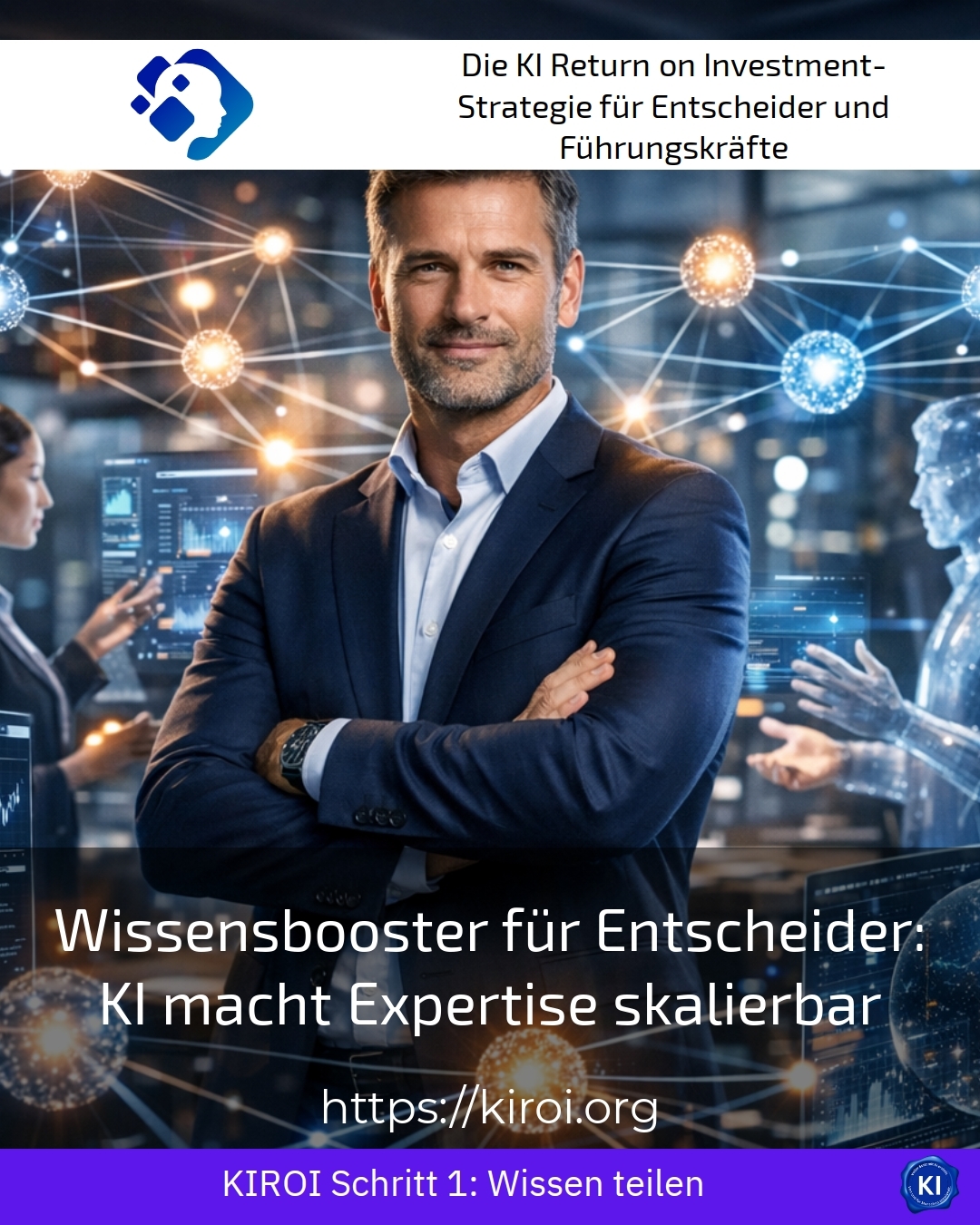
What if your best experts were suddenly available in one hundred locations at the same time, without their knowledge ever being lost or at risk from fluctuation? This idea may sound utopian at first, but intelligent systems make this possible today. The Knowledge booster for decision-makers: AI makes expertise scalable And this fundamentally changes how companies handle their most valuable asset. Leaders face the challenge of making expertise readily accessible. At the same time, they must ensure that this knowledge remains consistent and up-to-date. The solution lies in the systematic use of intelligent technologies.
Why traditional knowledge management is reaching its limits
Companies have been struggling with a fundamental problem for decades. Experienced employees carry enormous tacit knowledge. This knowledge is difficult to document and even harder to pass on. When a long-time sales manager leaves the company, decades of customer relationship knowledge often get lost. Handbooks and training materials only capture a fraction of what is truly relevant. The situation becomes significantly worse in times of a shortage of skilled workers.
A medium-sized machine manufacturer faced exactly this dilemma. Three of its most experienced service technicians retired at the same time. Their combined knowledge of machine maintenance and troubleshooting encompassed more than ninety years of professional experience. Traditional handovers would have taken months and would still have remained incomplete. A logistics company experienced similar challenges in expanding into new markets. The expertise of the dispatchers could not be replicated quickly enough. A financial services provider also reported on knowledge gaps following a restructuring.
The knowledge booster for decision-makers in practical application
Intelligent assistance systems fundamentally change this dynamic. They can capture expert knowledge, structure it and provide it contextually. A chemical company uses this technology for process optimization in production. The experience of the shift managers is systematically recorded and analyzed. New employees thus gain immediate access to proven recommendations for action. A pharmaceutical company uses similar systems for quality control. The expertise of the laboratory managers is now available around the clock.
The effect is particularly impressive in customer service. A telecommunications provider reduced the onboarding time for new employees by sixty percent. The system analyzes previous problem solutions and suggests appropriate action options. Service employees therefore make faster and more consistent decisions. An energy provider reports similar improvements in technical advice. Customer satisfaction increased measurably because inquiries were answered competently.
Best practice with a AIROI customer
An international automotive supplier faced the challenge of making the specialized knowledge of its development engineers available globally, because the sites operated in different time zones and knowledge gaps led to costly delays. The transruptions coaching accompanied the company in developing an intelligent knowledge system that systematically captured and categorized the expertise of more than three hundred engineers. The solution enabled new team members to access relevant experience within seconds without having to consult directly with experienced colleagues. The system continuously learned from new projects and automatically expanded its knowledge base, so that the quality of the recommendations steadily improved. The development time for new components was reduced by an average of twenty-three percent because typical errors were avoided. At the same time, the satisfaction of experienced engineers increased, because they spent less time on repetitive explanations and could focus on more challenging tasks. The project was implemented within eight months and fully amortized itself in the first year.
How the knowledge booster creates strategic advantages for decision-makers
The scaling of expertise enables entirely new business models. A consulting firm significantly expanded its service portfolio without proportionally increasing personnel costs. The intelligent systems take on standardized analysis tasks and prepare data. This allows advisors to focus on the strategic guidance of their clients. An auditor uses similar approaches for audit preparation. The quality of the analyses improved, while the lead times decreased [1].
New opportunities are also emerging in production. A food manufacturer is using expert systems for recipe development. The accumulated knowledge of product developers is being incorporated into new creations. At the same time, regulatory requirements are automatically taken into account. A cosmetics company is thus significantly accelerating the market launch of new products. The time-to-market was reduced by almost forty percent.
Challenges in implementing intelligent knowledge systems
The introduction of such systems requires careful planning and change management. Many experts initially experience resistance to documenting their knowledge. They fear that this will lead to them being replaced or losing their status. One insurance company addressed this problem with transparent communication. The experts were positioned as knowledge architects and were given new responsibilities. A construction company took a similar approach when digitizing project management knowledge. The experienced project managers were turned into mentors for the intelligent system [2].
Quality assurance of stored knowledge presents another challenge. Not every experience is transferable or representative. A medical technology company therefore implemented multi-stage validation processes. Expert knowledge is reviewed before integrating with specialist committees. A software company uses similar mechanisms for technical documentation. Clients often report initial uncertainties that dissipate after the first successes.
Technological foundations for scalable expertise
Modern knowledge systems are based on several technological pillars. Natural language processing enables intuitive interaction with the system. Employees can ask questions in their customary professional language. The system understands the context and provides relevant answers. A mechanical engineering company uses this technology for maintenance support. Technicians describe problems verbally and receive immediate action recommendations.
Knowledge graphs represent the relationships between different pieces of information. They enable the recognition of implicit connections. A chemical company uses this technology for research and development. Cross-connections between different projects are automatically identified. A technology company thus significantly accelerates the innovation processes. The systems proactively suggest relevant internal expertise [3].
Best practice with a AIROI customer
An international law firm sought ways to make the specialized knowledge of its partners accessible to associates and junior lawyers without unduly taking up the partners’ precious time. The transruptions coaching accompanied the firm in designing an intelligent research system that was trained on the partners’ internal precedents and argumentation patterns. The system analyzed thousands of briefs, contracts, and internal memos to capture and systematize the firm’s characteristic solutions. Young lawyers can now enter complex legal questions and receive suggestions based on the firm’s proven practice, while the system also points out potential risks and alternative approaches. The quality of the initial drafts improved measurably, and the partner-led revision cycles decreased by more than a third. At the same time, a vibrant knowledge archive was created that permanently secures the firm’s institutional expertise and grows continuously. The project impressively demonstrated how the knowledge booster for decision-makers: AI can provide the impetus to scale expertise even in knowledge-intensive service industries.
Integration into existing workflows and corporate culture
The success of intelligent knowledge systems depends heavily on their integration into everyday work. Isolated solutions are often not accepted. A trading company integrated the expert system directly into its existing warehouse management system. Buyers receive context-based recommendations during their normal work. An industrial company linked the knowledge system with the production software. Machine operators automatically receive relevant information during certain process steps.
Corporate culture must actively encourage the sharing of knowledge. A technology company introduced incentive systems for knowledge contributions. Employees are rewarded for the quality and use of their contributions. A consulting firm integrated knowledge sharing into performance evaluation. The willingness to document increased significantly as a result. A financial services provider supports cultural change through regular success stories.
Data protection and ethical aspects of knowledge digitalization
The digitization of expert knowledge raises important questions about data protection and employee rights. Who owns the knowledge that an employee has built up over years? How is it prevented from being misused? A pharmaceutical company developed detailed governance structures for its knowledge system. Access rights are granted and logged based on roles. An insurance company implemented strict anonymization rules for personal case studies [4].
The ethical dimension also concerns responsibility for decisions. If a system provides flawed recommendations, who bears the responsibility? A medical technology company defined clear liability regulations. Human experts retain the final decision-making authority. An engineering firm uses the systems explicitly as support, not as a substitute for human expertise.
My AIROI Analysis
The systematic scaling of expertise through intelligent technologies marks a turning point in the management of organizational knowledge. Companies that actively shape this change gain sustainable competitive advantages. They become more independent of individual sources of knowledge and can react more quickly to market changes. The democratization of expertise enables better decisions at all levels of the organization. At the same time, it increases the attractiveness as an employer because employees can access a rich wealth of experience from the outset.
However, implementation requires more than technological expertise. Successful projects are characterized by a careful balance between technology and people. Experienced experts must be won as partners, not treated as data sources. The corporate culture must encourage and reward the open sharing of knowledge. Leaders play a central role in creating this cultural framework.
From my consulting practice, I know that the biggest obstacles are rarely of a technical nature. Rather, projects fail due to a lack of strategic alignment or a lack of change management. Decision-makers should start with manageable pilot projects and make quick successes visible. Transruptive coaching supports in identifying the right use cases and developing sustainable implementation strategies. The knowledge booster for decision-makers: AI makes expertise scalable and opens up new horizons for organizational learning.
Further links from the text above:
[1] McKinsey: The Economic Potential of Generative AI
[2] Harvard Business Review: Knowledge Management
[3] Gartner: Knowledge Graphs Explained
[4] Bitkom: Artificial Intelligence in Companies
For more information and if you have any questions, please contact Contact us or read more blog posts on the topic Artificial intelligence here.








 Deutsch
 English (UK)