
Have you ever wondered why some leaders seem to excel effortlessly with intelligent technologies, while others, despite all their efforts, fall flat?
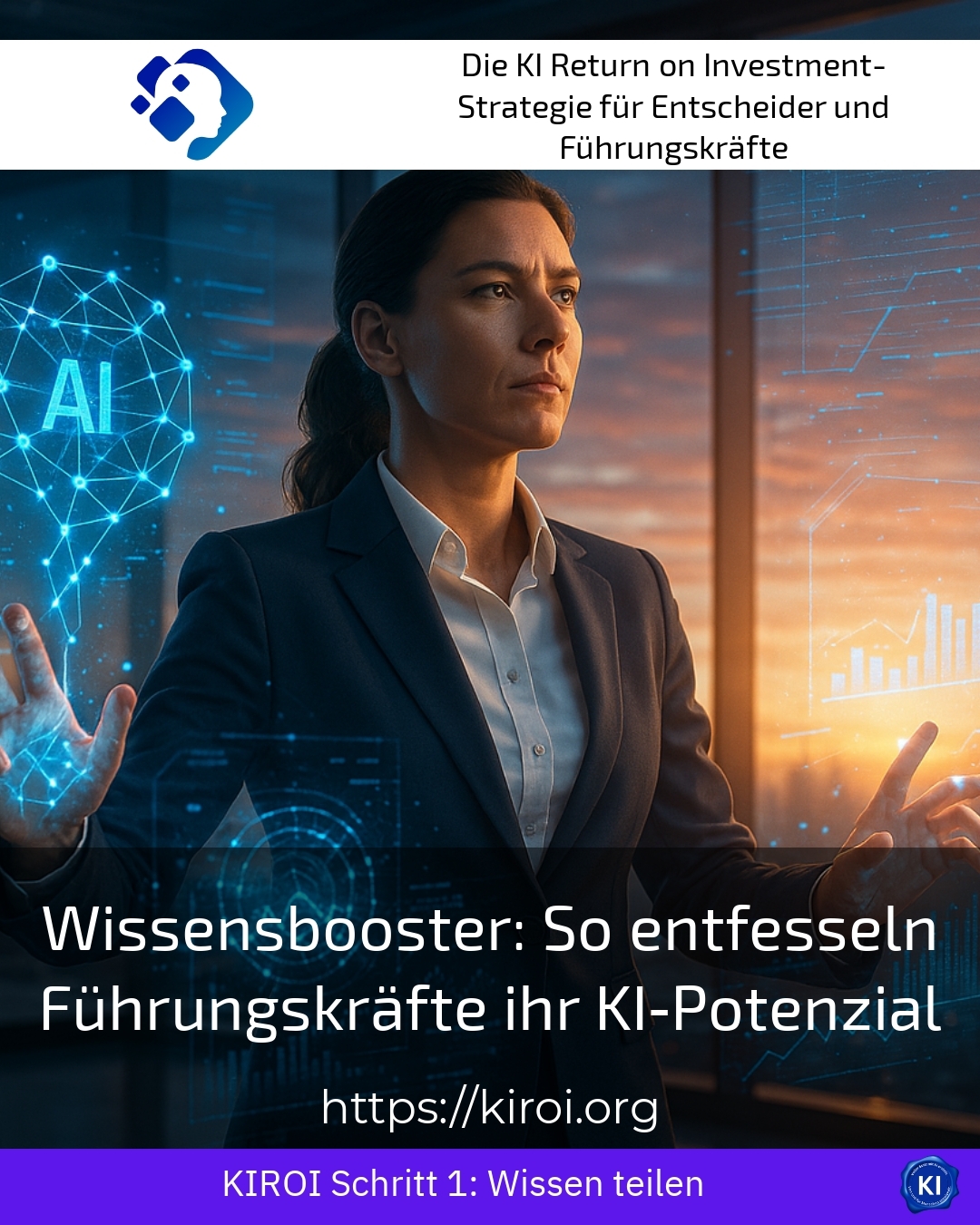
The answer often lies not in a lack of budget or lack of resources, but in a fundamental misunderstanding of what constitutes a real leader. Knowledge booster It is becoming increasingly important. In an era where machine learning and automated decision-making are revolutionizing entire industries, success or failure is no longer solely determined by technical expertise. Rather, it is becoming clear that leaders who actively shape their own learning journey and systematically build new competencies along the way achieve significantly better results than those who passively wait for training offerings. This insight fundamentally changes how we should think about strategic competence development in the digital age.
The Knowledge Booster as a Strategic Leadership Tool
The systematic expansion of one’s own competence spectrum is no longer an optional luxury today; it forms the indispensable foundation for sustainable competitiveness. Executives often report that they feel overwhelmed by the speed of technological change and barely have time to thoroughly explore new opportunities. However, this overwork rarely results from actual lack of time, but rather from the absence of a structured approach to continuous learning. A well-designed Knowledge booster It starts right here and transforms the disorganized flow of information into targeted skills development.
In healthcare, for example, we see clinical leaders who initially viewed automated diagnostic systems with skepticism. After targeted guidance, they came to understand how these tools complement medical expertise. Insurance companies use intelligent damage forecasts for more precise risk assessments. Logistics service providers optimize their route planning through learning algorithms. These examples illustrate that industry-specific understanding makes the crucial difference.
Best practice with a AIROI customer
A medium-sized manufacturing company from southern Germany approached us with a specific challenge that exemplifies many organizations. The management had made significant investments in intelligent production systems, but the expected efficiency gains remained largely absent. Upon closer examination, it became apparent that the problem was not the technology itself but the lack of understanding at the leadership level regarding its strategic integration into existing processes. Through several months of transruptive coaching, we worked with the management team to develop a customized learning concept. This included both technical fundamentals and strategic application scenarios. The leadership team gradually developed a deeper understanding of the capabilities and limitations of the systems in use. After six months, the company reported an increase in productivity that exceeded initial expectations. Particularly noteworthy was that the executives were now independently identifying new application areas and proactively developing improvement proposals.
How the right knowledge booster transforms decision-making processes
Decisions under uncertainty are part of the everyday life of every leader, but the complexity of these decisions has increased exponentially in recent years. Today, algorithmic systems can analyze data volumes that would be simply overwhelming for human capabilities. However, this does not mean that human judgment power has become obsolete. On the contrary, it is becoming increasingly clear that the combination of machine analysis power and human contextualization yields the best results.
Banks today rely on predictive models for creditworthiness assessment. Retailers use demand forecasts for inventory planning. Energy providers optimize their network utilization through real-time analyses. Human resources managers receive support in selecting suitable candidates. Marketing departments personalize customer communication based on behavioral patterns. All these application areas require executives who understand technical relationships as well as can reflect on ethical implications.
Many clients come to us concerned about losing touch with technology. They report meetings where technical terms become unfamiliar to them. They describe the feeling of having to make important strategic decisions based on incomplete understanding. This uncertainty can be paralyzing and often leads to avoidance strategies. Our transruptive coaching helps leaders systematically close these knowledge gaps.
Practical insights for everyday leadership
Bridging the gap between theoretical knowledge and practical application represents one of the biggest challenges in competence development. Often, executives report that after conferences or seminars, they are inspired, but have difficulty integrating what they have learned into their daily work. An effective Knowledge booster Therefore, it must not only convey information but also provide concrete implementation paths and enable reflection on one's own experiences.
In the automotive sector, we are currently experiencing a fundamental transformation. Vehicle manufacturers are evolving into mobility service providers. Workshops must understand how connected vehicles work. Retailers need expertise in new sales models with subscription features. These examples show how profound changes affect entire value chains.
Best practice with a AIROI customer
An international pharmaceutical company faced the challenge of qualifying its research and development department for the use of machine learning methods. The existing expertise lay primarily in traditional pharmaceutical disciplines, while understanding of data-driven research approaches was still in its infancy. As part of our support, we developed a multi-stage program tailored specifically to the needs of executives in the scientific environment. Special emphasis was placed on not imparting superficial technological trends, but rather creating a deep understanding of the methodological foundations. Participants learned how algorithmic pattern recognition can support the identification of promising drug candidates. They understood what data quality is required for reliable results. They developed criteria for evaluating solution providers. After completing the program, the company initiated several pilot projects that are already showing promising results.
Integrate the knowledge booster into the organizational culture
Individual competence development only truly takes effect when it is embedded in a learning-promoting organizational culture. Leaders significantly shape how employees handle learning challenges through their own behavior. By demonstrating openness to new insights and communicating transparently about their own learning processes, they create the conditions for a positive learning culture throughout the entire organization.
Media companies are experimenting with automated content production. Architecture firms are using generative design systems. Law firms are relying on contract analysis tools. Accountants are working with anomaly-detecting auditing systems. Human resources providers are optimizing their matching processes. These examples illustrate the cross-industry relevance of systematic competency development.
Our transruptive coaching provides guidance for designing organizational learning architectures. We help leaders become aware of and shape their role as role models. We take into account that each organization has its own history, culture, and specific challenges. Standard solutions are too limited here. Instead, we develop customized approaches together.
Overcoming mental barriers and unlocking potential
Not infrequently, it is less technical barriers than psychological ones that stand in the way of successful development of competence. The fear of being replaced by intelligent systems can lead to defensive reactions that make factual discussion difficult. Likewise, excessive technocratic optimism can lead to neglecting critical questions that would be indispensable for responsible implementation.
Telecommunications providers are automating parts of their customer service. Travel agencies are personalizing offers based on preference analysis. Educational institutions are developing adaptive learning systems. Agricultural enterprises are using precision agriculture. Municipal administrations are digitizing citizen services. In all these areas, executives must be able to properly assess both opportunities and risks.
Best practice with a AIROI customer
A traditional family-run textile company contacted us with an unusual request at first glance. The managing partner wanted to understand which technological developments might be relevant for her company and which she could safely ignore. This question of strategic prioritization is typical of medium-sized companies, whose resources are limited and therefore have to weigh the options very carefully. Together we analyzed the specific competitive situation and identified three areas of action of high relevance. The manager developed a nuanced understanding of which areas required swift action and where a wait-and-see approach seemed more appropriate. She learned to critically question technological trends and realistically assess their relevance to her own business model. The gained clarity led to significantly more focused investment decisions and a noticeable relief in operational day-to-day work.
My AIROI Analysis
After years of mentoring executives from a wide range of industries, several key insights have emerged that I consider particularly noteworthy. First, it is repeatedly shown that sustainable competency development takes time and cannot be replaced by one-off measures. Executives who continuously invest in their own development achieve better results in the long run than those who sporadically respond to trends.
Furthermore, I observe that the emotional dimension of change processes is often underestimated. Technological transformation affects not only processes and structures, but also identities and self-images. Leaders who are aware of this emotional component and actively shape it create more stable foundations for successful change.
I find the observation particularly encouraging that it is never too late to embark on systematic competence development. Even experienced executives who initially felt overwhelmed often discover a new enthusiasm for learning processes after initial skepticism. This experience has a positive impact on the overall professional self-concept.
In conclusion, I would like to emphasize that an effective Knowledge booster It should never be an end in itself. Rather, it serves the overarching goal of making better decisions, leading teams more effectively, and making organizations future-proof [1]. Technology is always a means to an end. What remains crucial is the human ability to reflect, to make ethical decisions, and to creatively solve problems [2].
Further links from the text above:
[1] AIROI-Methodology for AI competence development
[2] Consulting services for executives
For more information and if you have any questions, please contact Contact us or read more blog posts on the topic Artificial intelligence here.






 Deutsch
 English (UK)