
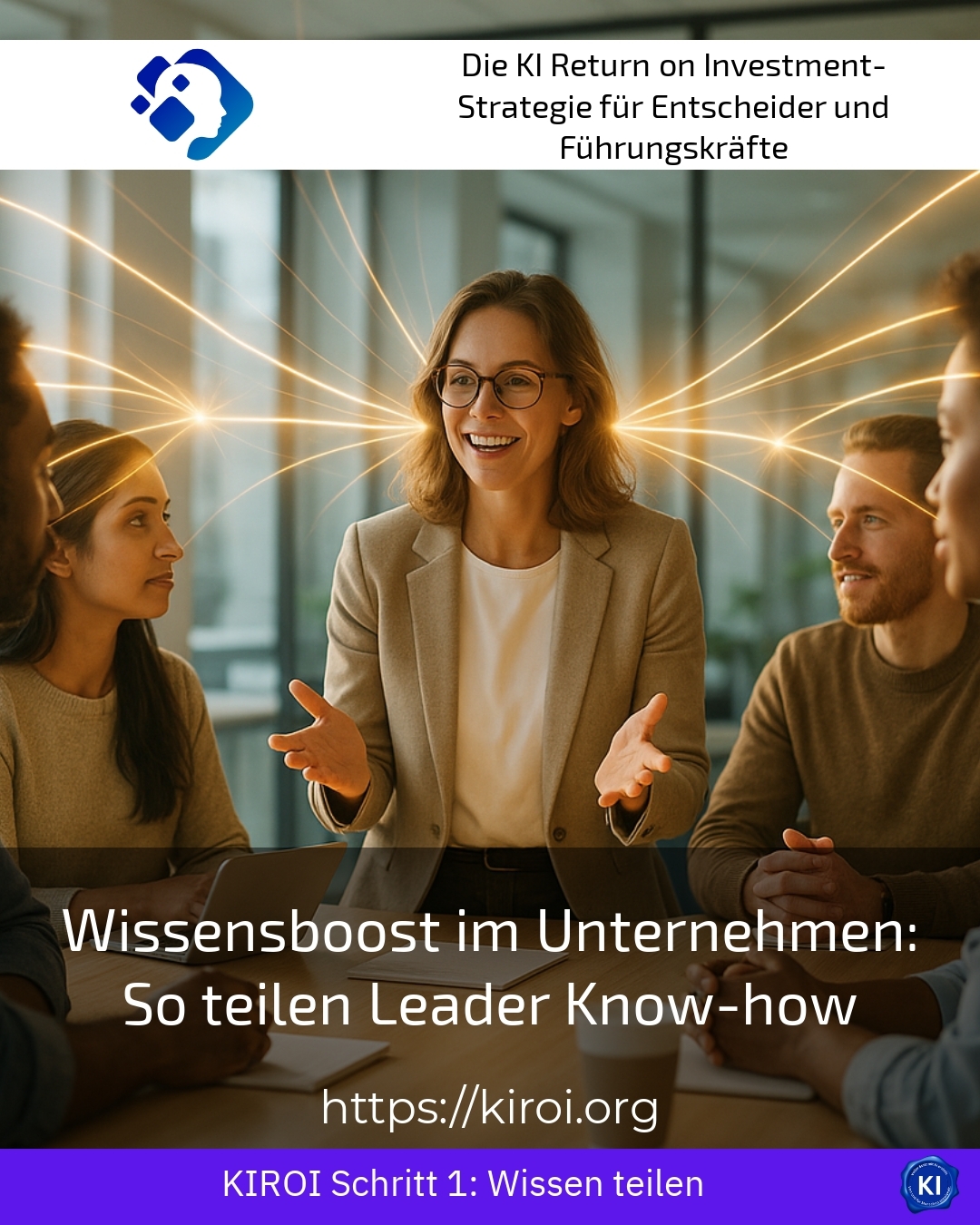
Imagine if all the experience and knowledge of your most seasoned leaders could become accessible to every employee within a matter of weeks. This is precisely the transformation that numerous organisations are currently undergoing by systematically implementing a Knowledge boost in the company Initiate. Leaders who actively share their expertise not only create measurable added value for their teams but also simultaneously establish a sustainable learning culture that extends far beyond traditional training formats. The crucial question is no longer whether knowledge should be shared, but rather how this process can be designed to be structured, efficient, and above all, impactful.
Why a knowledge boost in companies has become indispensable today
The modern world of work is changing at a speed that presents significant challenges for many organisations. Experienced leaders possess a wealth of implicit knowledge that often only exists within their minds. This knowledge risks being lost when employees leave the company or retire. At the same time, younger generations expect transparent access to information and development opportunities. They want to understand why decisions are made and what experiences lie behind them. Systematic knowledge transfer supports these expectations and promotes engagement in the long term.
In the automotive industry, for example, executives frequently report that complex production processes are only fully understood by a few specialists. If these experts are unavailable, delays and quality issues arise. Similar situations are found in mechanical engineering, where detailed technical knowledge has often grown over decades. In the chemical industry too, empirical values play a central role in process optimisation. These sectors impressively demonstrate how valuable structured knowledge transfer can be.
Best practice with a KIROI customer
A medium-sized mechanical engineering company faced the challenge that several experienced production managers would be retiring simultaneously. Management recognised the risk of a massive loss of knowledge early on and decided to seek professional support from transruptions-Coaching. Together, we developed a structured programme for knowledge extraction and documentation. The experienced managers were supported in transferring their implicit knowledge into tangible formats. We created video tutorials explaining complex machine settings. Additionally, detailed decision trees were developed for critical production situations. The successors received intensive mentoring sessions with their predecessors over several months. Through this structured approach, the company managed to ensure a nearly seamless transition. Production quality remained consistent, and the onboarding time for the new managers was significantly reduced. Today, the company also uses the developed formats for onboarding new employees at other levels.
Practical Methods for Systematic Knowledge Transfer by Leaders
Managers who want to share their knowledge effectively need concrete tools and methods. A proven technique is storytelling, where experiences are conveyed in the form of stories. This method leverages the natural human tendency to remember stories better than abstract facts. In the logistics industry, for example, successful managers rely on regular experience-sharing sessions where critical situations are analysed together. In retail, short video messages have proven effective, with managers sharing their assessments of current market developments. The pharmaceutical industry often uses structured mentoring programmes to impart regulatory knowledge.
Another effective method is so-called reverse mentoring. In this approach, experienced managers learn from younger employees and vice versa. This exchange promotes mutual understanding and bridges generational divides. This method is used particularly frequently in the IT industry. Here, older managers benefit from the technical know-how of young developers. At the same time, junior staff gain valuable insights into strategic decision-making processes. This approach is also becoming increasingly important in the financial sector.
The Knowledge Boost in the Company through Digital Platforms
Modern technologies are opening up completely new possibilities for knowledge exchange. Internal wikis, learning platforms and collaboration tools enable location-independent access to expert knowledge. In the energy sector, many companies are already using digital knowledge management systems. These systems store not only documents but also experience reports and best practices. The telecommunications sector often uses chatbots that have been trained on the knowledge of experienced employees. This allows basic technical knowledge to be accessed around the clock. In the healthcare sector, platforms are increasingly being created where medical staff can exchange case studies and treatment experiences.
However, the implementation of such systems requires careful planning and support. Technology alone does not create a culture of knowledge sharing. Leaders must lead by example and embody the use of the platforms. Only then can an authentic learning culture be created, which is supported by all employees. Transruption coaching can provide valuable impulses for such projects and support the change process.
Best practice with a KIROI customer
An internationally operating logistics company wanted to systematically capture and make accessible the experiential knowledge of its branch managers. The challenge lay in the fact that each branch had to take its own specific characteristics and local circumstances into account. As part of our transruption coaching support, we first developed a competence model that identified the critical knowledge areas. We then conducted structured interviews with the most experienced managers. These discussions were recorded and transformed into short learning modules. The practical examples from the day-to-day operations of the branches were particularly valuable. A manager from Southern Germany shared his experiences with difficult customs procedures. A colleague from the North explained her strategy for working with port authorities. The resulting knowledge archive is now extensively used by new managers during their induction. Feedback shows that clients feel significantly better prepared for their tasks through these materials.
The Role of Leadership Culture in a Sustainable Knowledge Boost in the Company
Knowledge transfer only works in an environment that fosters openness and trust. Leaders must first be willing to share their own knowledge. This often requires a change of mindset, as knowledge has traditionally been viewed as a source of power. Those who share their knowledge seemingly make themselves replaceable. This fear prevents many leaders from actively passing on their know-how. A modern leadership culture resolves this conflict. It recognises and rewards those leaders who successfully develop others. In the insurance industry, some companies have already established corresponding incentive systems. There, the development of successors is incorporated into the performance appraisal of leaders.
In the renewables sector, companies are demonstrating what an open knowledge culture can look like. Lessons learned workshops are regularly held, analysing both successes and failures. The construction industry is experimenting with cross-project knowledge databases to disseminate best practices more quickly. In the food industry, some corporations organise regular expert exchanges between different sites. These examples illustrate the variety of possible approaches.
Overcoming barriers and constructively using resistance
Every change initiative meets with resistance, and systematic knowledge transfer is no exception. Some employees fear losing importance through shared knowledge. Others see the time required for documentation and training as a burden. These concerns should be taken seriously and addressed openly. Transruptions coaching supports organisations in transforming such resistance into constructive energy. Clients often report that targeted discussions were the first to reveal the true causes of hesitancy.
In the steel industry, for example, it became clear that older skilled workers were willing to share their knowledge. However, they felt overwhelmed by digital tools. The solution was a combination of personal conversations and technical support. In the banking sector, the problem was often the heavy workload. Here, clear time allocations for knowledge activities helped. The textile industry is experimenting with gamified approaches to make knowledge sharing more appealing.
Best practice with a KIROI customer
A medium-sized family business in the packaging industry struggled with a pronounced silo culture. The various departments worked largely in isolation from one another. Valuable knowledge remained trapped within individual areas and could not be utilised across departments. As part of our transruptions coaching support, we initially organised cross-departmental workshops. In these events, the managers learned about the challenges faced by other departments. Surprising insights into potential synergies emerged. The production manager discovered that his experience with material efficiency was also relevant to the logistics department. The sales manager shared customer feedback that provided valuable impetus for product development. These workshops evolved into a regular management exchange. Today, the department heads meet monthly for structured knowledge sharing. Company management reports significantly improved collaboration and faster decision-making processes. While the silo culture has not completely disappeared, the barriers have become noticeably lower.
My KIROI Analysis
The discussion around systematic knowledge transfer in organisations repeatedly shows me how underestimated this topic still is in many companies. Leaders possess a tremendous wealth of experience that often remains untapped or is lost when they leave. However, the positive effects of structured knowledge transfer are visible across all industries. Companies that actively shape this process report shorter onboarding times and higher employee satisfaction. They experience improved innovation capabilities and more resilient structures. Investing in knowledge transfer pays off in the long term, even if the immediate benefit is not always directly measurable [1].
From my experience with disruption coaching projects, I can confirm that success is significantly dependent on the leadership culture. Technical solutions and structured processes are important, but not sufficient. It requires leaders who lead by example and authentically demonstrate their willingness to share. Accompanying such transformation processes requires patience and a deep understanding of organisational dynamics [2]. Clients often report that it was only through external support that the necessary objectivity and structure were brought into the process. The results speak for themselves and motivate more and more organisations to embark on this path. The Knowledge boost in the company is not a one-off action, but a continuous process that must be permanently maintained [3].
Further links from the text above:
[1] McKinsey – Why Knowledge Management Matters
[2] Harvard Business Review – The Leader as Coach
[3] Deloitte – Knowledge Sharing in Organisations
For more information and if you have any questions, please contact Contact us or read more blog posts on the topic Artificial intelligence here.











 Deutsch
  English (UK)