
Have you ever wondered why your company is still struggling with the same problems as before the digital transformation, despite expensive technology investments? The answer might surprise you and come as a relief at the same time, because it does not lie in even more algorithms or even more complex systems. Rather, an uncomfortable truth is revealed that many leaders only recognise after costly experiments: the best AI solution sometimes requires no artificial intelligence at all. This realisation may sound paradoxical at a time when companies worldwide are investing billions in machine learning and neural networks. Yet it is precisely for this reason that it deserves special attention, as it touches the core of strategically clever digitalisation.
The blind spot of modern businesses: when a belief in technology becomes a trap
In production halls and assembly lines, we have been observing a recurring pattern for years that appears both fascinating and concerning. Average companies have got into the habit of reflexively searching for an AI application for every emerging problem without first critically questioning whether this complexity is necessary at all. For example, a medium-sized mechanical engineering company invested six-figure sums in a neural network for quality control, even though simple optical sensors with firmly defined threshold values would have served the same purpose. An automotive supplier experienced something similar, spending months working on a predictive maintenance system based on deep learning, whereas a simple control loop with limit value monitoring could already have reliably predicted machine failures [1].
This phenomenon has profound causes that go far beyond a lack of technical understanding and lead directly into the psychology of decision-makers. The pressure to appear innovative, combined with the fear of missing the digital boat, drives companies into costly projects that frequently promise more prestige than utility. Added to this is a consulting landscape that naturally favours complex and therefore higher-margin solutions, rather than pointing out pragmatic alternatives. A manufacturer of precision tools recently reported that three different consulting firms had recommended AI-based systems to it without exception, even though its actual problem lay in inadequate data collection.
The best AI solution starts with the right question
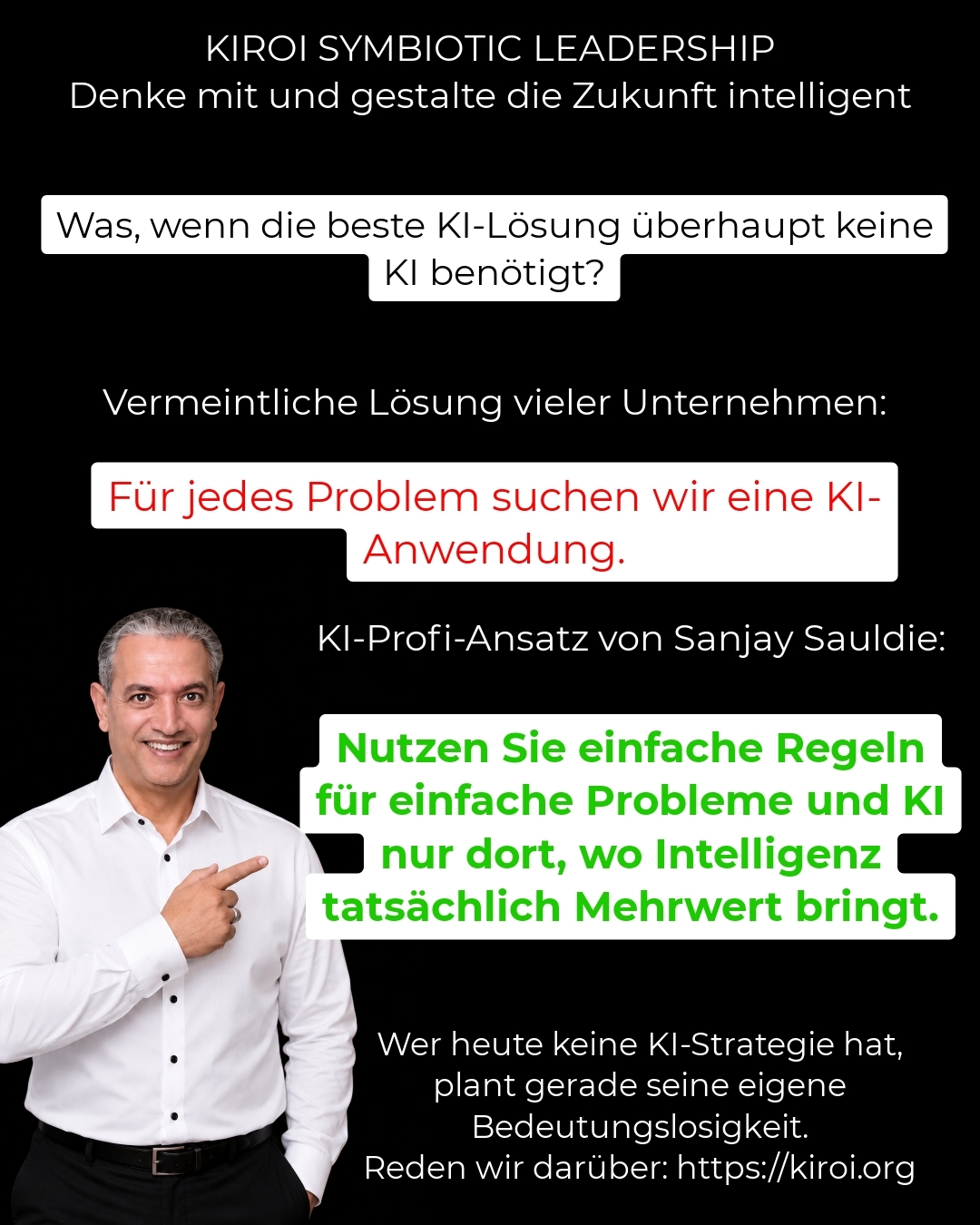
The AIROI approach we use when supporting digitalisation projects puts a fundamental question at the start of every consideration: does this problem actually require intelligence, or does a clever rule suffice? This distinction may seem trivial, but it turns out to be a crucial signpost for resource-efficient and sustainable solutions. In industrial practice, it repeatedly becomes clear that a large proportion of supposedly complex challenges can be traced back to deterministic patterns that can be elegantly solved with simple if-then logic.
Let us consider the example of warehousing in a drive technology component plant, where AI-supported inventory management was initially planned. However, careful analysis revealed that demand fluctuations were by no means chaotic, but rather followed clear seasonal and customer-related patterns. Instead of a learning algorithm, the company ultimately implemented a rule-based system with dynamic minimum inventory levels, which was not only more cost-effective, but also more transparent and easier to maintain. Similar insights were gained by an industrial pump manufacturer that successfully optimised its production planning using Excel-based heuristics, while the competition was still struggling with oversized AI projects.
Best practice with a AIROI customer
A medium-sized manufacturer of hydraulic components approached our transruptions coaching with a request to develop an AI system for error diagnosis in assembly. The initial situation seemed complex at first, as the error rate stood at a troubling four percent and was causing substantial rework costs and customer complaints. During the accompanying phase, we jointly analysed the actual error patterns and made a surprising discovery that transformed the entire project. Over eighty percent of all assembly errors could be traced back to precisely seven recurring causes, all of which could be identified using simple testing routines. Instead of training a neural network, we implemented a traffic-light system with clear checkpoints and visual work instructions. The employees were provided with tablets running a simple app that guided them through every critical assembly step and required confirmations. The result exceeded all expectations, as within three months the error rate dropped to below one percent. The investment amounted to a fraction of the originally budgeted AI spend, while employee acceptance was significantly higher because they understood and helped shape the system. This project exemplifies how the best AI solution sometimes consists of the deliberate decision against artificial intelligence.
Where artificial intelligence is truly becoming indispensable
The emphasis on simple solutions by no means implies a general rejection of AI technologies, but rather a differentiated view of their application areas. There are indeed problems where machine learning offers a real and substantial added value that could not be achieved with conventional methods. The art lies in the precise identification of these use cases and in the honest assessment of when complexity is justified.
In the surface inspection of body panels, for example, rule-based systems truly reach their limits because the variability of the defect patterns is too great and too subtle for rigid algorithms. Here, convolutional neural networks demonstrate their justified strength by learning from thousands of example images to recognise even unknown types of defect. The situation is similar in process optimisation in continuous manufacturing processes, where numerous interdependent parameters have to be adjusted in real time and human intuition reaches the limits of its capacity [2].
A foundry successfully implemented a reinforcement learning system that autonomously optimises melting parameters, achieving energy savings of twelve percent. A manufacturer of precision turned parts uses machine learning to predict tool wear, with the algorithms recognising subtle patterns in the process data that remain invisible to human analysts. These examples show that genuine AI competence does not lie in unreflective application, but in the clever selection of areas of use.
The AIROI principle in practice: A decision-making framework
The approach we support follows a structured decision tree that helps companies identify the right technology level for every problem. First, we examine whether the problem should be solved technologically at all, or whether organisational measures would be more effective. This question is asked surprisingly seldom, yet frequently leads to the most elegant solutions. An agricultural machinery supplier reduced its setup times by thirty percent, not through automation, but through a simple reorganisation of tool provision.
In the second step, we analyse the problem structure for determinism and variability. If the behaviour can be described completely by known rules, we consistently recommend rule-based systems. A packaging machine manufacturer successfully automated its quote configuration using an expert system based on explicit specialist knowledge that requires no training whatsoever. Only when genuine uncertainty exists and patterns must be recognised that cannot be explicitly formulated does machine learning come into focus.
The best AI solution recognises its own limits
A hybrid approach that intelligently combines different technology layers and leverages their respective strengths proves particularly valuable. In the quality assurance of an electric motor manufacturer, a layered system operates that performs simple dimensional checks with classic tolerance comparisons, while complex acoustic tests are left to a trained classifier. This architecture ensures maximum efficiency with minimal complexity because each component does precisely what it is best suited for.
A custom machinery manufacturer combines rule-based plausibility checks with an AI module for anomaly detection. The simple checks catch obvious errors, while the neural network is responsible only for subtle deviations. This multi-stage approach significantly reduces the training requirement while simultaneously increasing the robustness of the overall system. Experience shows that such hybrid architectures are frequently superior in industrial practice because they combine transparency and adaptability.
Best practice with a AIROI customer
A family-run manufacturer of gearboxes for industrial applications was faced with the challenge of optimising its maintenance and reducing unplanned downtime. The original plan envisaged a comprehensive predictive maintenance system incorporating vibration analysis and machine learning, with implementation estimated to take two years. As part of our ‘transruptions’ support, we proposed a phased approach that gradually increased the level of complexity. In the first phase, we implemented simple threshold monitoring for critical parameters such as temperature, pressure and current consumption. This measure cost a fraction of the original budget and already reduced unplanned downtime by thirty-five per cent. For the remaining, more difficult-to-predict outages, we only developed a machine learning model in a second phase, which was trained on the data that had now been accurately recorded. Today, the overall solution combines simple control loops for known fault modes with intelligent algorithms for complex degradation patterns. The key advantage of this approach lay not only in the lower costs, but also in the organisational learning curve the company underwent, which enabled digital expertise to be firmly embedded within the organisation.
Cultural shift as a prerequisite for smart technology decisions
The implementation of the AIROI principle requires more than technical knowledge and goes far beyond the pure selection of tools. It demands a cultural change that places pragmatism above prestige and has the courage sometimes to choose the unspectacular solution. In many manufacturing companies, we observe a dynamic in which AI projects serve as status symbols and their existence appears more important than their actual benefit [3].
A machine tool manufacturer reported that its executive board initially reacted with disappointment when the digitalisation team proposed a rule-based rather than an AI-based solution. Only the sober comparison of costs, risks and benefits led to the realisation that the simpler solution actually served the company better. This example illustrates how important an objective decision-making culture is for successful digitalisation and how transruptional coaching can help to guide such processes of reflection.
My AIROI Analysis
The central insight of this article can be summed up in a seemingly paradoxical sentence: true AI competence is demonstrated by knowing when artificial intelligence should not be used. Companies that develop this maturity avoid costly misallocations and concentrate their resources where they generate the greatest leverage. The best AI solution is the one that actually solves the problem, regardless of whether it is based on neural networks or simple if-then logic. For industrial practice, this specifically means that every digitalisation project should begin with an honest problem analysis that does not view complexity as an end in itself. The question of the appropriate technology level deserves the same attention as the question of the right algorithm or the suitable platform. Experience shows that companies pursuing this approach report faster implementations, higher employee acceptance and more robust systems. They develop a digital sovereignty that makes them less dependent on technology trends and positions them more competitively in the long term. The AIROI approach is not a rejection of innovation, but rather its refinement through strategic cleverness.
Further links from the text above:
[1] McKinsey – AI in Production: Opportunities and Limits
[2] Fraunhofer – Industrial AI Applications
[3] Harvard Business Review – Artificial Intelligence Insights
Are you a leader and would you like to learn how you can genuinely introduce AI into your company in a valuable and sustainable way, away from the hype? Take part Contact us or read more blog posts on the topic Artificial intelligence here.











 Deutsch
  English (UK)