
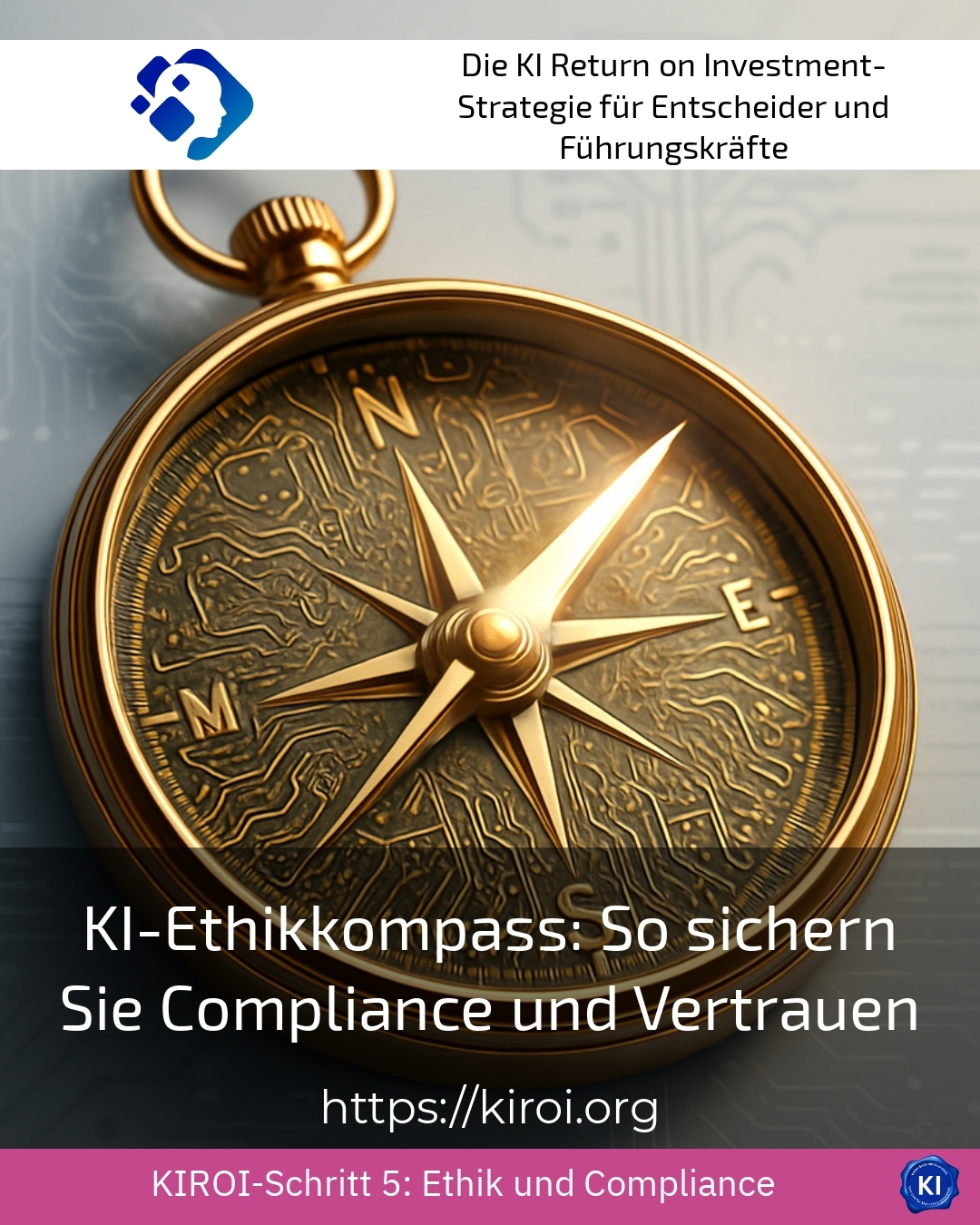
Imagine your intelligent systems making decisions that no one else can understand. Customers lose confidence, regulators are knocking on the door. This is exactly where the AI Ethics Compass: How to Ensure Compliance and Trust Nowadays, as algorithmic decisions permeate our daily lives, ethical orientation becomes a crucial competitive advantage. Companies face the challenge of combining technological innovation with moral responsibility. This article shows you concrete ways to achieve this balance.
Why ethical guardrails are indispensable today
The rapid development of intelligent technologies is fundamentally changing business models. Automated systems are taking on tasks that were previously reserved for humans. This shift carries significant risks if ethical principles are lacking. Algorithms can reinforce prejudices and reproduce discriminatory patterns. Therefore, companies need a reliable AI Ethics Compass: How to Ensure Compliance and Trust in all areas.
In the financial sector, for example, banks use intelligent systems for lending. One institute found that its algorithm systematically discriminated against certain population groups [1]. The consequences were severe: damage to reputation and regulatory investigations. Another example is seen in the insurance industry. There, systems analyze risk profiles, with opaque evaluations leading to customer dissatisfaction. Investment firms are also relying on automated trading strategies. These can trigger market turmoil due to faulty algorithms.
These examples illustrate a central insight: technology alone does not solve problems. Rather, a holistic approach that incorporates human values is needed. Transruptive coaching supports organizations in precisely this challenge by helping them connect technological projects with ethical responsibility.
The AI ethics compass as a strategic tool
A well-thought-out ethical framework serves as a navigational aid in complex situations. It defines principles that all parties can orient themselves by. It is not about rigid rules, but about flexible guidelines. These enable innovation while simultaneously setting clear boundaries. The AI Ethics Compass: How to Ensure Compliance and Trust connects abstract values with concrete action.
In the banking sector, institutions are increasingly implementing ethics committees for algorithmic decision-making. These committees review new applications before deployment. They systematically assess the potential impact on different customer groups. For example, a large credit institution has introduced a transparency report [2]. This explains to customers how decisions are made. In asset management, fund management companies rely on comprehensible valuation models. They document which factors influence investment decisions. Payment service providers are also revising their fraud detection systems. They ensure that legitimate transactions are not mistakenly blocked.
Best practice with a AIROI customer
A mid-sized financial services company faced a significant challenge when implementing an automated advisory system. The management wanted to increase efficiency while meeting regulatory requirements. However, initial tests showed that the system preferred certain investment products. These recommendations were not solely based on customer needs but also on commission structures. AIROI As part of the onboarding process, the team developed a multi-stage review process. First, experts analyzed the system’s decision logic in detail. Subsequently, they defined clear criteria for fair recommendations. The company also conducted regular audits by external auditors. An ethics officer has since continuously monitored the system’s spending. Customers now receive transparent explanations for each recommendation. Satisfaction levels increased significantly after the switch. The supervisory authority also evaluated the new approach positively. The project impressively demonstrates how ethical guidelines and economic success can go hand in hand. The time invested has repeatedly paid off.
Transparency as a foundation of trust
Trust is built through clarity and openness towards stakeholders. Customers want to understand why certain decisions are made. This expectation is particularly important in sensitive financial matters. Transparent communication thus becomes a competitive advantage. It clearly distinguishes responsible providers from their competitors.
Private equity firms use intelligent systems to evaluate potential investments. They must explain to investors what factors influence the selection process. Asset managers rely on automated portfolio adjustments for their clients. Investors expect clear explanations for every transaction. Neobanks that operate entirely digitally also face this challenge. Their chatbots and decision systems must operate in a comprehensible manner. Clients often report that this very transparency strengthens their loyalty.
Understanding compliance as a living process
Regulatory requirements are continuously evolving and becoming more complex. What is compliant today may already be outdated tomorrow. Companies must therefore establish agile structures for their compliance work. A rigid set of rules is no longer sufficient. Instead, dynamic processes are needed that anticipate changes.
Major banks are now implementing continuous monitoring systems for their algorithms. These systems automatically detect deviations from defined fairness criteria. Insurance companies are regularly adapting their risk models to new findings [3]. This prevents outdated assumptions from leading to incorrect decisions. Securities services providers also regularly review their trading algorithms. They ensure that they continue to comply with regulatory standards. The transruptions coaching provides insights on how to sustainably design such processes.
The AI Ethics Compass in practical application
Implementing ethical guidelines requires a systematic approach and perseverance. First, organizations should comprehensively analyze their existing systems. In doing so, they identify potential risk areas and areas for action. Subsequently, they develop specific principles for each use case. These principles are then translated into concrete instructions for action.
For example, a credit card company overhauled its scoring process. It ensured that demographic characteristics had no undue influence. An investment bank conducted simulations to test potential market effects. This prevents its algorithms from having destabilizing effects. Robo-advisors are also optimizing their recommendation logic according to ethical criteria. They consciously balance return expectations with risk disclosure.
Best practice with a AIROI customer
A regionally operating savings bank wanted to support its customer advisory services through intelligent systems. The goal was to relieve advisors and at the same time improve service quality. However, the initial pilot phase revealed unexpected difficulties in system acceptance. Customers did not feel sufficiently individually supported by standardized recommendations. Advisors, in turn, perceived the system as a limitation of their professional expertise. As part of the coaching process AIROI, the project team developed a new approach. The system was positioned as a support tool rather than as a decision-making authority. Advisors were given the opportunity to override and document system suggestions. This documentation is now being incorporated into the continuous improvement of the system. Customers are actively informed about the role of the system. You can always choose a personal conversation without system support. The savings bank also introduced regular feedback rounds with all parties involved. This approach significantly increased both employee and customer satisfaction. The example shows that technological solutions must take human needs into account. Only in this way can sustainable added value be created for all parties.
Employees as the key to ethical transformation
Technology alone cannot solve ethical challenges; that is a given. People remain indispensable for the interpretation and application of principles. Therefore, organizations must invest in the development of their teams’ competencies. Trainings raise awareness of ethical issues in everyday work. They empower employees to recognize critical situations and to act appropriately.
Leading financial institutions are now establishing special ethics training programs for IT teams. These not only provide technical knowledge but also moral judgment. Wealth managers learn to critically question automated recommendations. They continue to take responsibility for final client advice. Compliance departments are also expanding their expertise to include technological aspects. This allows them to better assess the functioning of algorithms.
Actively engage in stakeholder dialogue
Ethical decisions affect many stakeholders with different expectations. A constructive dialogue with all parties involved is therefore essential. This dialogue should be proactively conducted, not only when problems arise. It creates understanding and enables joint solution finding. Moreover, it strengthens societal acceptance of technological innovations in a sustainable way.
Major banks invite consumer advocates to consult on new systems. They constructively integrate their perspectives into product development. Fund management companies openly communicate about their investment criteria and methods [4]. They thus enable investors to make informed decisions about investments. Payment service providers are also actively seeking exchanges with data protection experts. This enables them to continuously improve their processes in a preventive manner.
My AIROI Analysis
Addressing ethical issues in intelligent systems is no longer an option; it has become an imperative necessity for future-proof organizations. The financial sector is particularly in the spotlight of public attention. Decisions are being made here that directly affect people's lives. A well-informed AI Ethics Compass: How to Ensure Compliance and Trust offers guidance in this complex environment.
My experience from numerous mentoring projects paints a clear picture. Companies that address ethical issues early on are more successful in the long run. They effectively avoid costly after-sales repairs and regulatory conflicts. At the same time, they gain the trust of customers and employees in a lasting way. This trust cannot be bought through marketing. It must be earned through consistent action, day by day.
The biggest challenge lies in translating abstract principles into concrete processes. This is where transruptive coaching comes in and supports the implementation. It helps teams develop their own solutions for specific contexts. After all, standard recipes rarely work reliably in complex environments. Instead, customized approaches that fit the organizational culture are needed.
Looking ahead shows that ethical competence is becoming a differentiating factor. Customers are increasingly sensitive to questions about algorithmic fairness. Regulators are tightening their requirements for transparency and accountability. Companies that invest today secure their competitive position for tomorrow. The path may be challenging, but it is definitely worth it.
Further links from the text above:
[1] BaFin – Supervision of Banks and Financial Services Providers
[2] Deutsche Bundesbank – Banking Supervision
[3] EU Artificial Intelligence Act
[4] ESMA – European Securities and Markets Authority
For more information and if you have any questions, please contact Contact us or read more blog posts on the topic Artificial intelligence here.









 Deutsch
 English (UK)