
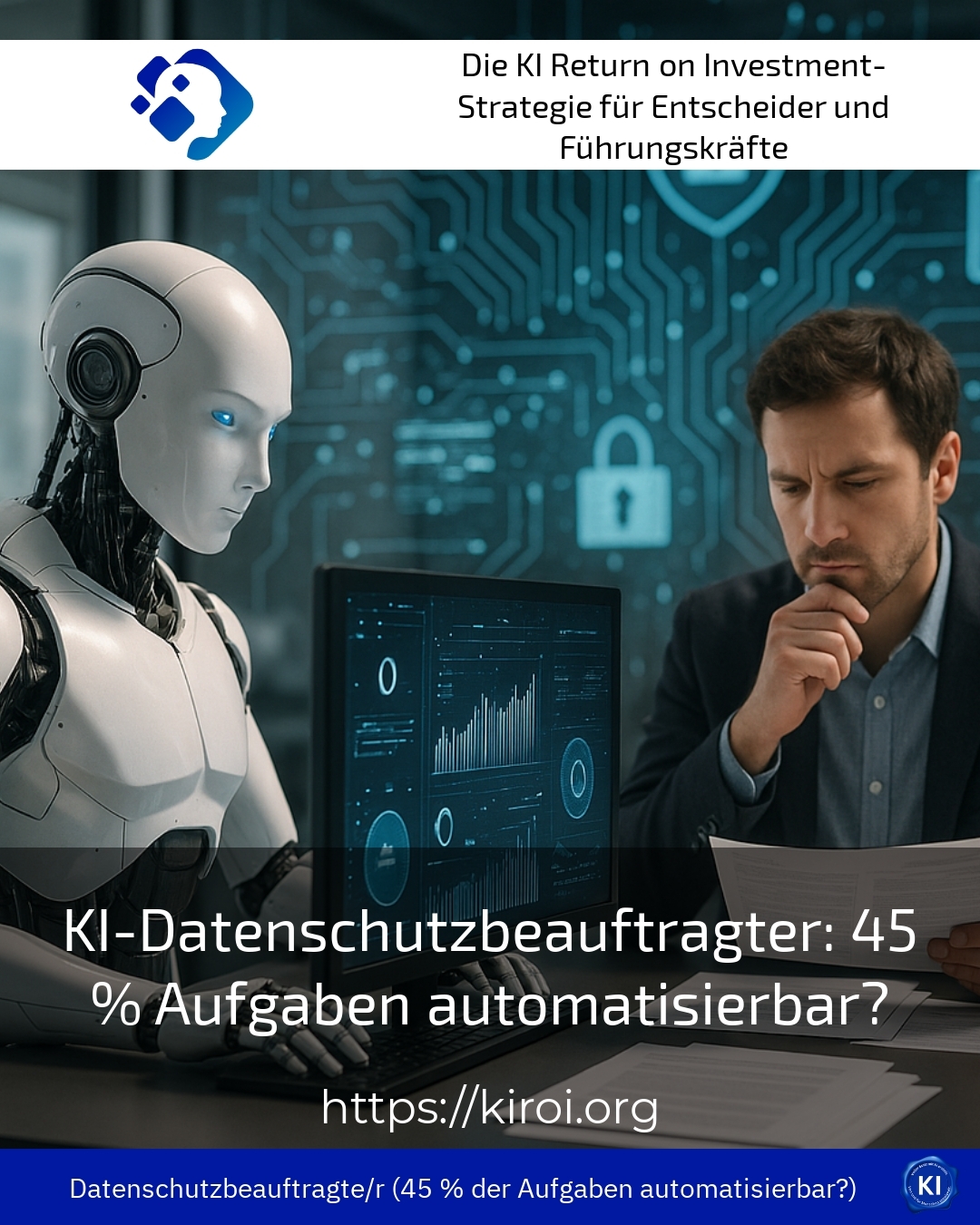
Will intelligent algorithms soon make the sensitive decisions regarding our personal data, or will humans remain indispensable? This question currently concerns many professionals working in the field of data protection and compliance, because current studies reveal a remarkable picture: Approximately 45 percent of the tasks of a AI Data Protection Officer These findings raise fundamental questions about the future of the profession, the need for human expertise, and the opportunities that arise for professionals who are willing to continue developing and acquiring new skills.
The basis for this analysis comes, among other things, from the Job Futureometer of the Institute for Employment Research [1]. This scientific tool systematically assesses the potential for automation in various occupational fields. For all professionals working in this sensitive area, the AIROI strategy a structured approach for further development. Interested parties can find the corresponding seminars, lectures, and workshops under the current schedule [2]. There you will receive practical insights on how to actively shape the transformation.
The reality of automation in the data protection field
The discussion about the AI Data Protection Officer And the automation of its tasks requires a differentiated consideration first of which activities could actually be replaced by machines. Routine tasks such as documenting processing activities, creating standardized privacy impact assessments, or monitoring access logs can already be supported by specialized software today. Many companies rely on automated compliance management systems that detect violations and generate reports. In the financial sector, for example, algorithms analyze millions of transactions daily for suspicious patterns. Insurance companies use automated systems to review consent forms. In healthcare, digital solutions are increasingly being used to examine patient data for anomalies.
Nevertheless, practice shows clear limitations to automation. Interpreting complex legal issues, balancing entrepreneurial interests with data protection obligations, and communicating with regulatory authorities require human judgment. An algorithm can identify a potential violation, but it cannot capture the nuances of a single case. It does not understand the political implications of a decision. It cannot engage in negotiations with critical stakeholders.
Best practice with a AIROI customer A medium-sized company in the e-commerce sector faced the challenge of modernizing its data protection processes without losing its personal expertise. In the framework of a AIROI workshop, we jointly analyzed the existing processes and identified specific areas where automated support seemed useful. The team implemented a system for the automatic collection and categorization of incoming requests from data subjects, which reduced the response time by more than 60 percent. At the same time, the responsible parties defined clear escalation levels in which human experts were absolutely required to be involved. The deletion routines for customer data were automated, but the final approval remained with the professional staff. After six months, the company reported a significantly improved compliance rate and happier employees who were now able to focus on more demanding tasks.
What competencies remain indispensable for the AI Data Protection Officer?
The question of the remaining 55 percent of non-automatizable tasks leads us to the core competencies that will also be required in the future by human experts. Strategic consulting for management is at the forefront, as executives and managing directors need a competent sparring partner who can assess risks and provide recommendations for action. Developing data protection strategies for new business models requires creative thinking and a deep understanding of technological developments. In the banking sector, experts advise on, for example, the implementation of open banking interfaces. Telecommunications providers need support in designing IoT services in a data protection-compliant manner. Production companies seek advice on the implementation of Industry 4.0 solutions.
Training and awareness-raising for employees remains a deeply human task. While e-learning modules can provide basic knowledge, answering individual questions and creating a real data protection culture require personal interaction. Experienced professionals often report that it is precisely the informal conversations at the fringes of training that provide the most valuable insights. In hospitals, for example, such dialogues lead to a better understanding of the sensitivity of patient data. In law firms, for example, such dialogues lead to stricter client confidentiality. Retail companies create awareness about handling customer data.
The ethical dimension of automated decision-making
A particularly exciting aspect concerns the ethical implications of automated data protection decisions. When an algorithm decides whether data processing is permissible, who then bears responsibility for incorrect decisions? This question is increasingly also being addressed by courts and supervisory authorities. The human factor AI Data Protection Officer It serves as an indispensable corrective here. It critically questions the results of automated analyses. It takes societal values and ethical principles into account. It balances different interests against each other. In the pharmaceutical industry, for example, complex questions arise regarding the use of health data for research purposes. Social networks must balance the protection of privacy against the right to free expression. Employers face the challenge of protecting employee data while simultaneously fulfilling operational needs.
Best practice with a AIROI customer An international automotive company wanted to introduce an automated system to assess data protection risks in new projects, but encountered significant resistance from the workforce. Employees feared that their expertise would be undermined and that the system could lead to rigid decision-making. As part of a AIROI mentoring program, we jointly developed a hybrid model in which automated risk assessment serves as a supporting tool, not as a decision-making authority. The professionals received training on how to interpret the system’s results and incorporate them into their advice. The tool now provides informed data analyses, while the final recommendations are formulated by experienced experts. Acceptance increased significantly, and the quality of the advisory service improved measurably. Especially in the case of cross-border data transfers, the combination of machine analysis and human expertise proved particularly valuable.
Transformation opportunities through AIROI the strategy
The AIROI strategy offers a structured framework for professionals who want to strengthen their position in an increasingly automated working world. The approach helps people identify and develop their unique strengths. The ability to perceive technological developments not as a threat but as a tool appears particularly important. In the media industry, experts learn how to use automated content analysis for data protection audits. Logistics companies discover how GPS tracking and data protection can be combined. Educational institutions develop data protection-compliant concepts for digital learning.
The workshops provide practical skills for dealing with algorithmic decision systems. Participants learn to understand the functioning of machine learning without having to become programmers themselves. They develop a critical awareness of the limitations of automated systems. They practice communicating complex technical concepts in an understandable way. In the energy sector, for example, this knowledge helps evaluate smart meter data. Shipping companies benefit from analyzing customer profiling. Human resources providers improve their advice on automated recruitment processes.
Shaping the future as an AI data protection officer
Looking to the future shows that the role of the data protection expert will change, but it by no means has to disappear. Rather, a new professional profile is emerging that combines technological expertise with legal and ethical understanding. Professionals who are positioning themselves today can actively contribute to this development. They become bridges builders between the technical and legal worlds. They act as translators between algorithms and humans. They take on the role of guardians over digital self-determination. In the field of public administration, new consulting offerings for e-government projects are emerging. Startups in the field of artificial intelligence require qualified expertise in ethical guidelines. Large technology corporations are increasingly seeking professionals who understand both worlds.
Best practice with a AIROI customer A group of data protection experts from various industries participated in a AIROI series of seminars to prepare together for the challenges of increasing automation. During the workshops, the participants developed a network for regular exchange of experiences that continues beyond the actual event. Together, they developed evaluation criteria for automated data protection tools that they will use in their respective organizations. One participant from the insurance industry reported how he used these criteria to reject an unsuitable system and instead implement a more suitable solution. Another participant from the healthcare sector developed a training concept for her clinic based on the insights gained. The group meets regularly to discuss current developments and learn from each other.
My AIROI Analysis
The analysis of the automation potential in the field of data protection reveals a differentiated picture that provides neither cause for panic nor complacency. The mentioned 45 percent of tasks that can be automated mainly concern routine activities that are already often perceived as not fulfilling their purpose today, while the remaining tasks encompass precisely those activities that require human expertise, ethical judgment, and communicative competence. The AIROI follow-up has shown in numerous projects that professionals who actively engage with technological developments and specifically expand their skills can emerge strengthened from the transformation process. The willingness to rethink one's own role and develop from operational routine tasks towards strategic advice and ethical reflection appears to be crucial. The examples from various industries illustrate that hybrid models that combine human expertise with automated support often deliver the best results. The future does not belong to either humans or machines, but to the intelligent interplay of both. Professionals who invest in their own development today and familiarize themselves with the possibilities and limitations of automated systems will also be able to make indispensable contributions in an increasingly digitized world. The AIROI strategy provides a proven framework that provides impetus and accompanies individual transformation.
Further links from the text above:
[2] AIROI seminars and live events with Sanjay Sauldie
For more information and if you have any questions, please contact Contact us or read more blog posts on the topic Artificial intelligence here.







 Deutsch
 English (UK)