
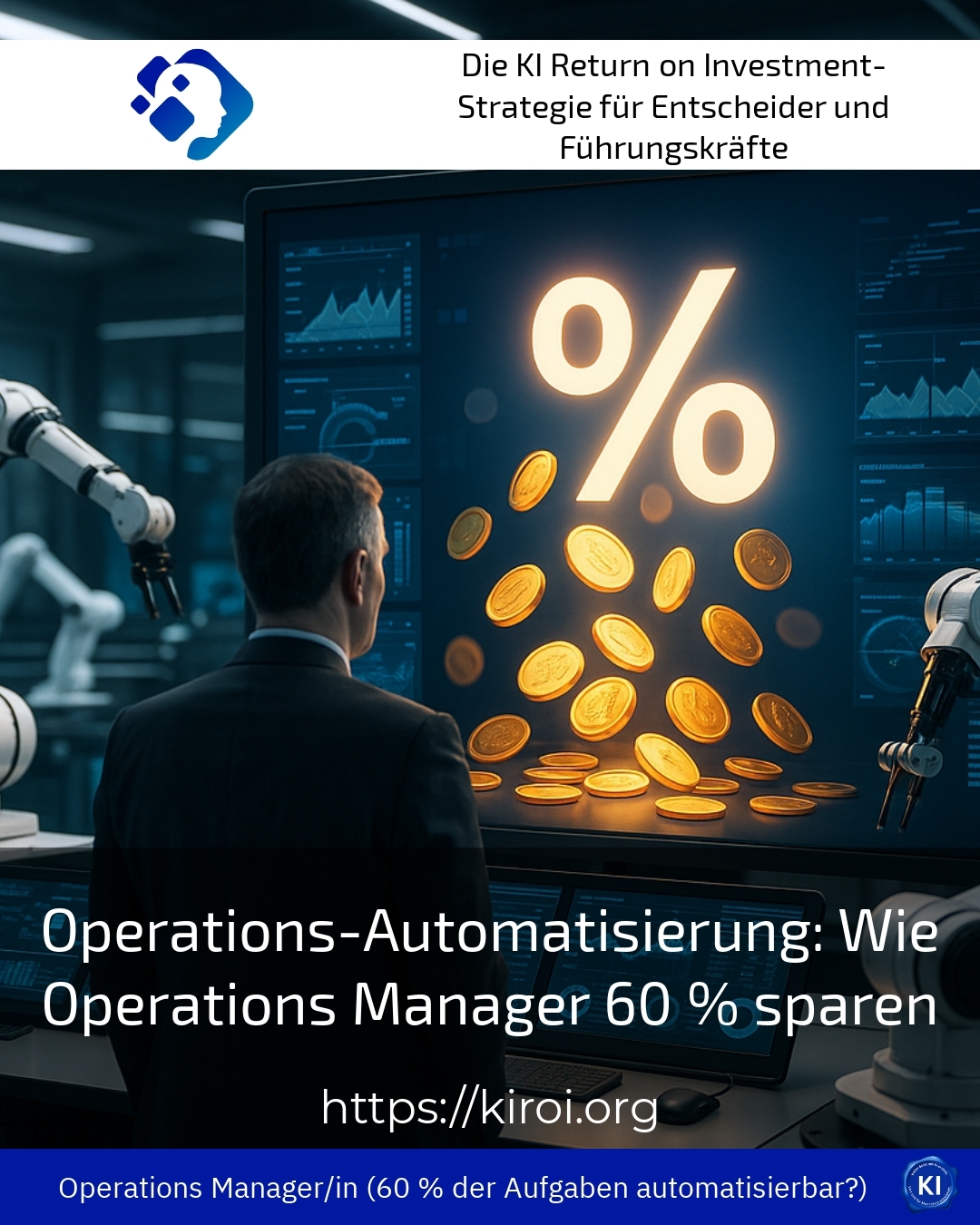
Have you ever wondered why some companies can reduce their operating costs by more than half while others, despite the latest technology, barely make any progress? The answer often lies in intelligent management. Operations automation, This concept encompasses much more than simply replacing human labor with machines. Rather, it represents a fundamental shift in the way organizations structure, monitor, and continuously improve their daily operations, with digital tools and algorithmic decision-making playing a central role.
The findings for this article come from the Job Futureometer of the Institute for Employment Research [1]. This source impressively shows which activities are already automatable today. If you are active in this field, the AIROI seminars offer valuable insights and practical guidance. The current dates can be found here. risawave.org/en/live-events-with-sanjay-sauldie/, where regular lectures and workshops take place.
Why traditional approaches reach their limits
In many organizations, we still observe processes that have hardly changed in decades, even though technological possibilities would long ago open up other paths. For example, a logistics company processes hundreds of delivery slips manually every day. Employees spend hours reconciling order numbers. The error rate increases in proportion to the fatigue of the workforce. A manufacturing plant, on the other hand, relies on visual inspections that depend on the daily form. Quality fluctuations remain inevitable and cost a lot of money. In healthcare as well, manual documentation processes lead to significant time losses. Caregivers spend up to a third of their working time on administrative tasks.
These examples illustrate a fundamental problem that affects many industries and whose solution does not lie solely in acquiring new software. Often, executives report in AIROI workshops that although they have invested in modern systems, the expected savings have not materialized. The reason often lies in the fact that the implementation was carried out without strategic guidance. The technology was introduced, but the processes remained unchanged.
Best practice with a AIROI customer A medium-sized company in the warehouse logistics sector approached us because operating costs were continuously rising while customer satisfaction was declining. The initial situation was typical for many organizations of this size, as there were numerous isolated solutions that did not communicate with each other and employees spent a significant portion of their working time manually transferring data between different systems. As part of the AIROI follow-up process, we first analyzed all processes and identified those areas that showed the greatest potential for intelligent automation. Within six months, the company implemented a comprehensive inventory management system that automatically triggers orders as soon as defined thresholds are reached. Warehouse employees received mobile devices that they could use to conduct picking and detect errors in real time. The result of this transformation was impressive, as operating costs decreased by 47 percent while delivery accuracy increased from 89 to 98 percent. The freed up capacity was used by the company to introduce express shipping, which reached new customer segments.
The three pillars of successful operational automation
Successful transformation projects always rely on a holistic approach that takes into account technology, people, and processes alike. The first pillar is process analysis, in which each individual step is documented and examined for its potential for automation. In manufacturing, this means, for example, that not only the production machines are considered but also the upstream and downstream activities such as material preparation, quality control, and packaging. In retail, this analysis encompasses the entire product chain from incoming goods to shelf management to checkout. Financial service providers, on the other hand, focus on control processes, reconciliations, and reporting.
The second pillar concerns the qualification of the workforce. Because Operations automation This does not mean that human labor is becoming superfluous. Rather, the requirements are shifting, and employees are increasingly taking on coordinating and monitoring tasks. In a call center, digital assistants handle standard inquiries, while human agents focus on complex issues. In accounting, algorithms generate routine entries, but the review of unusual transactions remains the responsibility of the professional staff. Hospitals are adopting automated scheduling, but individual patient care remains in human hands.
The third pillar encompasses the continuous monitoring and constant optimization of the implemented solutions. Automated systems generate valuable data that can be used for further improvements. For example, an energy provider analyzes consumption patterns to predict maintenance work. Transport companies analyze route data and adapt their route planning dynamically. Restaurants use sales data to optimize personnel planning and purchasing.
Typical challenges in operations automation
In the AIROI-Seminars, we are constantly confronted with similar questions that executives face. Many report on resistance within the workforce caused by a lack of communication. Others struggle with integrating new systems into existing IT environments. Still others underestimate the time required for training and mentoring their teams. We address these issues in the AIROI-strategy through structured procedures that have proven effective in various industries.
An insurance company faced the challenge of experienced claims handlers fearing being replaced. Through transparent communication and the involvement of these experts in system development, the skepticism turned into enthusiasm. A craft business, in turn, had to recognize that its previous phone and paper-based order processing was no longer up to date. The gradual introduction of digital tools, accompanied by intensive training, led to a doubling of order capacity. A hotel implemented automated check-in terminals and initially feared a loss of personal service. In fact, employees gained time for individual guest service.
Concrete savings potential through intelligent process design
The frequently cited savings of 60 percent and more are not theoretical values but are based on documented experiences from a wide variety of industries. These potential savings consist of various components. The direct personnel cost savings often only represent a part of the overall benefits. In addition, reduced error costs, faster throughput times, and improved resource utilization are also included.
In food production, automatic monitoring of cold chains enables a drastic reduction in spoilage and waste. Textile companies rely on automated cutting optimization, which reduces material consumption by up to 15 percent. Printing companies use intelligent order bundling to minimize setup times and maximize machine utilization. These examples show that Operations automation It goes far beyond simply accelerating the process.
Best practice with a AIROI customer A service company in the field of building management came to us with a specific problem. The deployment planning of the cleaning teams was carried out manually by a dispatcher who spent several hours a day coordinating the work and still achieved regularly suboptimal results because short-term changes were difficult to account for. As part of the AIROI follow-up, we developed a concept for intelligent deployment planning together with the customer that took into account various factors such as the size of the facility, cleaning intervals, travel routes, and employee qualifications. The implementation was carried out in stages, with the experienced dispatcher being involved from the outset and her expertise being incorporated into the algorithms. After full implementation, the planning effort decreased by more than 80 percent, while at the same time travel costs decreased by 23 percent because the routes were now optimized. The dispatcher now took on strategic tasks such as acquiring new properties and quality control, allowing the company to increase its order volume by 40 percent within a year without hiring additional administrative staff.
The role of Operations automation in various fields
Depending on the industry, the specific use cases vary considerably, but the fundamental principles remain the same. In healthcare, automated systems support medication dispensing and reduce the risk of mix-ups. Pharmacies use picking robots that deliver the right preparations within seconds. Nursing facilities rely on digital documentation, which significantly reduces administrative workload.
In manufacturing, connected machines enable predictive maintenance that avoids unplanned downtime. Automotive suppliers automatically coordinate their production with their customers’ demand forecasts. Furniture manufacturers use parametric design systems that enable individual adjustments without manual effort. All these examples illustrate how broad the spectrum of possibilities actually is.
Retail businesses benefit from automated ordering systems that optimize inventory levels and avoid overstocking. Department stores rely on self-checkout systems that reduce queues. Online retailers use intelligent recommendation algorithms that boost sales per customer. These developments are not only transforming internal processes but also fundamentally changing the customer experience.
My AIROI Analysis
Transforming operational processes through intelligent automation represents one of the most important strategic challenges of our time for many organizations. The experiences from numerous AIROI projects clearly show that success is significantly dependent on the quality of the accompanying support. Companies that approach automation without a structured approach often encounter avoidable obstacles, while those that rely on proven methods and experienced support regularly exceed their goals.
The AIROI-strategy offers a proven framework for addressing the diverse aspects of Operations automation to approach it systematically. The focus is not on the technology itself, but on the benefits for the organization and its employees. Executives who wish to embark on this path will find valuable insights and practical tools in the AIROI seminars, lectures, and workshops.
The coming years will show which organizations will successfully capitalize on the opportunities of automation and which will fall behind. The groundwork is being laid today. Those who act now will gain a sustainable competitive advantage that manifests itself in increased efficiency, higher quality, and happier employees.
Further links from the text above:
[1] Job-Futuromat of the Institute for Employment Research
For more information and if you have any questions, please contact Contact us or read more blog posts on the topic Artificial intelligence here.







 Deutsch
 English (UK)