
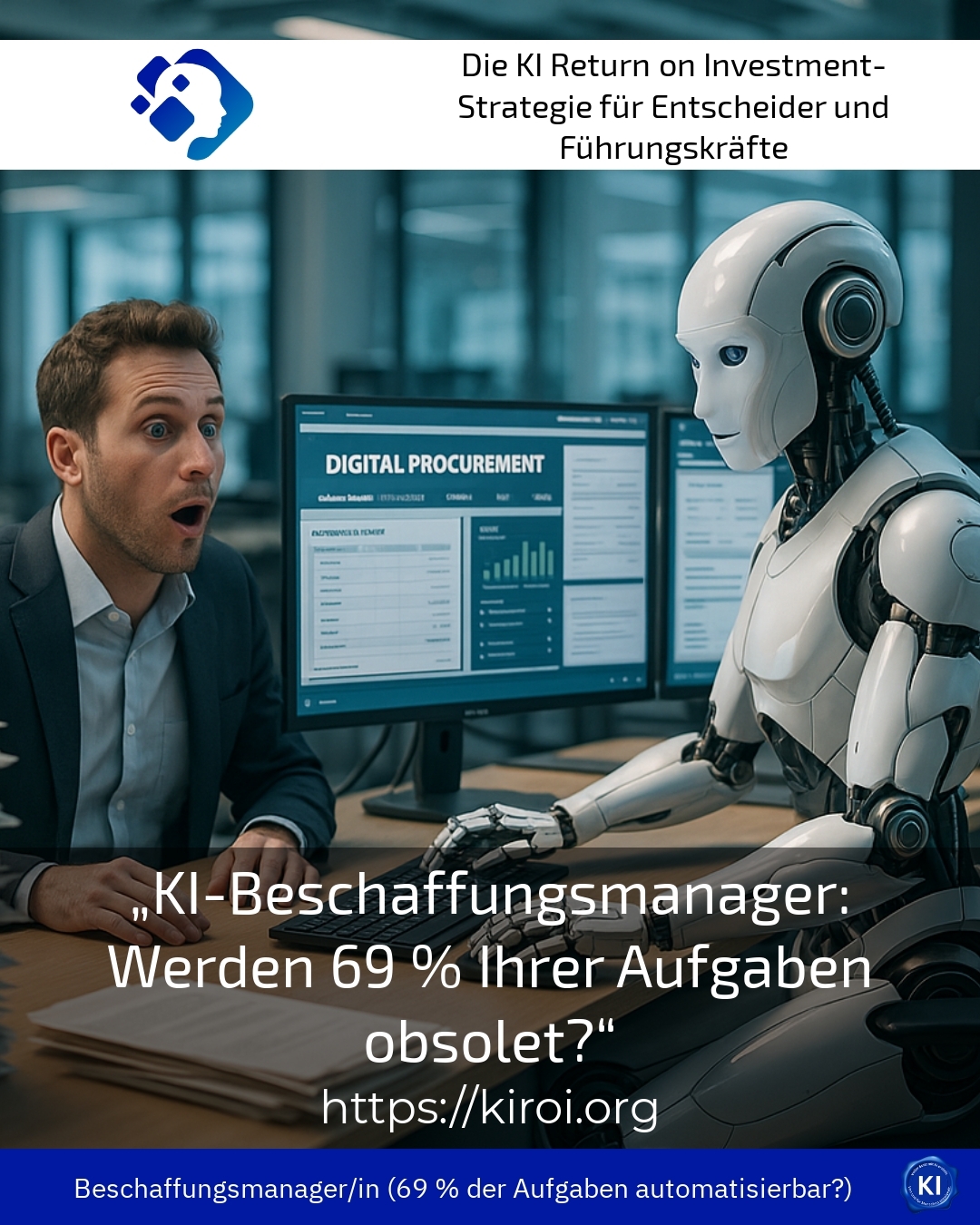
Have you ever wondered if your professional expertise will still be in demand in a few years, or if intelligent systems could carry out your daily tasks faster and more precisely? This question is currently occupying countless professionals in strategic purchasing, as the automation potential of modern technologies is now reaching impressive dimensions that should make even experienced professionals think. AI procurement manager This is at the center of a debate that goes far beyond simple process optimization and raises fundamental questions about the future of skilled knowledge work.
These findings are based, among other things, on analyses of the Job Future Observatory of the Institute for Employment Research [1], which systematically examines which job profiles could be replaced by technological developments. If you are yourself active in this dynamic field of work and want to proactively prepare for the transformation, the AIROI seminars offer a thorough opportunity for strategic repositioning. The current dates can be found at [https://risawave.org/de/live-events-mit-sanjay-sauldie/ 2], where you can find information about lectures, workshops, and intensive training formats tailored specifically to the challenges of the digital transformation.
The revolution in strategic procurement: Why the AI procurement manager is becoming a game changer
The integration of intelligent systems into the procurement process is fundamentally changing how companies organize and optimize their supply chains. Traditional tasks such as supplier research, which used to require hours of manual work, can now be completed in minutes through algorithm-driven platforms. The automated analysis of market data enables purchasing decisions based on real-time information. Comparisons across hundreds of suppliers are conducted simultaneously and without human intervention. Contract management tools review clauses and identify risks faster than any lawyer.
The transformation in demand forecasting and order fulfillment is particularly impressive. Intelligent systems analyze consumption patterns and predict future needs with astonishing accuracy. They take seasonal fluctuations, production schedules, and even external factors such as weather data into account. Automatic order fulfillment at thresholds defined below is now standard practice. Systems communicate independently with supplier portals and act on conditions.
Best practice with a AIROI customer
A medium-sized manufacturing company in the metalworking industry faced the challenge of fundamentally modernizing its purchasing processes without losing valuable experience from its long-standing employees. AIROI As part of the mentoring process, the team developed a strategy that meaningfully combined technological automation with human expertise. The purchasing department implemented an intelligent ordering system that fully automated routine orders for consumables. At the same time, the experienced buyers henceforth focused on strategic supplier partnerships and complex negotiation situations. Throughput times for standard orders decreased by an impressive 78 percent, while employees used their newfound time for value-added activities. What was particularly remarkable was the acceptance within the team, as the guidance through AIROI workshops helped to reduce fears and identify opportunities. The employees often reported that they now felt their work to be more fulfilling because repetitive tasks were eliminated. The company also recorded a cost savings of 23 percent in operational procurement.
Automation potential in detail: Where machines surpass humans
The analysis of structured data is one of the indisputable strengths of algorithmic systems, as it processes information volumes that are simply unmanageable for humans. When evaluating supplier offers, modern tools can compare hundreds of parameters within seconds. They evaluate not only prices but also delivery conditions, quality metrics, and sustainability criteria. The risk analysis of supply chains is based on data sources that are continuously updated. Political developments, currency fluctuations, and logistical bottlenecks are automatically incorporated into evaluations.
In the area of document processing, particularly significant efficiency gains are evident due to the use of modern technologies. Accounting checks, which previously required manual verification of each individual item, are now carried out fully automatically. Order confirmations are scanned, interpreted, and compared with order data. Deviations trigger automatic escalation processes that require only human intervention when actual clarification is required. The archiving and retrieval of contracts work through intelligent search functions. Naturally spoken queries replace complex database queries.
Communication with suppliers also undergoes fundamental changes through automation, which many professionals initially underestimate. Chatbots answer standard inquiries around the clock and in multiple languages. Automated reminders ensure punctual deliveries without manual follow-up. Feedback systems collect reviews and aggregate them into meaningful supplier scores. Appointment coordination for negotiations is handled through intelligent calendar tools. Even initial negotiation rounds can be guided by pre-programmed algorithms.
The human factor: Why the AI procurement manager can’t replace everything
Despite all technological advancements, there are areas of responsibility where human skills remain indispensable and even gain in importance. Strategic partnerships with key suppliers require empathy and relationship skills. Complex negotiation situations require intuition and the ability to interpret nonverbal signals. Crisis management in the event of supply disruptions requires creative problem-solving under time pressure. Developing innovative procurement strategies requires industry knowledge and foresight.
The ethical dimension of purchasing decisions is gaining additional relevance in times of growing societal awareness of sustainability. Questions of supply chain responsibility cannot be answered purely algorithmically. Evaluating working conditions at suppliers requires on-site visits and personal conversations. Environmental impacts must be evaluated in their overall context, not just through measurable metrics. The balance between cost optimization and social responsibility remains a profoundly human decision.
Best practice with a AIROI customer
An internationally operating trading company recognized early on the need to prepare its purchasing teams for the changed requirements and sought structured guidance for this transformation process. AIROI The strategy helped develop a clear distinction between automated and strategic activities. The company specifically invested in training for relational supplier management and negotiation skills. At the same time, routine processes were consistently digitized and automated, creating space for value-adding activities. Employees participated in workshops on using intelligent analytical tools and learned to critically interpret their results. The development of an internal competence model defining the skills relevant in the future was particularly valuable. The leaders often reported that the guidance provided by AIROI experts helped to break down resistance within the team and establish a positive culture of change. After completing the program, the company not only had more efficient processes but also more motivated employees who filled their new roles with confidence.
New competency profiles: What the AI procurement manager of the future must be able to do
Successful navigation through technological transformation requires a fundamentally expanded set of competencies that goes far beyond traditional purchasing skills. Fundamental data analysis skills are a basic requirement for all professionals in strategic purchasing. Understanding algorithmic decision-making processes enables the critical evaluation of system recommendations. The ability to define meaningful metrics is becoming increasingly important. Change management skills help in guiding organizational changes. Intercultural communication skills remain essential for global supplier relationships.
In the future, the ability to orchestrate various technological tools and human resources in complex procurement projects will be in particularly high demand. Coordinating human-machine teams requires new leadership approaches and communication strategies. Defining meaningful automation limits requires a deep understanding of processes. Continuous optimization of system parameters requires analytical skills and a willingness to experiment. Integrating new technologies into existing processes requires project management expertise. Training colleagues in the use of intelligent tools is becoming an everyday task.
Innovation and creativity are becoming crucial differentiating characteristics compared to purely algorithmic solutions that, while quick, cannot think innovatively. Identifying new procurement markets requires entrepreneurial thinking and a willingness to take risks. Developing alternative material solutions requires technical understanding and the ability to cooperate. Developing sustainable supply chains requires network skills and persuasiveness. Anticipating future needs requires strategic foresight and market knowledge.
Strategies for successful transformation: impulses for your career path
Proactive engagement with technological developments forms the foundation for a successful career reorientation in this changing professional field. Regular further education should not be seen as a burdensome obligation, but as a strategic investment. Participation in industry events enables the exchange with like-minded individuals and experts. Networking with technology providers provides insights into upcoming developments. Experimenting with new tools in professional life fosters practical experience. Documenting one’s own learnings supports the systematic development of skills.
Conscious positioning in the strategic segment of the profession significantly increases resilience to automation effects, as complex tasks are particularly difficult to substitute. Taking on projects with a high negotiating leverage strengthens indispensable core competencies. The development of specializations in niche markets creates unique value contributions. Maintaining personal supplier networks generates irreproducible relational capital. The acquisition of mentoring roles positions the individual as a knowledge provider and multiplier. The active design of transformation processes demonstrates leadership qualities.
Best practice with a AIROI customer
An experienced manager from the purchasing department of a mechanical engineering company sought guidance during a time when technological changes fundamentally challenged the usual scope of tasks. Individual support from AIROI experts helped identify and specifically develop personal strengths. Together, a development plan was created that addressed both technological and interpersonal competencies. The manager took on the role of digital transformation ambassador internally and became a bridge between the IT department and the purchasing team. Through the systematic documentation of best practices, an internal knowledge management system was created that benefited other departments as well. Participation AIROI in workshops also enabled valuable contacts with colleagues from other industries who faced similar challenges. After a year, the manager reported that she now viewed her professional future with significantly more confidence because she had actively redefined her role. The company benefited from increased innovation and a purchasing department that saw changes as an opportunity rather than a threat.
My AIROI Analysis
The analysis of current developments clearly shows that automation in strategic purchasing is no longer a vision of the future; it is already a present reality that is gaining momentum every day. Professionals who remain closed off to this development risk actually having significant parts of their current activities become obsolete, while those who take a proactive stance can benefit from exciting new opportunities. AIROI The strategy provides a structured framework for analyzing individual situations, identifying personal development potential, and outlining concrete action steps that fit the respective career phase.
The key to success lies not in competing with algorithms, but in the intelligent complementarity between human and machine capabilities. Those who learn to use technological tools as amplifiers of their own expertise become more valuable than replaceable. Focusing on activities with a high component of relationship building, creativity, and strategy creates sustainable differentiation. Continuous investment in skills that machines cannot replicate or can replicate only with difficulty ensures long-term employability. The transformation should not be viewed as a threat, but as an opportunity for professional development.
What seems particularly important to me is the realization that successful transformation rarely succeeds on its own; it benefits from exchange, guidance, and structured reflection. The AIROI seminars and workshops provide just such a framework for anyone who wants to actively shape their professional future. The experiences of numerous participants show that the systematic discussion of the topic not only reduces fears but can also spark genuine enthusiasm for the new possibilities. Ultimately, it is one’s own attitude that determines whether one experiences the coming years as victims of change or as creators of an exciting new working world.
Further links from the text above:
[1] Job-Futuromat of the Institute for Employment Research
[2] AIROI seminars and live events with Sanjay Sauldie
For more information and if you have any questions, please contact Contact us or read more blog posts on the topic Artificial intelligence here.








 Deutsch
  English (UK)