
What remains for humans when machines can respond faster, more precisely, and comprehensively than any expert could ever be?
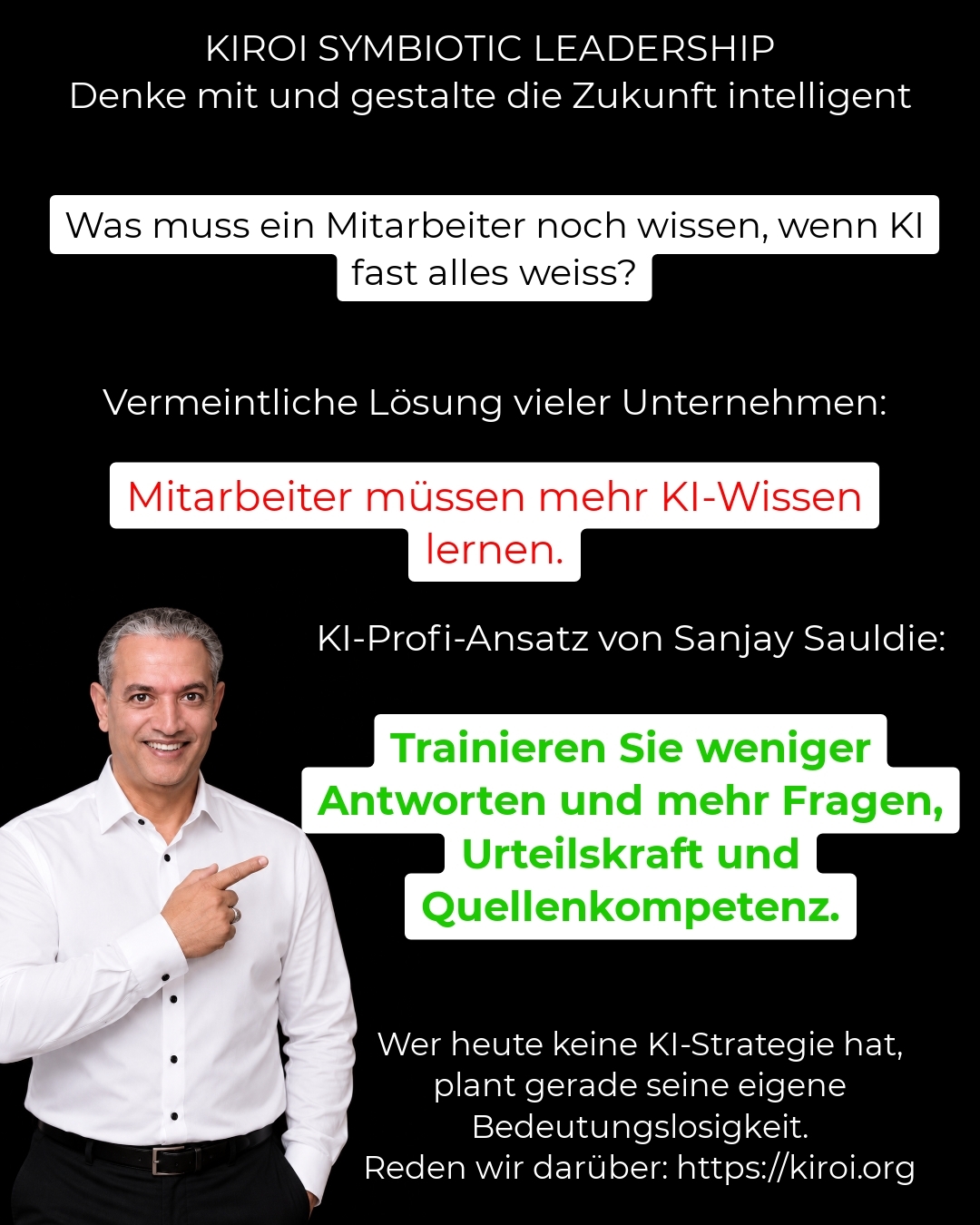
This question currently concerns countless professionals, executives, and HR managers in all sectors of the economy, because the rapid development of algorithmic systems challenges fundamental assumptions about professional qualification and human value. The classic notion that knowledge means power and that the one who has the most facts is the one who is at an advantage is increasingly losing its validity, while a new order of competencies is emerging in which the ability to think critically, to ask precise questions, and to assess sources responsibly takes center stage. In this context, an approach that has gained importance is gaining traction: AIROI-Solution: Train less on answers and more on questions, judgment and source competence It provides a basis for describing the fundamental paradigm shift in corporate continuing education.
The changed landscape of professional competence
The transformation we are currently experiencing is analogous to a tectonic shift in the foundations of what we understand by professional expertise, and this change affects without exception all sectors of the economy, from the manufacturing industry to the service sector, and even creative industries and scientific institutions. While previous technological revolutions primarily automated manual activities, the current developments are deeply penetrating cognitive work processes, so that even highly skilled knowledge workers find themselves confronted with the question of what unique contribution they can still make when systems process information in seconds that a human could hardly capture in weeks.
In the field of financial advice, for example, algorithmic systems can now generate complex portfolio analyses, evaluate historical market data, and calculate predictive models that would have previously required an entire team of analysts. In medical diagnostics, similar things are happening: imaging techniques are being supported by learning systems that detect abnormalities with a precision that often exceeds human perception. In legal advice, automated systems scan thousands of documents, judgments, and contract clauses in fractions of the time that a lawyer would need.
These examples illustrate that the traditional notion of the expert as the guardian of specialized knowledge requires fundamental revision. The question is no longer who knows the most facts, but who asks the right questions, who can critically sort through the results of algorithmic analyses, and who is able to distinguish between trustworthy and questionable sources.
The conventional approach and its limitations
Many organizations are responding to this development with an obvious but ultimately shortsighted approach by training their workforce to use the new technological tools, optimize input commands, and understand the fundamental workings of algorithmic systems. This approach, which we refer to as Employees need to learn more AI knowledge The ability to characterize technical skills is based on the assumption that technical understanding is the primary bottleneck and that the solution lies in more training, more tutorials, and more certifications.
The limits of this approach become quickly apparent. For example, an insurance company invests significant resources in training programs that teach the claims analysts how to perform damage analysis more efficiently using algorithmic systems. The employees learn which inputs lead to optimal results and how to format the generated reports. What they do not learn, however, is the ability to assess whether the system’s outputs are plausible, whether relevant aspects may have been overlooked, or whether the underlying data contains biases that could lead to erroneous conclusions.
In an advertising agency, a similar pattern emerges. The creative staff are trained to use generative systems to produce text drafts, image concepts, and campaign ideas more quickly. The technical skills improve noticeably, but the fundamental ability to assess creative quality, recognize cultural sensitivities, and assess strategic relevance remains underdeveloped. The result is employees who generate output efficiently but increasingly become uncertain about critically evaluating that output.
One logistics company provides another illustrative example. The dispatchers are trained to perform route optimizations and capacity planning using intelligent systems. The training focuses on operational skills and technical parameters. However, the ability to recognize unusual situations, where the algorithmic recommendations may be based on outdated assumptions or fail to adequately account for local conditions, is left unconsidered.
AIROI The solution: Train less on answers and more on questions, judgment and source competence
The AIROI-approach marks a fundamental shift in perspective that fundamentally reorders the priorities of corporate training and positions people not as operators of systems but as critical supervisors and creative catalysts. Instead of primarily teaching employees how to extract efficient responses from technological systems, this approach focuses on developing three core competencies that, in a world of ubiquitous algorithmic intelligence, constitute the crucial human value added: the art of precise questioning, the ability to make judgments, and the ability to critically evaluate sources.
The art of asking questions proves to be significantly more demanding than it might seem at first glance. In an architectural office, for example, the difference between an average and an excellent professional is increasingly less about who creates the better designs themselves, but about who can formulate the more precise, creative, and strategically relevant questions that lead to innovative solutions. An experienced architect knows which aspects of a construction project deserve special attention, which questions an algorithmic system may not take into account, and which creative directions it is worth exploring.
Judgement as a second core competence refers to the ability to critically assess the costs of technological systems, to verify plausibility, and to take into account contextual factors that may not be represented in standardized algorithms. In a pharmaceutical company, for example, systems may conduct extensive literature searches and identify potential drug candidates, but assessing which research directions are actually promising requires a deep understanding of scientific relationships, clinical realities, and regulatory frameworks that goes beyond pure data analysis.
Ultimately, the competence to source information is becoming increasingly important in an information landscape increasingly dominated by algorithmically generated content. A journalist who researches using technological tools must be able to assess which sources are trustworthy, which information may have been distorted or generated synthetically, and how different perspectives should be weighted. This competence cannot be taught through technical training but requires a combination of critical thinking, domain knowledge, and ethical reflection.
Best practice with a AIROI customer
A medium-sized consulting firm with around two hundred employees faced the challenge that its consultants were increasingly uncertain about the added value they could still offer given the availability of algorithmic analysis tools. The management initially took the conventional route and implemented extensive technical training programs that did not yield the expected results. Although the employees became more efficient in using the tools, they increasingly lost confidence in their own professional judgment. As part of a transruptive coaching process, a fundamentally different approach was developed that completely reversed the training priorities. Instead of technical operational competence, workshops on critical questioning, hypothesis formation, and source criticism were now conducted. The consultants learned to view algorithmic analyses as a starting point for deeper investigations, rather than as end products. They developed checklists for plausibility testing and systematically practiced asking the right follow-up questions. After six months, both the employees and the clients reported a noticeably improved quality of advice, because human expertise was no longer perceived as redundant but as an indispensable complement to algorithmic capabilities. The consultants gained new confidence in their specific contribution.
Practical implementation of the three core competencies
The concrete implementation of the AIROI-approach requires a structured development process that systematically builds on the three core competencies and integrates them into everyday work. For example, so-called question laboratories have proven to be effective in developing question competence; teams work together to refine problem statements before using technological tools. One personnel consulting company implemented such laboratories to train its recruiters in identifying the truly relevant questions when searching for candidates, rather than relying on standardized search queries.
Structured reflection processes prove effective for developing judgment. For example, weekly peer review sessions were introduced in an engineering office, where the results of algorithmic calculations and simulations are critically discussed together. During these sessions, professionals learn to systematically look for blind spots, consider alternative interpretations, and include contextual factors that may not have been taken into account in the automated analyses.
Source expertise can be developed through targeted exercises that train critical information handling. A news agency implemented a program in which editors are regularly confronted with deliberately erroneous or misleading information to sharpen their ability to recognize inconsistencies. These exercises are combined with reflection phases in which the applied testing strategies are analyzed and refined.
AIROI The solution: Train less on answers and more on questions, judgment, and source competence in different contexts.
The application of this approach naturally varies depending on the industry and field of activity, although the fundamental principles remain universally valid. In a research institute, implementation means that scientists are trained to formulate the right research questions, rather than relying on algorithmically generated hypotheses. They learn to critically assess the quality of data sets and recognize the limitations of automated analyses.
In a bank, the implementation focuses on empowering client advisors to critically question the algorithmically generated investment recommendations and align them with the specific context of each client. The advisors develop an understanding of when standardized recommendations are appropriate and when individual factors require a different approach.
In a design agency, creatives learn to redefine their role: no longer as producers of designs, but as critical curators who can identify and develop the culturally relevant, strategically appropriate, and aesthetically compelling solutions from a multitude of algorithmically generated options.
The strategic dimension of human competence
Beyond individual capabilities, the AIROI-approach opens up a strategic perspective on the role of human competence in organizations. Companies that consistently adopt this approach do not position their workforce as interchangeable operators of technological systems, but as indispensable agents of judgment and critical intelligence that meaningfully complement algorithmic capabilities and place them in the right context.
An automotive supplier that continues to train its quality engineers according to the AIROI-principle benefits from skilled workers who not only operate algorithmic testing systems but also know their limits and can monitor them critically. They recognize unusual patterns that automated systems might overlook and can assess when manual checks are necessary.
A business advisory firm that pursues this approach differentiates itself in the market by the quality of its problem analyses and strategic recommendations, not by the speed of its data processing. Its consultants become trusted partners who help clients ask the right questions and critically evaluate the answers generated.
Ultimately, a publishing house positions its editors and writers as guarantors of quality and trustworthiness in an information landscape increasingly flooded with automatically generated content. Human curation and critical assessment become a differentiating quality feature.
My AIROI Analysis
The central insight of this study lies in fundamentally redefining what human competence means in a work environment dominated by algorithmic intelligence. The conventional response of many organizations, which primarily focus on technical training and operational skills, is too short-sighted and misses the real development needs. AIROI-Solution: Train less on answers and more on questions, judgment and source competence offers a way out of this dilemma by shifting the focus from technical handling to the genuinely human abilities that algorithmic systems can complement and control.
The three core competencies – precise questioning, critical judgment, and sovereign evaluation of sources – together form a competence profile that does not become obsolete due to technological developments but, on the contrary, gains in importance as more capable algorithmic systems become available. People who develop these competencies transform their role from knowledge provider to critical supervisor, from answer provider to questioner, from passive consumer to active curator.
For organizations, this means a fundamental realignment of their training strategies and an honest reflection on which human skills are actually valuable and which can be replaced by technological solutions. Transruptive coaching can provide valuable insights in this regard and support the transformation process [1]. The path leads away from the idea of the human as an efficient data processor towards the appreciation of genuine human qualities such as intuition, ethical reflection, and context-sensitive judgment. These qualities are not merely valued despite the increasing capabilities of algorithmic systems, but are precisely what distinguish successful professionals and organizations. These qualities are not merely valued because of the increasing capabilities of algorithmic systems, but because they are essential to the success of successful professionals and organizations.
Further links from the text above:
[1] AIROI – Artificial intelligence properly organized and implemented
Are you a leader and would you like to learn how you can genuinely introduce AI into your company in a valuable and sustainable way, away from the hype? Take part Contact us or read more blog posts on the topic Artificial intelligence here.









 Deutsch
  English (UK)