
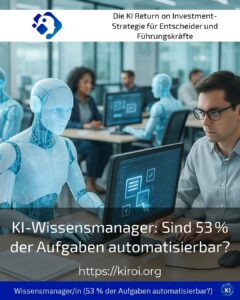
Will your professional expertise soon be taken over by intelligent systems, and how can you prepare yourself to not only survive but also flourish in an increasingly automated working world? This question currently concerns countless professionals in the field of knowledge organization and information management, because the rapid development of machine learning systems fundamentally changes the requirements for professional activities. AI knowledge manager This is at the heart of a transformation that brings both opportunities and challenges. Current analyses suggest that more than half of typical tasks in this professional field could be supported by intelligent algorithms or even be completely automated.
The findings presented here are based, among other things, on data from the Job Future Observatory of the Institute for Employment Research [1], which systematically analyzes which professional activities can be substituted by modern technologies. If you are yourself active in this dynamic field and would like to prepare yourself strategically for the upcoming changes, the AIROI seminars offer a structured framework for your personal and professional development. The current dates and detailed information on lectures and workshops can be found under risawave.org/en/live-events-with-sanjay-sauldie/. The AIROI. strategy helps professionals strengthen their unique human competencies while also using technological tools profitably.
Understand the automation potential in the field of AI knowledge management
The analysis of the automatability of professional activities reveals a differentiated picture that goes far beyond simple percentages and has profound implications for strategic career planning. Routine tasks such as categorizing documents, extracting relevant information from large data sets, or creating standardized reports can already be performed with remarkable precision by intelligent systems today. The maintenance of knowledge databases, which traditionally required significant manual effort, can be significantly more efficiently managed through automated processes. At the same time, new fields of activity are emerging that require close collaboration between human expertise and machine intelligence.
In practice, this means that the daily work with information systems is fundamentally changing. The manual labeling of content is increasingly being replaced by semantic analysis. Search functions are evolving into intelligent assistants. Quality assurance of knowledge assets requires new methodological approaches. Professionals often report that their role is shifting from execution to monitoring and control.
Best practice with a AIROI customer
A medium-sized company in the field of technical documentation faced the challenge of organizing and making its internal knowledge bases more efficient. The responsible professional initially had concerns that her position could be compromised by the introduction of automated systems. However, as part of the AIROI mentoring process, a concept was developed that intelligently combined human expertise with technological capabilities. The employee took on the strategic management of the new system and focused on quality control and the training of colleagues. Within a few months, she was able to shift her workload from repetitive tasks to value-adding activities. She developed new taxonomies and continuously optimized the system’s user-friendliness. The company benefited from faster access to relevant information. Employee satisfaction increased measurably as search frustration was significantly reduced. This example vividly demonstrates how the AIROI strategy can provide concrete impetus for successful transformation.
Concrete areas of activity in change
The collection and structuring of business knowledge is one of the core tasks that can be significantly supported by intelligent systems. Text recognition systems automatically analyze documents and suggest appropriate categories. Language models summarize longer texts and extract key information. Ontologies are continuously expanded and refined through machine learning methods. The identification of knowledge gaps is increasingly based on data. Outdated information is automatically marked and suggested for review.
Another example concerns the answering of internal inquiries. Chatbots and virtual assistants provide standard information. They pass on more complex questions to human experts. The documentation of inquiries and solutions is automated. Knowledge gaps are systematically identified and closed.
The training of employees is also changing fundamentally. Personalized learning paths are created algorithmically. Knowledge tests adapt to the individual’s level of knowledge. Microlearning units are automatically generated from existing documents. The measurement of success is continuous and real-time.
What competencies the AI knowledge manager will need in the future
The shift from performing to controlling and strategic activities requires an expanded skill set that combines technical understanding with communication skills and analytical thinking. The ability to understand complex relationships and prepare them for different audiences is becoming increasingly important. Critical thinking becomes indispensable for evaluating and, if necessary, correcting the results of automated processes. Designing human-machine interfaces is evolving into a key skill.
In practice, successful professionals share certain characteristics. They understand fundamental concepts of machine learning. They can accurately formulate requirements for technical systems. They reliably recognize the limitations of automated solutions. They effectively communicate between IT departments and technical departments. They drive change processes with conviction.
The AIROI seminars systematically address these specific areas of expertise. Participants receive practical tools for professional life. They develop an understanding of the possibilities and limitations of current technologies. They network with like-minded people and exchange experiences. The workshops provide a space for individual questions and concrete case studies.
Best practice with a AIROI customer
A senior executive at an internationally operating service company sought ways to make the knowledge management of their department future-proof without completely abandoning proven processes or causing employees to become disengaged. As part of the AIROI coaching process, an extensive analysis of the existing work profiles was first conducted, which revealed surprising insights into optimization potential. The gradual introduction of automated support functions was carried out in close coordination with the team. Resistance was successfully overcome through transparent communication and the involvement of employees in decision-making processes. After one year, the productivity of the department had increased significantly. The employees reported increased job satisfaction due to the elimination of monotonous tasks. New tasks such as the strategic development of the knowledge management system were enthusiastically embraced. The leader was able to solidify her role as a designer of the digital transformation within the company. This example illustrates how the AIROI strategy can support sustainable change processes.
The role of the AI knowledge manager in organizational development
Beyond operational activities, an expanded scope of tasks is emerging that encompasses strategic and organizational dimensions. Consulting for executives on the design of knowledge-intensive processes is gaining in importance. The development of governance structures for handling automated systems becomes necessary. Ethical issues related to algorithmic decision-making are coming to the fore. Ensuring data quality and information integrity remains a human responsibility.
In practice, professionals are increasingly taking on coordinating functions. They moderate the collaboration between different departments. They define standards for the documentation of knowledge. They systematically evaluate new technological solutions. They train colleagues in using digital tools. They represent the interests of users before IT managers.
Another example from practice concerns the integration of various information systems. Companies often use a variety of different platforms. The linking of these systems requires conceptual work. Interfaces must be defined and maintained. Data formats must be harmonized and standardized.
Strategies for personal positioning
Proactively designing one’s own professional development enables professionals to perceive upcoming changes not as a threat but as an opportunity to actively utilize them. Continuous training in relevant fields creates the foundation for successful adaptation. Networking with other professionals fosters the exchange of experiences and best practices. The adoption of pilot projects enables the early gathering of practical experience with new technologies.
Concrete action recommendations can be summarized as follows. Identify the activities in your work routine with high automation potential. Develop competencies in adjacent areas with lower substitution risk. Position yourself as a bridge builder between humans and technology. Carefully document your successes in implementing new solutions. Proactively communicate the added value of your work to decision-makers.
The AIROI strategy provides a structured framework for this development. It takes into account individual starting situations and objectives. It combines theoretical knowledge with practical application. It promotes the establishment of a supportive network. It supports change processes using proven methods.
Best practice with a AIROI customer
An experienced information organization specialist at a large industrial company found himself at a turning point in his career when the introduction of a company AIROI-wide knowledge management system with extensive automation features was announced. Instead of waiting and passively observing the developments, he decided on a proactive approach and attended a seminar to systematically evaluate his options. In the workshop, he developed a personal strategy that combined his long-standing experience with new technological competencies. He successfully positioned himself as an internal consultant for the implementation of the new system. His expertise regarding the corporate culture and the needs of various departments proved indispensable. He took on the task of training over one hundred colleagues in how to use the new platform. His role within the company was not weakened but significantly strengthened. Today he is responsible for the strategic development of the entire knowledge management system. This development exemplifies how AIROI mentoring can open up concrete career opportunities.
My AIROI Analysis
The question of whether more than half of activities in the field of professional knowledge organization can be automated cannot be answered with a simple yes or no; rather, it requires a differentiated approach to the various fields of activity and their specific characteristics. Technological development undoubtedly advances at an impressive pace, enabling the automation of activities that only a few years ago were considered exclusively human domains. At the same time, new tasks and responsibilities are continuously emerging that require human abilities such as critical judgment, emotional intelligence, and creative problem solving.
The crucial insight is that the automation of certain activities does not necessarily mean the disappearance of jobs. Rather, the demand profile is changing fundamentally. Professionals who adapt early to these changes can not only secure their position but also expand it. The AIROI strategy supports this process through a holistic approach that combines individual strengths with the demands of the digital age.
What is particularly remarkable is that the human ability to contextualize information remains irreplaceable. Machines can recognize patterns and identify connections. However, they do not understand the deeper meaning of information for specific business situations. Interpreting knowledge in an organizational context requires experience and judgment. These competencies cannot be programmed; they must be cultivated.
The future belongs to those who understand technological possibilities as tools and not as competition. The AIROI-Seminare impart exactly this perspective and empower participants to utilize their unique human qualities in a profitable way. The combination of professional expertise with technological competence creates a profile that will be highly valued in the labor market of the future.
Further links from the text above:
[1] Job-Futuromat of the Institute for Employment Research
For more information and if you have any questions, please contact Contact us or read more blog posts on the topic Artificial intelligence here.









 Deutsch
  English (UK)