
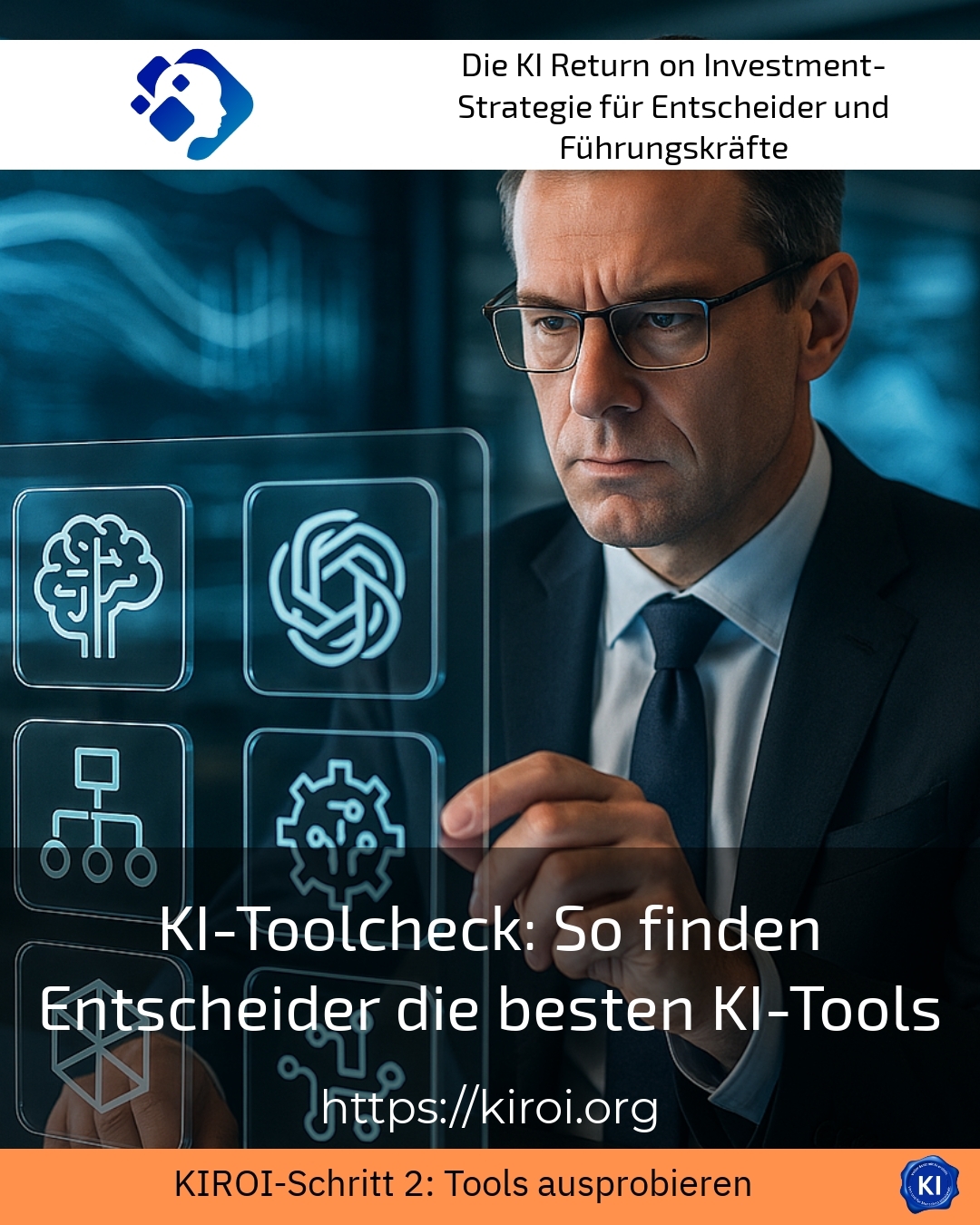
Today, choosing the right digital tools determines the success or failure of entire business divisions. Leaders face the challenge of filtering out those solutions from a seemingly endless array of options that actually create added value. The AI Toolcheck: How decision-makers can find the best AI tools thereby becomes an indispensable core competency of modern corporate management. While some organisations are already recording significant productivity gains, others report costly misjudgements in technology selection. What distinguishes successful implementations from failed projects? How do experienced decision-makers navigate through the jungle of offerings? These questions currently occupy board members, managing directors and department heads alike. The answers to them are more complex than many consultancy offers would suggest. In this article, you will learn which criteria really count and how you can proceed systematically.
Why a Structured AI Tool Check Has Become Indispensable
The speed of technological developments has increased dramatically in recent years. New applications appear on the market almost weekly. Decision-makers frequently report a certain sense of being overwhelmed in the face of this dynamic. The danger of making hasty decisions increases significantly as a result. At the same time, pressure is growing from various directions. Competitors are already implementing innovative solutions into their processes. Employees demand modern work tools for their daily tasks. Customers expect faster response times and personalised offers.
For example, a financial services provider was faced with the task of optimising its customer service. Without a systematic evaluation, the company might have chosen an unsuitable solution. A retail company, in turn, was looking for ways to optimise its inventory. There, it quickly became apparent that various providers pursued completely different approaches. A logistics service provider needed support with the route planning of its vehicle fleet. The available options differed considerably in terms of range of functions and integration possibilities.
These examples illustrate a central aspect. Every organisation has individual requirements and conditions. A blanket recommendation can therefore rarely work. Instead, what is needed is a structured evaluation process. This should take into account both technical and organisational factors. Only in this way can poor decisions with far-reaching consequences be avoided.
AI tool check: How decision-makers can find the best AI tools through systematic needs analysis
The first step of any successful technology selection begins with an honest stocktake. Where do the biggest challenges currently lie within business processes? Which tasks tie up an excessive amount of resources? Where do errors or delays regularly occur? These questions may seem trivial, but they are surprisingly often skipped. Many companies begin their search with a preconceived solution in mind. They have heard of a specific application and now want to use it. This approach rarely leads to the desired result.
For example, an insurance company realised that claims processing was taking too long. However, analysis showed that missing technology was not the problem. Rather, unclear responsibilities and outdated process structures were to blame. An engineering company was looking for solutions for predictive maintenance. It turned out there that data collection had to be improved first. An energy supplier wanted to automate its customer service. However, the needs analysis revealed that certain enquiries required human expertise.
Best practice with a AIROI customer
A medium-sized manufacturing company approached us with the desire to introduce a specific automation solution. The management had heard about impressive results at a trade fair. As part of the support provided by transruptions-Coaching, we first conducted a comprehensive process analysis. This analysis brought to light surprising insights. The actual problem did not lie in production, but in the upstream order entry process. That was where delays and transmission errors occurred, which rippled through the entire value chain. We subsequently supported the company in realigning its priorities. The solution originally favored was initially put on hold. Instead, we focused on optimising the interfaces between sales and production. Following the successful implementation of a more suitable solution, the company reported a significant improvement in lead times. In addition, the error rate in order processing dropped considerably. This experience impressively demonstrates how important an unbiased needs analysis can be. Had the company implemented the original solution, the core problem would have remained unsolved.
Asking the right questions to begin with
Effective needs analysis begins with the right questions. What specific outcomes are to be achieved? How do we measure the success of the planned change? Who are the stakeholders affected and what expectations do they have? What timeframes are we talking about for implementation? Which existing systems must be taken into account? These questions form the foundation for all further steps. They help to flesh out vague ideas. At the same time, they prevent important aspects from being overlooked.
Develop evaluation criteria for an effective AI tool check
Following the needs analysis comes the development of specific evaluation criteria. These criteria should be measurable and comparable. They must reflect the organisation's specific requirements. In doing so, we distinguish between hard and soft factors. Hard factors include technical specifications and costs. Soft factors concern user-friendliness and vendor reputation.
A pharmaceutical company placed special emphasis on regulatory compliance. Data storage had to comply with strict regulations. A retailer, on the other hand, prioritised the scalability of the solution. Rapid growth required flexible capacity adjustments. A consultancy firm focused on integration options with existing systems. Seamless incorporation into existing workflows was crucial.
The weighting of these criteria varies depending on the corporate situation. For a start-up, initial investments may play a larger role. An established corporation might place more value on long-term support guarantees. These differing priorities must be reflected in the evaluation system. Only then will the comparison of different options yield meaningful results.
Check technical integration capability
The technical integration capability deserves special attention in the evaluation process. Hardly any tool exists in isolation within the corporate landscape. It must be able to communicate with existing systems. Data formats must be compatible. Interfaces should be documented and stable. The IT department should be involved early on.
A telecommunications company had to learn this lesson the hard way. The chosen solution promised impressive features. However, integration into the existing CRM landscape proved to be extremely complex. An automotive supplier had had similar experiences. There, incompatibilities led to delays lasting months. A healthcare provider invested significant resources in subsequent adjustments. These examples underline the importance of a thorough technical preliminary assessment.
Using pilot projects as a basis for decisions
Theoretical evaluations have their limits. Paper is patient, as a well-known idiom goes. Therefore, experienced professionals regularly recommend carrying out pilot projects. These enable testing under real-world conditions. They reveal strengths and weaknesses that remain hidden in product presentations. At the same time, the team gathers valuable experience.
A media company tested three different solutions in parallel across various departments. The results diverged considerably from the manufacturers' promises. A chemical corporation conducted a three-month pilot project with intensive documentation. The insights gained had a decisive influence on the final decision. A transport company had its drivers test different applications in day-to-day operations. The feedback from practice proved to be invaluable.
Best practice with a AIROI customer
A facility management service provider was facing an important technology decision. The executive board had already selected a preferred supplier. As part of our support, we nevertheless recommended a structured benchmark test. We assisted in designing a six-week pilot project. Three different solutions were used in parallel across various branch offices. In doing so, we defined clear key performance indicators and documentation standards. The employees received uniform training for all the systems tested. Following the conclusion of the pilot phase, the results surprised everyone involved. The supplier originally favored performed the weakest in several key categories. Another solution, by contrast, won people over with its user-friendliness and reliability. Particularly remarkable was the feedback from the on-site staff. They reported clear differences in daily use. These insights would not have been gained without practical testing. The company ultimately decided on a solution that was not initially in the shortlist. The investment in the pilot project has thus paid off many times over.
Define success criteria for pilot projects
The success of a pilot project depends on clear framework conditions. Measurable objectives must be defined in advance. When is the test considered successful? Which minimum requirements must be met? How are qualitative feedbacks recorded and evaluated? These questions should be answered before the project starts. Otherwise, there is a risk of subjective evaluations.
Consider organisational factors in the AI tool check
Technical suitability alone does not guarantee implementation success. Organisational factors play an equally important role, at the very least. User acceptance determines the practical benefit. Training needs must be realistically assessed. Change management measures should be planned from the outset.
A real estate company underestimated the training effort required for a new solution. The rollout dragged on for months. An educational institution neglected to involve the employees affected. Resistance to the new system persisted for a long time. In contrast, a craft business planned sufficient time for training. As a result, the rollout went much more smoothly.
Transruptions coaching can provide valuable momentum for such projects. Support from experienced professionals helps to avoid typical pitfalls. Employees feel taken seriously and involved. Resistance can be identified and addressed at an early stage. These aspects are often crucial to success.
Incorporate long-term perspectives into the decision.
A technology decision often has an impact for years. Therefore, long-term perspectives must be taken into account. How is the vendor expected to develop? What roadmap for further developments exists? How financially stable is the company positioned? These questions relate to the future-proofing of the investment. [1]
A software company for law firms chose a solution from a small start-up. Two years later, the provider ceased operations. An architectural practice relied on an established market leader. Regular updates kept the solution current. An engineering consultancy checked the financial reports of potential partners before making a decision. This diligence paid off in the long run.
Check scalability and adaptability
Businesses change continuously. New business areas emerge, others are abandoned. The chosen solution should be able to keep pace with these developments. Scalability up and down is important. Options for adaptation to changing requirements should be provided. Rigid systems can quickly become an obstacle.
My AIROI Analysis
After years of supporting companies with technology decisions, clear patterns for success and failure emerge. Successful organisations invest sufficient time in needs analysis. They avoid rushing into decisions on specific vendors or solutions. They involve all relevant stakeholders at an early stage. The AI Toolcheck: How decision-makers can find the best AI tools is understood as a continuous process, not as a one-off project.
The biggest mistakes frequently arise from acting in a rush. The pressure to implement a solution quickly leads to superficial assessments. Important criteria are overlooked or incorrectly weighted. Integration into existing systems is underestimated. Change management aspects receive too little attention. These failures take their revenge later through costly rework.
My recommendation is therefore: take the necessary time to make an informed decision. Develop clear evaluation criteria before conducting the market analysis. Carry out pilot projects to put theoretical assumptions to the practical test. Accompany the rollout with appropriate change-management measures. Plan training and support right from the start. [2]
Investing in a structured selection process pays dividends several times over. You avoid costly misjudgements. You increase user buy-in. You create the foundation for successful use over many years. Transruption coaching can effectively accompany and support this process. The experience of numerous projects is incorporated into the consultancy. In this way, companies benefit from tried-and-tested approaches and avoid typical mistakes.
Further links from the text above:
[1] Bitkom – Artificial Intelligence in Companies
[2] McKinsey – Insights into Artificial Intelligence
For more information and if you have any questions, please contact Contact us or read more blog posts on the topic Artificial intelligence here.










 Deutsch
  English (UK)