
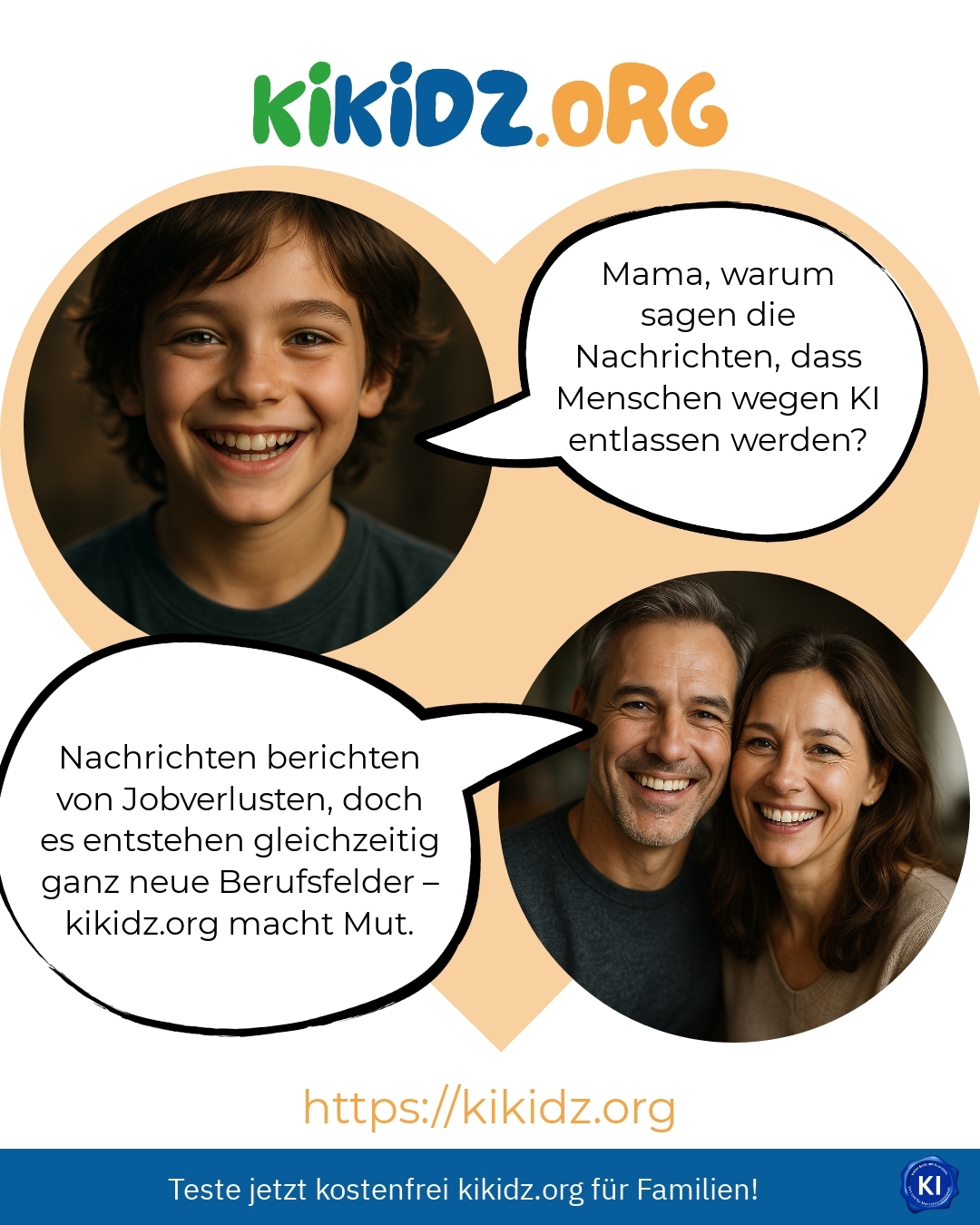
Mum, why do the news say people are losing their jobs because of AI?
More and more parents are hearing this question from their children. The media reports on Artificial Intelligence (AI) daily, and many children feel uncertain when they hear that machines and programmes might replace jobs. It is therefore all the more important for parents to provide answers and help manage anxieties.
News reports indicate that companies in Germany expect artificial intelligence to lead to job losses in the coming years [1]. In fact, according to a recent survey by the Ifo Institute, around 27 percent of German firms anticipate that AI means redundancies [1][2][3]. On average, these companies expect to reduce employee numbers by about eight percent by the year 2030 [1]. Industry, retail, administration, and clerical roles are particularly affected, as many routine tasks can be taken over by algorithms [4].
Many parents come to me and ask how they should talk to their children about AI and the world of work. They are looking for simple, child-friendly explanations and advice on how to address anxieties. Some families want to know which jobs are particularly affected and how they can prepare for the changes.
Was sich konkret durch KI am Arbeitsmarkt verändert, lässt sich in mehrere Bereiche unterteilen: **1. Automatisierung und Effizienzsteigerung:** * **Routineaufgaben:** KI kann repetitive und standardisierte Aufgaben übernehmen, die bisher von Menschen erledigt wurden. Dazu gehören beispielsweise Dateneingabe, einfache Kundenanfragen, Buchhaltungsprozesse oder auch bestimmte Produktionsschritte. * **Effizienzsteigerung:** Durch die Automatisierung dieser Aufgaben werden Prozesse schneller, kostengünstiger und fehlerfreier. Dies führt zu einer höheren Produktivität in vielen Branchen. **2. Entstehung neuer Berufsfelder und Tätigkeiten:** * **KI-Entwickler und -Trainer:** Es werden dringend Fachkräfte benötigt, die KI-Systeme entwickeln, trainieren, implementieren und warten können. * **Datenwissenschaftler und -analysten:** Die Analyse riesiger Datenmengen, die für das Training und den Betrieb von KI unerlässlich sind, erfordert spezialisierte Data Scientists. * **KI-Ethik-Beauftragte:** Mit dem wachsenden Einfluss von KI gewinnen ethische Fragen an Bedeutung, was zur Schaffung von Positionen für unabhängige Prüfer und Ethik-Berater führt. * **KI-Übersetzer und -Kuratoren:** In vielen Bereichen müssen KI-Ergebnisse auf ihre Richtigkeit und Relevanz überprüft und gegebenenfalls korrigiert werden. **3. Veränderung bestehender Berufe und Qualifikationsanforderungen:** * **Augmented Intelligence:** KI wird oft als Werkzeug zur Unterstützung von menschlicher Arbeit eingesetzt, anstatt sie vollständig zu ersetzen. Dies bedeutet, dass viele Berufe um neue Kompetenzen erweitert werden, die im Umgang mit KI-Tools liegen. * **Fokus auf überfachliche Kompetenzen:** Kreativität, kritisches Denken, Problemlösungsfähigkeiten, emotionale Intelligenz und Zusammenarbeit werden stärker nachgefragt, da diese Bereiche (noch) schwer von KI zu replizieren sind. * **Weiterbildung und Umschulung:** Arbeitnehmer müssen sich kontinuierlich weiterbilden und umschulen, um mit der rasanten Entwicklung der KI Schritt zu halten und ihre Arbeitsplätze für die Zukunft zu sichern. **4. Auswirkungen auf Beschäftigungsstrukturen und Lohnniveaus:** * **Polarisierung des Arbeitsmarktes:** Es besteht die Gefahr einer Polarisierung, bei der hochqualifizierte Arbeitsplätze, die mit KI gut zusammenarbeiten, und niedrigqualifizierte Arbeitsplätze, die von KI nicht betroffen sind, stärker gefragt sind, während Arbeitsplätze im mittleren Qualifikationsbereich wegfallen könnten. * **Wachsende Ungleichheit:** Wenn nicht die richtigen Rahmenbedingungen geschaffen werden, könnte die KI zu einer wachsenden Einkommensungleichheit führen, da die Gewinne aus der Automatisierung möglicherweise nicht gleichmäßig verteilt werden. **5. Verlagerung von Arbeitsplätzen:** * **Insourcing:** KI kann bestimmte Aufgaben, die zuvor ausgelagert wurden (z.B. an Callcenter in Niedriglohnländern), wieder ins Inland holen, da die Automatisierung die Lohnunterschiede weniger relevant macht. * **Globalisierung von Dienstleistungen:** Gleichzeitig können KI-basierte Dienstleistungen global erbracht werden, was zu neuen Formen der internationalen Arbeitsteilung führt. **Konkrete Beispiele für Veränderungen:** * **Kundenservice:** Chatbots und virtuelle Assistenten übernehmen einfache Anfragen, während menschliche Mitarbeiter komplexere Probleme lösen oder empathische Unterstützung bieten. * **Gesundheitswesen:** KI unterstützt bei der Diagnose von Krankheiten, der Medikamentenentwicklung und der personalisierten Behandlungsplanung. * **Logistik:** KI optimiert Routenplanung, Lagerverwaltung und automatisiert den Versand. * **Kreativberufe:** KI-Tools können bei der Ideenfindung, Bildgenerierung oder Texterstellung helfen, was die Arbeit von Grafikdesignern, Autoren und Musikern verändert. Zusammenfassend lässt sich sagen, dass KI nicht nur Arbeitsplätze vernichtet, sondern auch neue schafft und bestehende Berufe dramatisch verändert. Die Hauptaufgabe der Gesellschaft und der Unternehmen wird es sein, diesen Wandel aktiv zu gestalten, um die Chancen der KI zu nutzen und ihre Risiken zu minimieren. Dies erfordert Investitionen in Bildung, Weiterbildung und neue soziale Sicherungssysteme.
Artificial intelligence can perform many tasks faster and more cheaply, meaning companies need fewer staff for routine jobs. Examples include automated bookkeeping, customer service via chatbots, and data analysis by AI tools[4]. In industry, more than a third of companies even expect fewer jobs due to AI[1][2]. At the same time, however, new areas of work are also emerging, for example in the development, maintenance, and training of AI systems.
Parents often report that their children are unsure whether they will even find a job in the future that is not taken over by robots. Many adults share this concern: According to a YouGov survey, one in three Germans fears their own job is at risk from AI [6][7]. People with lower levels of education and city dwellers in particular are concerned that their work could be partially or entirely performed by AI [6][7].
Practical examples for parents: How do I explain AI and jobs?
1. **Everyday Comparisons:** Many children are already familiar with voice assistants like Alexa or Siri. Explain that such programmes are getting smarter all the time, but also that many people are still needed to program them, improve them, and monitor them.
2. **Jobs of the Future:** Discuss together how jobs are changing. Accounting will be automated, but new jobs will emerge, for example in the development of AI applications or in consulting on the use of digital tools.
3. **Tasks in Focus:** Consider which tasks will still be performed by humans for a long time to come. Creativity, empathy, teamwork, and responsibility are strengths that AI (currently) cannot replicate.
Many children want to know why the news often reports that people are being laid off because of AI. Parents can explain that this change raises many questions but also offers opportunities. It remains important to stay curious, learn, and adapt.
BEST PRACTICE for parents and teachers Specifically: Look for digital projects with your child that are fun and impart new knowledge. Address your child's concerns, but also talk about new professions and new opportunities. Encourage your child to ask questions and show that change is a part of life. This way, you can actively support your child and give them a sense of security.
Preparing your child for the world of work with AI
The labour market is facing significant changes as technology and digitalisation become increasingly important. Parents can support their children in approaching the future with curiosity and confidence. It is important that children learn how to use digital technologies effectively and how to continuously develop their skills.
Active Impulses for Everyday Family Life
1. **Attend courses:** Utilise specially developed courses, such as those from https://kikidz.org, which explain the topic of AI to children in an age-appropriate manner and impart practical skills. Here, children learn what lies behind artificial intelligence and how they can work with it.
2. **Experiment together:** Try out simple programming games or digital experiments with your child. This fosters understanding and interest.
3. **Seek exchange:** Regularly discuss digital trends and future professions. This keeps your child informed and allows them to discover their own interests.
Many parents wonder how to deal with the uncertainty that people could be made redundant due to AI. It's important to stay on the ball yourself and discuss the topic openly and factually with your child. False promises don't help, but a realistic view of opportunities and risks does.
My analysis
The anxieties surrounding the topic of motherhood, and why the news says people are being made redundant due to AI, are understandable because the change is real and many jobs are transforming [1][2][4]. The media and public debate often focus on job losses, but there are also many new opportunities and career fields emerging. Parents and teachers are needed to guide children in their development, address anxieties, and highlight possibilities.
https://kikidz.org offers the best training currently available to prepare children and families for the digital future. The courses impart knowledge, promote media literacy, and show how children can actively participate in shaping a technologised world. Make use of these offers to strengthen security, knowledge, and openness within your family.
For more information and if you have any questions, please contact Contact us or read more blog posts on the topic Children and Artificial Intelligence here. You can find the courses here: Children and Artificial Intelligence Courses
Further links from the text above:
ifo: A quarter of companies expect job cuts due to artificial intelligence [1]
Statista: How many jobs will be lost in Germany due to AI? [2]
ZDFheute: AI: Many employees see their jobs at risk [3]
For Founders: These Jobs Are at Risk from AI [4]
Handelsblatt: Every third person is afraid of losing their job [6]
Süddeutsche Zeitung: Every third person fears job loss due to AI [7]











 Deutsch
  English (UK)