
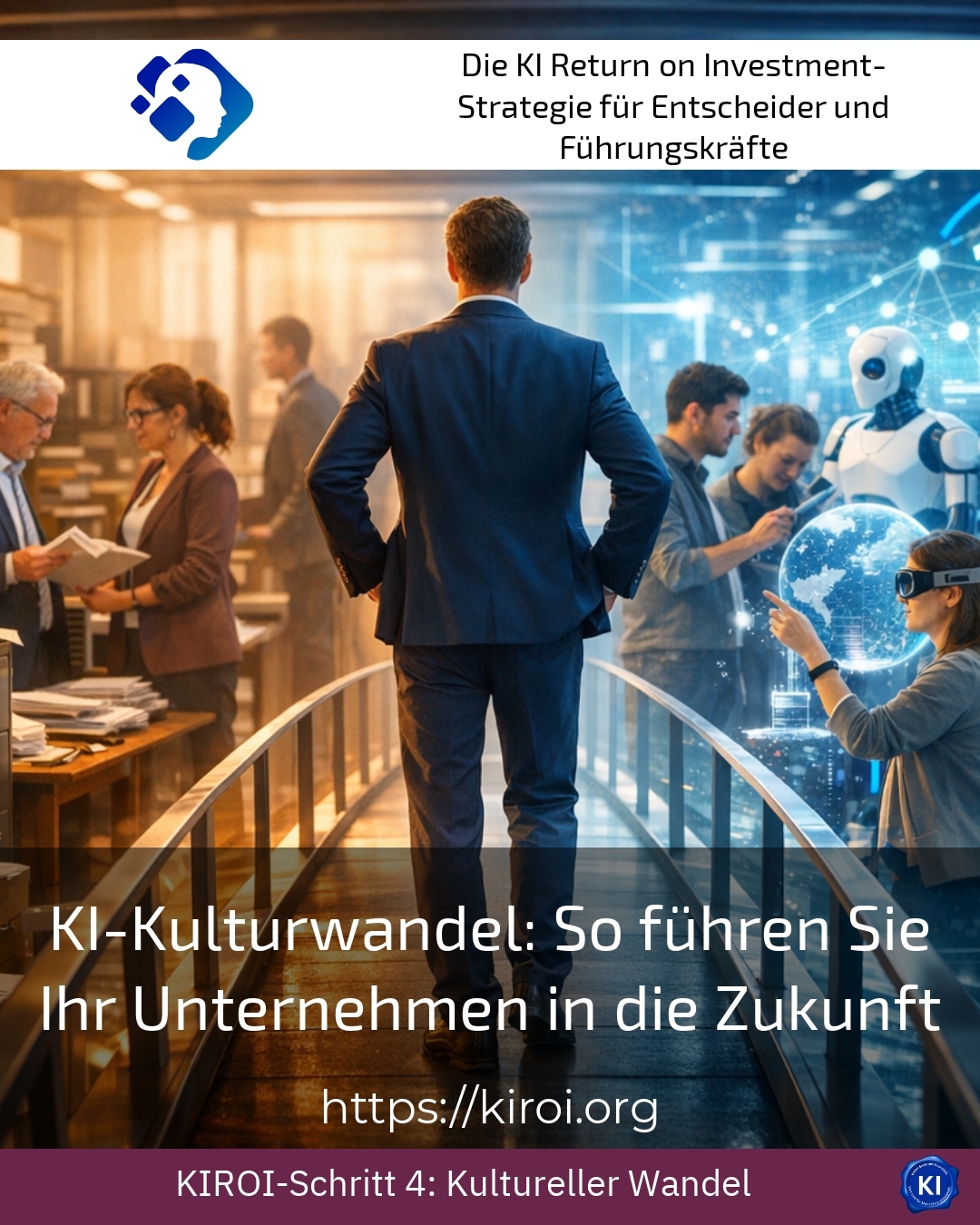
Have you ever wondered why some companies seem to master digital transformation effortlessly, while others fail and fall back despite enormous investments? The answer lies not in the technology itself, but in a fundamental AI cultural change, This transformation goes far beyond installing new software and transforms the entire way an organization thinks, acts, and collaborates. This change requires courage, foresight, and a clear strategy. At the same time, it requires leaders who are willing to break with old patterns. In a world where intelligent systems increasingly support decision-making and optimize processes, corporate culture becomes the decisive factor of success that determines whether an organization flourishes or stagnates.
The invisible force behind successful transformation
Many leaders underestimate the importance of cultural change. They focus on hardware, algorithms, and data infrastructures. However, they forget the most important factor: people. Because technology alone does not create a sustainable competitive advantage. It is only when employees understand and accept new tools that they can fully realize their potential. Studies consistently show that about seventy percent of all digital transformation projects fail [1]. The main reason is almost always a lack of cultural readiness and a lack of change management.
For example, a medium-sized machine manufacturer from southern Germany invested substantial sums in predictive maintenance systems. The technology was highly advanced and promising. Yet no one effectively used the new possibilities. The service technicians distrusted the predictions of the algorithms. They preferred to rely on their decades of experience. It was only when management began actively involving employees that the situation changed. Workshops, open dialogues, and transparent communication created trust. Suddenly, the intelligent systems became valued tools rather than threats.
A logistics company experienced similar experiences when introducing autonomous route planning. At first, the drivers felt controlled and disempowered. Many feared the loss of their jobs. Only through targeted training and honest conversations did the breakthrough occur. The employees realized that the technology supported and relieved them of their workload. Today, they often report improved work quality and less stress.
Best practice with a AIROI customer
A traditional family business in the manufacturing industry faced the challenge of modernizing and making its over-the-decades-established structures more future-proof. The management team recognized early on that technological investments alone would not be enough to compete in the international market and to open up new markets. Together with transruptions coaching, we developed a comprehensive concept that put people at the center and simultaneously defined clear technological goals. We accompanied the company over several months in the gradual implementation of intelligent production control, while paying special attention to the fears and concerns of the long-standing employees. Through regular impulses, moderated dialogue rounds, and individual coaching sessions, it was possible to establish a new culture of openness and continuous learning. After the project was completed, the employees reported increased commitment and a positive attitude towards change. Productivity increased by a significant twenty percent, while turnover dropped significantly.
The change in AI culture begins at the top
Leaders must become ambassadors of change themselves. They cannot expect employees to embrace new ideas if they themselves remain entrenched in old patterns. Authentic leadership means admitting uncertainty and seeking solutions together. For example, a CEO of a retail company began speaking publicly about his own learning processes. He shared about his difficulties with new analytical tools. This openness created an atmosphere of trust and encouraged others to ask questions.
Similar dynamics are also evident in the financial sector. A regional bank introduced intelligent customer advisory systems. The advisors initially feared becoming redundant and losing their personal connection to customers. The management reacted wisely and transparently. It defined new roles that combined human empathy with technological precision. The advisors became relationship managers, while algorithms took on routine analyses. Customer satisfaction and employee motivation increased in parallel.
An energy provider used the transformation as an opportunity to reposition itself. Instead of cutting jobs, it created new development paths. Employees from traditional fields were trained to become data specialists and process optimizers. The investment in people paid off. The company is now considered an attractive employer and attracts talent more easily.
Understanding and constructively using resistance
Resistance to change is not a weakness, but a natural protective mechanism. People fear the unknown and want to preserve their competence. Wise leaders recognize resistance as valuable clues to potential problems. They use critical voices as an early warning system and source of improvements. A pharmaceutical company therefore established a formal feedback system for new technology projects. Critics were not excluded but actively included. Their concerns fed into the further development of the systems.
One automotive supplier took a similar approach. When introducing intelligent quality control, it formed mixed teams. Experienced production workers worked closely with IT specialists. This created a mutual understanding of different perspectives. The developed solutions were more practical and were accepted more quickly.
In the food industry, one company demonstrated how transparency reduces fears. It introduced a dashboard that showed how intelligent systems made decisions. Employees could always see why certain recommendations were generated. This transparency created trust and fostered the acceptance of new work practices.
Adapting structures and processes for AI cultural change
Cultural change requires structural support. Companies must rethink and adapt their organizational structures. Rigid hierarchies often hinder the flow of information and slow down decision-making. Agile structures, on the other hand, enable faster responses to new insights and market changes. A telecommunications provider completely reorganized its teams. Instead of functional silos, cross-functional units with clear responsibilities emerged.
Incentive systems also play an important role. If employees are only rewarded for short-term results, there is no motivation for long-term changes. An insurance company introduced new evaluation criteria. Innovation readiness and progress in learning were included in performance evaluation. Suddenly, experimenting became valuable instead of risky.
A retail company created so-called innovation labs. Employees could test new ideas there without fear of failure. The most successful concepts were then transferred to the regular operations. These spaces for creativity sustainably fueled cultural change and created an atmosphere of curiosity.
Best practice with a AIROI customer
A healthcare group approached us because despite significant investment in technology, the expected efficiency gains had not materialized and employee satisfaction had even declined. The analysis quickly revealed that the implementation of new systems had been carried out without cultural support and that the employees felt left behind. Transruptions Coaching developed, together with the HR department, a multi-stage program that involved both leaders and team members and tailored it to their specific needs. We provided guidance on new forms of communication and accompanied the establishment of regular reflection sessions where successes and challenges could be openly discussed. Within a year, employee engagement metrics improved significantly, and the technological investments began to pay off. The management reported on a noticeably changed atmosphere, characterized by openness and mutual respect. This project impressively demonstrated that sustainable transformation must always combine cultural and technological aspects.
Communication as the key to success
Open and honest communication forms the foundation of any successful transformation. Employees want to understand why changes are necessary. They want to know what effects they can expect on their work. A chemical company established regular town hall meetings on the progress of the transformation. Executives answered uncomfortable questions directly and honestly. This transparency reduced rumors and strengthened trust.
A media house used internal podcasts to inform about new developments. Employees from various departments reported on their experiences. This peer-to-peer communication was more authentic than official statements. The acceptance of new working methods increased measurably.
In the construction industry, a project developer showed how visual communication makes complex relationships understandable. Infographics and short videos illustrated new processes in a clear way. Even employees with less technical knowledge were able to understand and support the changes.
Ensuring sustainability through continuous learning
One AI cultural change It is not a one-time project with a defined end point. It requires continuous development and adaptation to new circumstances. Companies must create learning structures that support and promote lifelong learning. A technology company introduced personal development budgets for all employees. Each one could decide for themselves which skills they wanted to develop. This increased motivation and engagement alike.
One consulting firm established internal mentoring programs. Experienced employees shared their knowledge with younger colleagues. At the same time, they learned from their digital expertise. This reciprocal exchange enriched all involved and strengthened the cohesion.
A hotel chain created virtual learning communities across locations. Employees shared best practices and solved problems together. The organization’s collective intelligence grew continuously and helped to solve challenges more quickly.
My AIROI Analysis
The AI cultural change It presents companies with complex challenges that go far beyond technological issues and touch on the entire self-understanding of an organization. My experience from numerous accompanying projects shows that successful transformation always begins with the people and requires taking their needs seriously. Technology is merely a tool whose value is only realized through competent and motivated users. Leaders play a crucial role as role models and facilitators of change. They must create spaces for experimentation and understand mistakes as learning opportunities. At the same time, employees need clear guidance and honest communication about opportunities and risks. The presented examples from various industries illustrate that no one-size-fits-all recipe exists, but each organization must find its own path. Transruptive coaching can provide valuable impulses and professionally accompany the process without imposing pre-determined solutions. Clients often report breakthroughs when they openly address their fears and are allowed to develop solutions together. The investment in cultural change may initially seem less tangible than the purchase of new systems. However, in the long term, it determines the success or failure of any transformation initiative and thus the future viability of the entire company [2].
Further links from the text above:
[1] McKinsey – Unlocking success in digital transformations
[2] Harvard Business Review – Organizational Culture
For more information and if you have any questions, please contact Contact us or read more blog posts on the topic Artificial intelligence here.







 Deutsch
 English (UK)