
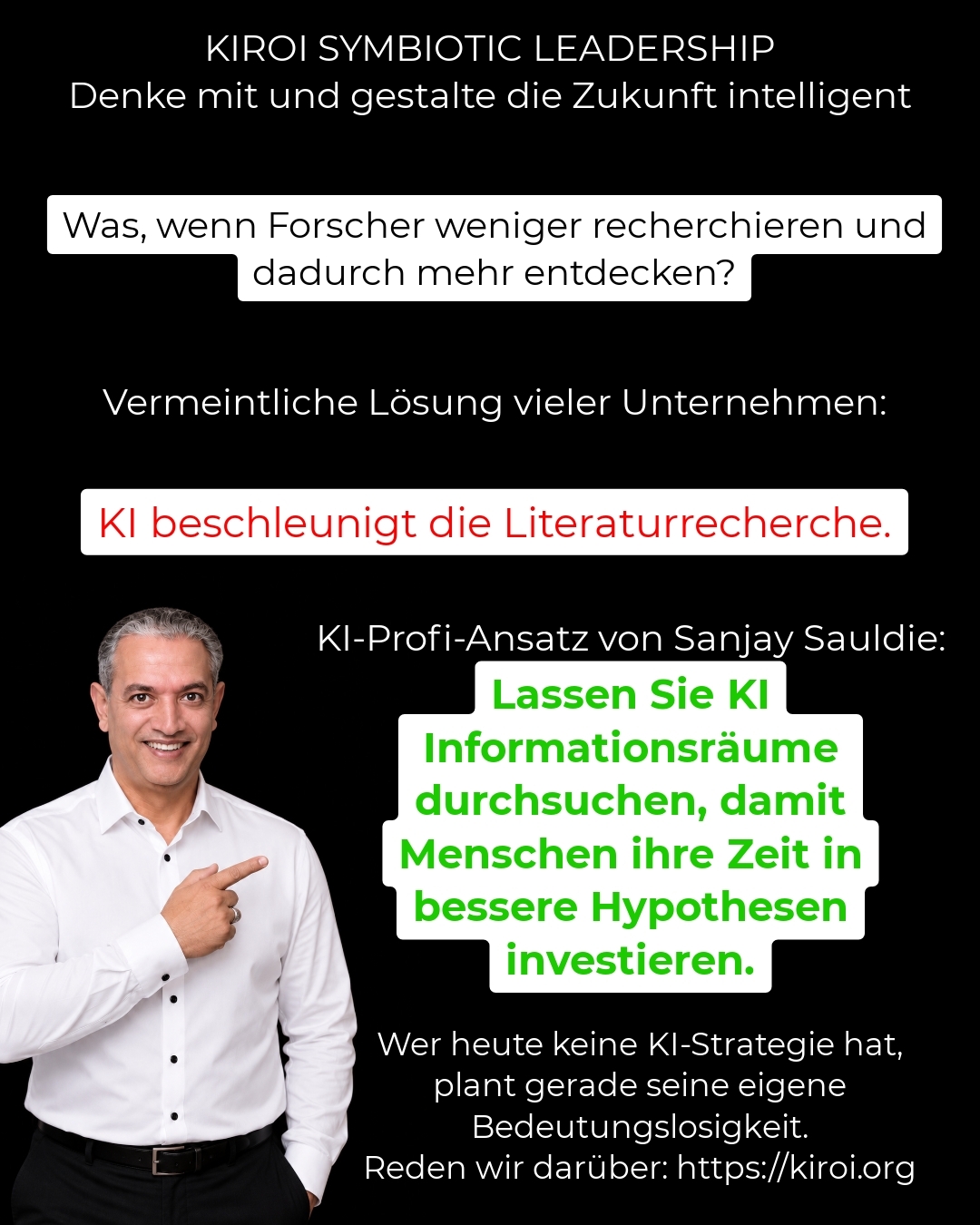
Have you ever wondered why brilliant minds disappear for years into libraries and databases before they can even develop a single new idea? The paradoxical truth is this: The more we search, the less we sometimes find the essence. In a world where the accumulated knowledge of humanity is growing exponentially and doubling every few years, experts face a fundamental dilemma that massively impairs their creative work. AI speeds up literature research in a way that seemed unimaginable just a few years ago, fundamentally changing the way knowledge is created and evolves. This transformation affects not only individual individuals but entire organizations that strive for innovation leadership and must realize that traditional methods are reaching their limits.
Understanding the paradox of the information flood
The sheer volume of available knowledge systematically and relentlessly overwhelms even the smartest experts. Today, a pharmaceutical company must average several thousand scientific publications before a new drug can even enter the development phase. Medical professionals spend up to a third of their working time struggling through specialized literature instead of treating patients or developing new therapeutic approaches. Engineers in the automotive industry scour patent databases, technical documentation, and research reports, while the competition is already working on the next breakthrough. This situation resembles a hamster wheel that is spinning faster and faster and in the process really doesn’t advance anyone.
The cognitive costs of these research marathons are often underestimated and rarely included in corporate balance sheets. After hours of reading and sorting through information, the mental energy for creative synthesis and original thought is lacking. A biotechnology company recently reported that its scientists took an average of four weeks to capture the current state of knowledge about a single protein. At the same time, new publications are emerging daily that immediately render this painstakingly compiled overview obsolete. The irony is that more knowledge does not automatically lead to better decisions, but often leads to analysis paralysis and missed opportunities.
How average companies tackle the problem
Many organizations are responding to this challenge with traditional approaches that treat the symptom but do not address the root cause. They hire more staff, extend project timelines, or specialize teams in ever narrower areas of knowledge. For example, a medium-sized machine manufacturer doubled its research department only to find that the quality of the results had barely improved. Other companies invest in expensive database systems and knowledge management platforms that store information but offer no real relief. These measures are akin to trying to fight a wildfire with a garden hose.
More progressive approaches are already using digital tools, but often fall short of their potential. Search engine-based solutions provide quick results, but do not understand the context and nuances of specialized questions. A chemical company implemented a keyword-based system that produced thousands of irrelevant results and only increased user frustration. Text-based analysis tools can generate summaries, but often overlook the crucial connections between different areas of knowledge. The real challenge lies not in finding information, but in recognizing its significance and linking it together.
AI accelerates literature research as a strategic competitive advantage
Modern technologies offer a fundamental realignment of knowledge work that goes far beyond simple automation. AI speeds up literature research, By not only searching texts but also understanding semantic relationships and making relevant connections. A pharmaceutical company was able to reduce the time for systematic reviews from several months to a few weeks, while even improving completeness. Medical technology companies use intelligent systems to map patent landscapes and identify undiscovered innovation potential. These tools do not replace human expertise but enhance cognitive abilities.
The practical implications of this transformation are evident in various contexts in impressive ways. Automotive suppliers are accelerating their material research by extracting relevant properties from scientific databases using intelligent systems. Food manufacturers are identifying potential allergens and interactions faster than ever before, thereby improving product safety. Energy companies are scouring technical literature for optimization potential in renewable technologies and finding approaches that would have eluded human research teams. The common insight is this: Those who master the information flood gain time for what really matters.
The AIROI-method: intelligently opening up information spaces
The AIROI-approach follows a clear philosophy that places people at the center and understands technology as a tool. Let intelligent systems systematically explore information spaces so that people can invest their time in better hypotheses. This perspective fundamentally differs from approaches that view automation as an end in itself. A diagnostic company implemented this strategy and reported that its scientists had, for the first time, time for exploratory thinking and creative connections. The quality of the developed ideas improved measurably, while the development cycles shortened.
Specifically, this approach involves the redistribution of cognitive resources within organizations and teams. Routine tasks such as organizing, categorizing, and summarizing documents are delegated to systems that are optimized for this purpose. People focus on interpretative and creative tasks that machine intelligence cannot perform. A cosmetics manufacturer freed its product developers from hours of database research and experienced a doubling of the number of submitted innovation proposals. However, this transformation requires a rethinking at all levels of the organization and a conscious design of the human-machine interaction.
Best practice with a AIROI customer
A medium-sized company in the field of industrial biotechnology faced a critical challenge that massively hampered its growth and endangered its competitiveness. The development department needed an average of eight months to work out the scientific background for new enzyme products and document it. Three highly qualified scientists spent the majority of their working time systematically researching the literature and creating state-of-the-art reports. As part of the AIROI mentoring process, it was first analyzed which research tasks could benefit from intelligent systems’ support and which human expertise was required. The company then implemented a specialized system that semantically extracts scientific publications, patents, and technical documentation and visualizes relevant connections. The introduction phase included intensive training to familiarize employees with the new tools and to reduce reservations. After six months, the researchers reported that they had for the first time time to devote time to experimental work and the development of their own research hypotheses. The average time for background research decreased to about six weeks without any loss in quality or completeness. Particularly noteworthy was that the system identified connections between research areas that had not been noticed by experts despite years of experience. A new enzyme product emerged directly from such a machine-discovered connection between environmental microbiology and industrial application. The freed up time was invested by the employees in collaborations with academic partners and the publication of their own research results.
Practical implementation and human factors
Successful implementation requires more than just technological expertise and financial resources. Cultural factors play a crucial role, as many professionals strongly associate their identity with their research expertise. A medical device manufacturer experienced initial resistance because employees feared being replaced by machines. It was only when it became clear that the technology enriched their work rather than replacing it that the skepticism turned into enthusiasm. Transruptive coaching supports organizations in communicating this transformation as an opportunity and in constructively addressing fears.
The quality of the results depends crucially on the formulation of the questions and the critical evaluation of the answers. Intelligent systems do not provide ready-made solutions; they provide structured starting points for human thinking and decision-making. An agricultural technology company explicitly trained its teams to handle machine-generated summaries and critically evaluate them. The ability to ask good questions and evaluate results in context has become the new core competency. This development requires continuous learning processes and an open culture of error, which encourages experimentation and learns from failures.
How AI is accelerating changes in various areas of literature research
The effects of this transformation extend to nearly all knowledge-intensive fields and industries. Material scientists use intelligent systems to identify optimal alloy compositions for specific applications from millions of publications. Environmental technologists search the literature for biological degradation processes for new pollutants, thereby significantly shortening development times. Food technologists identify functional ingredients and their interactions faster than ever before and bring innovative products to market more quickly.
The connection between accelerated research and improved hypothesis formation is evident in measurable results and concrete success stories. A packaging manufacturer developed biodegradable materials within months that would have taken years previously. Cosmetics companies discover natural active ingredients with desired properties in fractions of the time previously required, while simultaneously reducing animal testing. Beverage manufacturers optimize fermentation processes based on systematically acquired scientific insights and improve flavor and shelf life. The shared experience confirms: Less time spent searching means more time to think and experiment.
Integration into existing workflows
The practical integration of new tools requires a careful analysis of existing processes and their weaknesses. A chemical company first documented in detail how its employees currently research and what frustrations arise in the process. This inventory revealed inefficiencies that no one had previously systematically recorded and that consumed significant resources. Transruptive coaching supports teams in gradually introducing changes and learning from early experiences. Pilot projects in defined areas allow for the correction of childhood diseases and the development of best practices before a broader rollout takes place.
Success is critically linked to the integration of technological tools with existing knowledge management systems and work platforms. A diagnostic company integrated intelligent search functions directly into its laboratory information systems, thereby reducing media gaps. Pharmaceutical companies automatically link literature analyses with clinical study data and regulatory documentation for a holistic view. This seamless integration prevents new tools from being perceived as an additional burden and instead delivering real added value. Acceptance increases measurably when the benefits are immediately felt in daily workflow and do not require any additional steps.
My AIROI Analysis
The transformation of knowledge work by intelligent systems is still in its infancy, but it already shows impressive results in various application contexts. Organizations that invest early in these skills build systematic advantages that strengthen and accumulate over time. Experience shows that technological tools alone are not sufficient and that human factors are often underestimated in their importance for success. A facilitated introduction that addresses cultural aspects, qualification needs, and change management challenges significantly increases the probability of success and reduces resistance. The transruptive accompaniment of such projects has shown that the combination of strategic clarity, technical expertise, and human sensitivity makes the difference between failure and sustainable success.
Particularly noteworthy is the observation that freed time does not automatically lead to better results; it must be deliberately created through leadership and structure. Organizations must actively create and protect spaces for creative thinking, experimentation, and interdisciplinary exchange, while avoiding operational urgencies. Otherwise, the time gained will be wasted in other routine tasks or absorbed by new reporting requirements, leading to loss. Leadership plays a crucial role in communicating the transformation, managing expectations, and promoting new working practices through their own behavior. The AIROI perspective emphasizes that technology should always be at the service of human goals and must never become an end in itself in practical application.
Clients often report that the biggest obstacles are not of a technical nature but lie in habits, fears, and organizational structures that make change difficult. Therefore, accompanying such transformation projects requires patience, empathy, and the ability to integrate and convey different perspectives. The journey from traditional research to intelligent knowledge discovery is not a sprint but a marathon with many learning loops and adjustments. Organizations that embark on this journey with openness, a spirit of experimentation, and a clear vision will reap the benefits of their investment and differentiate themselves significantly from the competition.
Further links from the text above:
[1] Nature: How AI is transforming scientific research
[3] ScienceDirect: AI in Research and Development
Are you a leader and would you like to learn how you can genuinely introduce AI into your company in a valuable and sustainable way, away from the hype? Take part Contact us or read more blog posts on the topic Artificial intelligence here.









 Deutsch
 English (UK)