
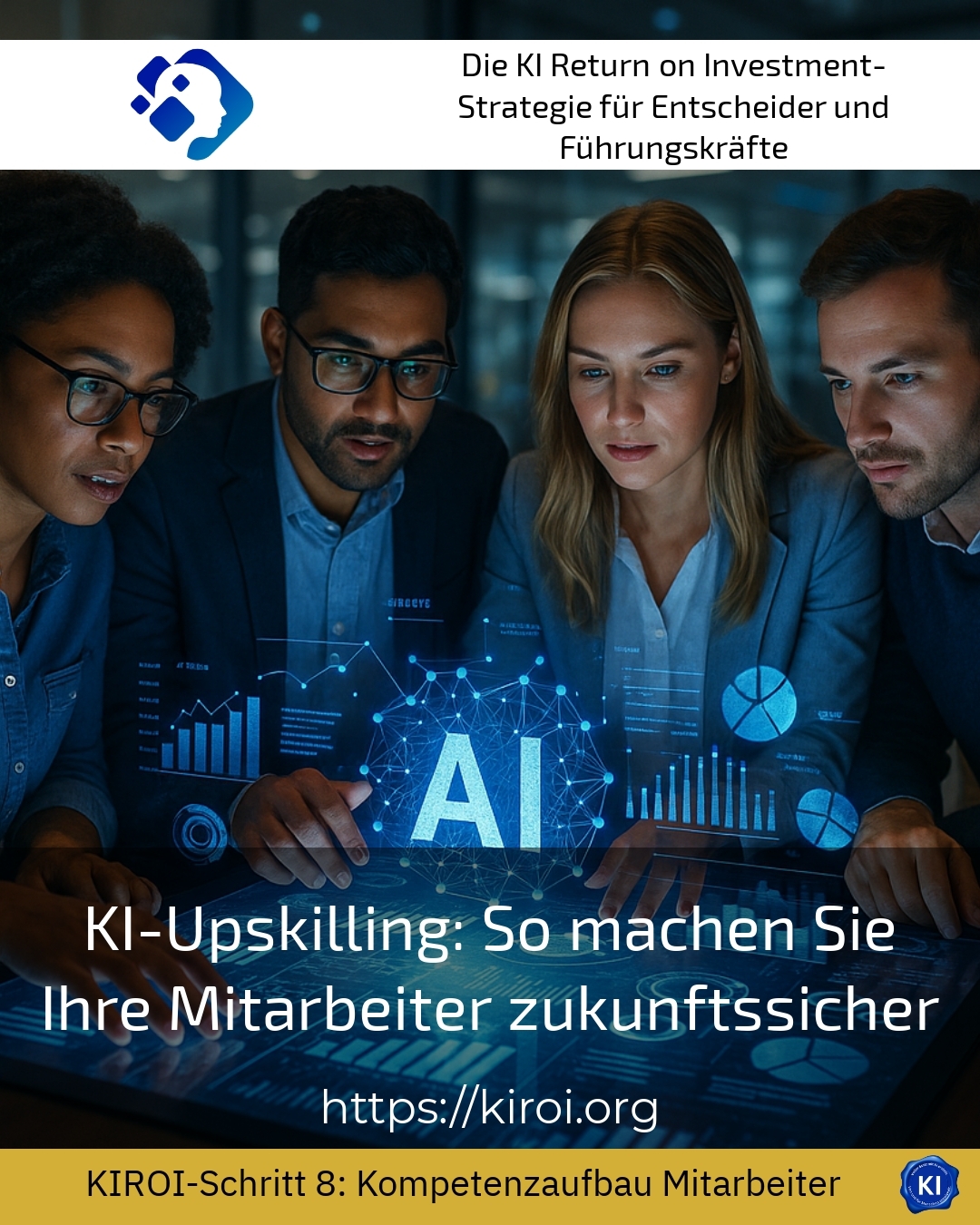
The digital transformation is fundamentally changing every industry. Companies face a crucial question: How do we prepare our teams for a rapidly changing world of work? AI Upskilling: How to Make Your Employees Future-Proof – this challenge occupies managers and HR professionals alike. Because those who do not invest in the skills development of their workforce today risk losing touch with competitors tomorrow. In this article, you will learn which strategies have proven effective and how you can initiate sustainable change in your organisation.
Why competence development is crucial now
The world of work is undergoing fundamental change. Automated processes are increasingly taking over routine tasks. At the same time, entirely new fields of activity are emerging. This development affects practically all economic sectors. A medium-sized manufacturing company from Bavaria, for example, has found that traditional machine operators today must understand complex control systems. The demands on technical understanding have risen considerably.
Similar patterns are also emerging in the healthcare sector. Nursing staff are increasingly working with digital documentation systems. Doctors are using intelligent diagnostic tools for support. These tools do not replace expertise, but rather complement it intelligently. In the retail sector, on the other hand, customer advice and inventory management are changing equally. Employees today require different skills than they did just a few years ago.
The financial sector is also undergoing a profound transformation. Bank employees need to understand how algorithmic systems support credit decisions. Insurance employees work with automated claims processing systems. And in customer service, hybrid models are emerging that combine human advice with technical support. All these examples highlight a common denominator: lifelong learning is no longer an option, but a necessity.
AI Upskilling: How to future-proof your employees through strategic planning
A successful qualification strategy begins with an honest assessment. What skills does your company currently possess? What skills will be needed in the coming years? This analysis forms the foundation for all subsequent steps. It is advisable to actively involve both managers and employees. Because only by understanding the perspectives of all stakeholders can suitable measures be developed.
In mechanical engineering, several companies have had positive experiences with so-called competence maps. These clearly visualise which skills are available where within a company. At the same time, they highlight gaps that should be addressed. A automotive supplier uses this tool to specifically plan further training measures. This allows the HR department to use resources efficiently.
Craft businesses also benefit from a structured approach. An electrician from the Rhine-Main region, together with their employees, has defined development pathways. Everyone on the team knows which qualifications are required for specific areas of responsibility. This transparency creates both motivation and orientation. In the logistics sector, by contrast, larger companies are investing in digital learning platforms. These make it possible to provide training content flexibly and according to demand.
Best practice with a AIROI customer
A medium-sized food production company faced the challenge of preparing its growing workforce for new technological requirements. Many employees had been with the company for decades and had little experience with digital tools. Management opted for a cautious approach that would involve all employees. Together with transruptions-coaching, a comprehensive needs analysis was initially carried out. This revealed that the greatest uncertainties lay not in technical skills, but in the fundamental attitude towards change. The coaching team subsequently supported managers and teams in several workshops. The focus was on developing a positive learning culture throughout the company. Older employees were used as mentors for their specialist knowledge, while younger colleagues contributed technical know-how. This mutual support significantly strengthened team cohesion. After six months, those responsible reported a significantly increased willingness to embrace new things. Productivity remained stable, despite extensive training measures taking place concurrently. Clients in such projects often report similar experiences when they shape change processes actively and appreciatively [1].
Developing individual learning paths
People learn at different speeds and in different ways. This understanding should inform every qualification strategy. Some employees prefer traditional in-person training with personal interaction. Others prefer to learn independently at their own pace using digital media. Experience shows that combining different formats yields the best results.
In the pharmaceutical industry, one company has had positive experiences with so-called learning partnerships. In these, two employees each support each other in acquiring new skills. In the renewable energy sector, installers are increasingly relying on manufacturer training with practical exercise sessions. This combination of theory and practice has proven to be particularly effective. Innovative learning formats are also emerging in the hospitality industry, such as short video tutorials for new till systems.
The construction industry is increasingly experimenting with virtual reality applications for training purposes. Complex processes can thus be trained safely before they are implemented on the actual construction site. This method saves time and significantly reduces sources of error. In the field of building services engineering, specialist companies are using digital twins of systems for training purposes. This allows employees to play through various scenarios and deepen their knowledge.
Overcoming resistance and creating acceptance
Not all employees are open to change. This reluctance is understandable and should be taken seriously. Fears of being overwhelmed or losing one's job often play a central role. Open communication about goals and expectations can help here. Managers should make it clear that further training is not a threat, but an opportunity.
A printing company from Saxony has chosen an interesting approach. Management invited sceptical employees to contribute their own ideas for the design of learning programmes. This involvement led to significantly higher acceptance of the later measures. In the metalworking sector, companies reported similar experiences. When employees can co-create, they identify more strongly with the goals.
Even small successes should be made visible and appreciated. For example, in a tax consultancy firm, learning successes are regularly shared within the team. This motivates others and shows that progress is possible. An advertising agency from Hamburg introduced so-called "learning lunches" where employees present their new knowledge. These informal formats lower the barrier to participation and encourage exchange. In the social sector, providers have had positive experiences with peer advisory groups.
AI Upskilling: How to Make Your Employees Future-Proof with the Right Company Culture
Sustainable skills development requires more than just individual training measures. It needs a corporate culture that values and promotes continuous learning. This culture doesn't emerge overnight, but develops gradually. Leaders play a role model function in this, which should not be underestimated. If they themselves are open to new things, it signals credibility.
A software company from Munich grants its employees time for self-directed learning on a weekly basis. This so-called learning time is firmly integrated into daily work routine and is respected by everyone. In the textile sector, individual companies have introduced similar models. Here too, it becomes clear that structural integration is more important than one-off appeals. In the field of management consulting, regular further training is often part of the company philosophy.
Fault tolerance is another important building block of a learning-conducive culture. Those who are afraid of making mistakes will hardly try new things. A chemical company has therefore created so-called experimentation rooms. There, teams can test new technologies without having to fear consequences for failures. This psychological safety fosters innovation and willingness to learn equally. In the retail sector, initial companies are experimenting with similar concepts for their branches.
Best practice with a AIROI customer
A family-run furniture production company approached transruptions-Coaching with a specific request. The third generation wanted to digitalise the company but encountered reservations from long-standing employees. During the coaching process, it became clear that the resistance stemmed from valid concerns. Many feared that their years of experience would suddenly become worthless. The support provided by transruptions-Coaching helped to address these fears constructively and transform them into energy for change. Together, the team developed a qualification concept that built upon existing strengths. The experienced wood specialists were given the opportunity to integrate their traditional knowledge into digital documentation. At the same time, they gradually learned to work with computer-controlled manufacturing systems. A key success factor was the close involvement of the works council representative, who acted as a mediator between the generations. After approximately nine months, the mood within the company had noticeably shifted. The initial scepticism had given way to cautious curiosity. Today, experienced and younger employees work closely together and learn from each other. Clients often report that this intergenerational collaboration, in particular, leads to the most valuable outcomes [2].
Measurable successes and long-term prospects
Investments in skills development should demonstrably pay off. It is therefore advisable to define clear goals and key performance indicators from the outset. These can be quantitative or qualitative in nature, depending on the company's situation. For example, a logistics company measures the number of successfully completed training modules per employee. In addition, regular satisfaction surveys are conducted to evaluate the quality of the offerings.
In the healthcare sector, hospitals use competency profiles that are regularly updated. This allows the progress of individual employees to be tracked and documented. In the energy industry, utility companies rely on certification programmes with recognised qualifications. These offer employees an additional incentive, as they can prove their qualifications outside the company as well. In the trades, guilds have developed similar programmes.
In the long term, it's about more than individual learning successes. It's about creating an organisation that continuously evolves. A mechanical engineering company from Baden-Württemberg has recognised this and aligned its HR strategy accordingly. For them, qualification is no longer a side issue, but an integral part of corporate planning. In the chemical industry, several corporations are pursuing similar approaches with strategic personnel development.
The role of external support in transformation projects
Not all challenges can be overcome alone. Sometimes an external perspective can provide valuable insights and uncover blind spots. Professional guidance helps to approach complex change processes in a structured manner. This is not about ready-made solutions, but about a partnership based on equal footing.
transruptions-Coaching clearly positions itself as support for projects involving organisational change. The approach is based on the conviction that every company brings its own strengths and resources. The aim is to identify and further develop these. In the media sector, several publishers have benefited from such support. The digital transformation presented particularly high demands on the workforce there.
The benefits of external support are also evident in the manufacturing sector. A tool manufacturer reported that the external perspective helped to break down ingrained ways of thinking. In the service sector, on the other hand, companies value the methodological expertise that external partners bring. It is always important that responsibility for implementation remains within the company itself. Only in this way can sustainable change be achieved.
My AIROI Analysis
The systematic development of employees' skills is not a short-term fad, but a strategic necessity for companies of all sizes and sectors. My analysis shows that successful organisations share several factors: they start with an honest assessment of the current situation, actively involve all stakeholders, and create structural conditions for continuous learning. The corporate culture plays a role that is at least as important as the specific training measures themselves.
The numerous examples from different sectors illustrate that there is no one-size-fits-all solution. Each company must find its own path, suited to its specific situation. At the same time, valuable insights can be drawn from the experiences of others. The realisation that resistance to change should not be seen as an obstacle but as a valuable source of information seems particularly important to me. Behind scepticism often lie legitimate concerns that must be taken seriously.
AI Upskilling: How to Future-Proof Your Employees – This task requires patience, perseverance, and a clear vision. However, the investment pays off in multiple ways: skilled employees are more motivated, productive, and remain loyal to the company for longer. Given demographic change and the shortage of skilled workers, this is a significant argument. Companies that invest in their people today will be better positioned tomorrow than those that sleep through this development. The future belongs to the learners – and to the organisations that enable and promote learning [3].
Further links from the text above:
[2] World Economic Forum – Future of Jobs Report
[3] Bitkom – Further Training in the Digital World of Work
For more information and if you have any questions, please contact Contact us or read more blog posts on the topic Artificial intelligence here.








 Deutsch
  English (UK)