
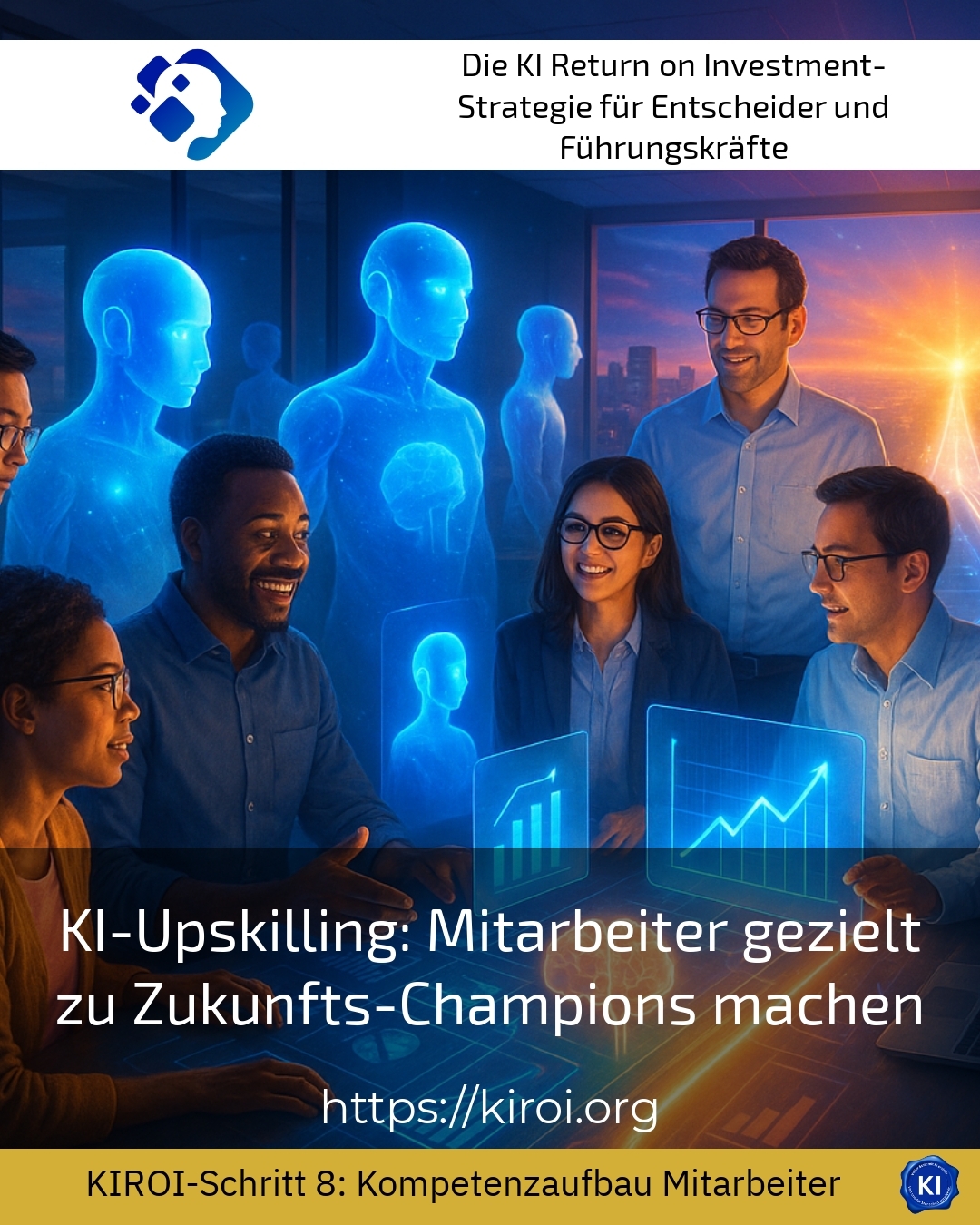
The digital revolution is fundamentally changing every workplace. Companies face the challenge of making their teams fit for new technologies. AI Upskilling: Making Employees Targeted Future Champions is the crucial success factor. But how can this transformation be achieved in practice? Many managers report uncertainties in implementation. They wonder which skills really count and how they can bring their workforce along. This article provides practical impulses and shows proven approaches.
Why developing digital skills is crucial now
The world of work is undergoing a profound structural change. Routine tasks are increasingly being automated. At the same time, entirely new fields of activity are emerging. This shift affects almost all industries and professional groups. Employees therefore require new skills. They must learn to work collaboratively with intelligent systems. Companies that invest in this development early on secure important competitive advantages. They can react more quickly to market changes and develop innovative solutions. Building digital skills is thus no longer an option, but a strategic necessity.
Many organisations have recognised this urgency. They are looking for suitable ways to empower their workforce. It often becomes clear that traditional training formats are not sufficient. Employees need practical learning experiences. They need to be able to try out new tools directly within their work context. Only then does a genuine understanding of the possibilities and limitations of modern technologies emerge. Transruption coaching supports companies in designing such learning environments.
AI Upskilling: Making Employees Targeted Future Champions Through Structured Learning Paths
Successful competency development follows clear structures. It begins with an honest assessment. Which skills are already present? Where are there gaps? This analysis forms the foundation for all further measures. Individual learning objectives are then defined. Experienced consultants take into account both the company strategy and the personal strengths of the employees. This creates tailor-made development programmes that deliver real added value.
Practical implementation requires various learning formats. Workshops provide foundational knowledge in a compact form. Project-based learning enables direct application in daily work. Mentoring programmes promote knowledge exchange between experienced and less experienced colleagues. This combination of different approaches significantly increases learning effectiveness. Employees can embed their knowledge better and transfer it to practice more quickly.
Best practice with a AIROI customer
A medium-sized company faced the challenge of qualifying its workforce for new digital work processes. Management had recognised that technological changes would affect all departments. Together with the transruptions coaching team, a comprehensive skills analysis was first carried out. This revealed a significant need for training, particularly in the area of data analysis. The company subsequently developed a three-stage learning programme. In the first stage, all employees received a basic introduction to digital tools. The second stage involved in-depth workshops for key personnel from various departments. These multipliers then passed on their knowledge to their teams. The third stage consisted of supervised practical projects where what had been learned was directly applied. After six months, measurable improvements in work efficiency were evident. Employees reported increased confidence in dealing with new technologies. The opportunity to contribute their own ideas and immediately try out what they had learned was particularly well received.
The role of leaders in the change process
Leaders play a key role in skills development. They significantly shape the learning culture within their teams. When managers themselves show an interest in new technologies, it motivates their employees. They create space for learning and experimentation. They encourage questions and accept mistakes as part of the learning process. This attitude is crucial for the success of training measures.
At the same time, leaders themselves need support. Many report feeling uncertain about how to handle technological change. They wonder how best to guide their teams. Transruption coaching offers targeted support here. It helps leaders to expand their own digital proficiency. Additionally, they receive tools to manage change processes within their teams. This enables them to become credible role models for continuous learning.
Practical strategies for sustainable competence development
Sustainable skills development requires a long-term approach. One-off training sessions are not enough. Instead, companies should create continuous learning opportunities. This can be achieved through regular knowledge boosts. Short digital learning units can be easily integrated into the daily work routine. They keep knowledge fresh and enable step-by-step learning [1]. This method is often referred to as microlearning and shows good results in many contexts.
Furthermore, exchange between colleagues promotes joint learning. Learning circles or experience groups offer space for discussions and mutual support. Employees can share their findings and benefit from each other. Such formats additionally strengthen team cohesion. They create a climate in which learning is considered valuable and desirable. Companies often report positive effects on employee satisfaction.
The selection of suitable learning content deserves special attention. Not all topics are equally relevant to all employees. A differentiated approach based on job roles and prior knowledge is sensible. Some teams primarily need technical understanding. Others benefit more from strategic knowledge about potential applications. The AIROI method supports this differentiation and helps to define suitable learning paths [2].
AI Upskilling: Making Employees Targeted Future Champions with Individual Support
Everyone learns in their own way. Some prefer visual materials. Others learn better through hands-on practice. Still others benefit from intensive conversations and discussions. Effective training programmes take these differences into account. They offer different approaches to the same topic. This allows employees to choose the path that suits them best.
Individual coaching support further enhances this personalised development. Specific questions can be clarified in one-on-one discussions. Employees are given space to address their own uncertainties. Together with their coach, they develop concrete next steps. This personal support often makes the decisive difference. It transforms general knowledge into individual competence.
Best practice with a AIROI customer
A larger organisation had already undertaken several training initiatives. However, the results fell short of expectations. Employees were unable to sufficiently transfer what they had learned into their daily work. Transruptions coaching was brought in to analyse the situation. The investigation revealed that previous measures had paid too little attention to individual needs. There was a lack of opportunities for practical application with guidance. A new concept was developed together. This combined short learning modules with regular practical phases. Each participant also received a personal learning coach. This coach was available for questions and provided support with specific work tasks. Results noticeably improved within a few weeks. Employees reported that they could now actually apply the new knowledge. Managers observed significantly higher motivation in their teams. The combination of structured learning and individual support proved to be particularly valuable. This mix made it possible to reach and encourage different learning types equally.
Mastering challenges and constructively using resistance
Change processes rarely run smoothly. Resistance is a natural part of any transformation. Some employees fear being replaced by new technologies. Others doubt the sense of the changes. Still others feel overwhelmed by the speed of change. These concerns deserve serious consideration. They show which topics need to be addressed even better in communication.
Open conversations about worries and fears build trust. Leaders should actively seek out and encourage these discussions. They can highlight the opportunities that change offers. New skills increase one's employability. They open up more interesting areas of work and greater scope for creativity. These positive aspects should be clearly communicated. At the same time, honesty is important. Not all questions can be answered immediately. Leaders are also allowed to admit to uncertainties.
Transruption coaching also supports companies during difficult phases. It offers methods for constructively dealing with resistance. Valuable insights are often hidden behind rejection. Critical voices can draw attention to real problems. They help to improve qualification programmes and make them more practice-oriented. Ultimately, an open approach to criticism strengthens the entire change initiative [3].
Measurable successes and continuous improvement
The effectiveness of training measures should be reviewed regularly. Various indicators are suitable for this. How well can employees use new tools? How has their way of working changed? What concrete results have been achieved? These questions help to assess progress.
As well as quantitative measurements, qualitative feedback provides important insights. Participant surveys show which elements were particularly helpful. They also reveal potential areas for improvement. This information is incorporated into the further development of the programmes. This creates a continuous improvement process. Training offerings are increasingly tailored to actual needs.
AI Upskilling: Making Employees into Future Champions as a Collective Task
Developing digital skills is not an individual task. It requires the cooperation of various stakeholders. Management, HR, and specialist departments must work together. External experts can provide valuable input. Employees themselves are also important partners in the process. Their experiences and ideas enrich any qualification programme.
This collaborative approach fosters acceptance of the measures. When employees are involved in the design process, they identify more strongly with the objectives. They see themselves as active contributors rather than passive recipients of training. This attitude reinforces learning motivation and leads to better results. Companies should therefore consciously create opportunities for participation.
Best practice with a AIROI customer
A company wanted to enthuse its entire workforce for digital transformation. The management opted for a participatory approach. Initially, working groups were formed from different departments. These groups collected ideas for meaningful qualification topics. The employees contributed their practical experience. They knew best which skills were lacking in their daily work. This input resulted in a tailor-made programme. Transruption coaching accompanied the entire development process. It moderated the working groups and contributed methodological knowledge. The combination of internal knowledge and external expertise proved to be particularly fruitful. The finished programme was very positively received by the employees. They recognised their own ideas within it. The willingness to participate was correspondingly high. The managers also actively supported the initiative. They had accompanied the creation process and fully stood behind the goals. This collaborative approach contributed significantly to the success of the qualification programme.
My AIROI Analysis
The systematic development of digital competencies is becoming increasingly important for companies. Those who empower their employees early on create important prerequisites for future success. It is becoming apparent that technical knowledge alone is not enough. Methodological skills and an open attitude towards change are equally important. Effective qualification programmes take all these dimensions into account.
The practical examples illustrate how successful paths can look very different. The crucial factor is the match between measures and concrete needs. Standard solutions often fall short. Therefore, a careful analysis of the initial situation forms the basis for effective programmes. Transruption coaching offers valuable support here.
The AIROI method has proven its worth in many projects. It combines strategic perspectives with practical implementation. It considers both organisational and individual factors. This holistic approach significantly increases the probability of success. Companies that work with this method frequently report sustainable improvements.
Looking ahead, further developments are anticipated. The demands for digital skills will continue to grow. Companies must therefore continuously invest in the training of their employees. One-off measures will not be sufficient. Permanent structures for lifelong learning are needed. Those who build these structures today will have an advantage tomorrow.
Further links from the text above:
[1] McKinsey – Future of Work Insights
[2] AIROI - Masterplan for AI Transformation
[3] Harvard Business Review – Change Management
For more information and if you have any questions, please contact Contact us or read more blog posts on the topic Artificial intelligence here.








 Deutsch
  English (UK)