
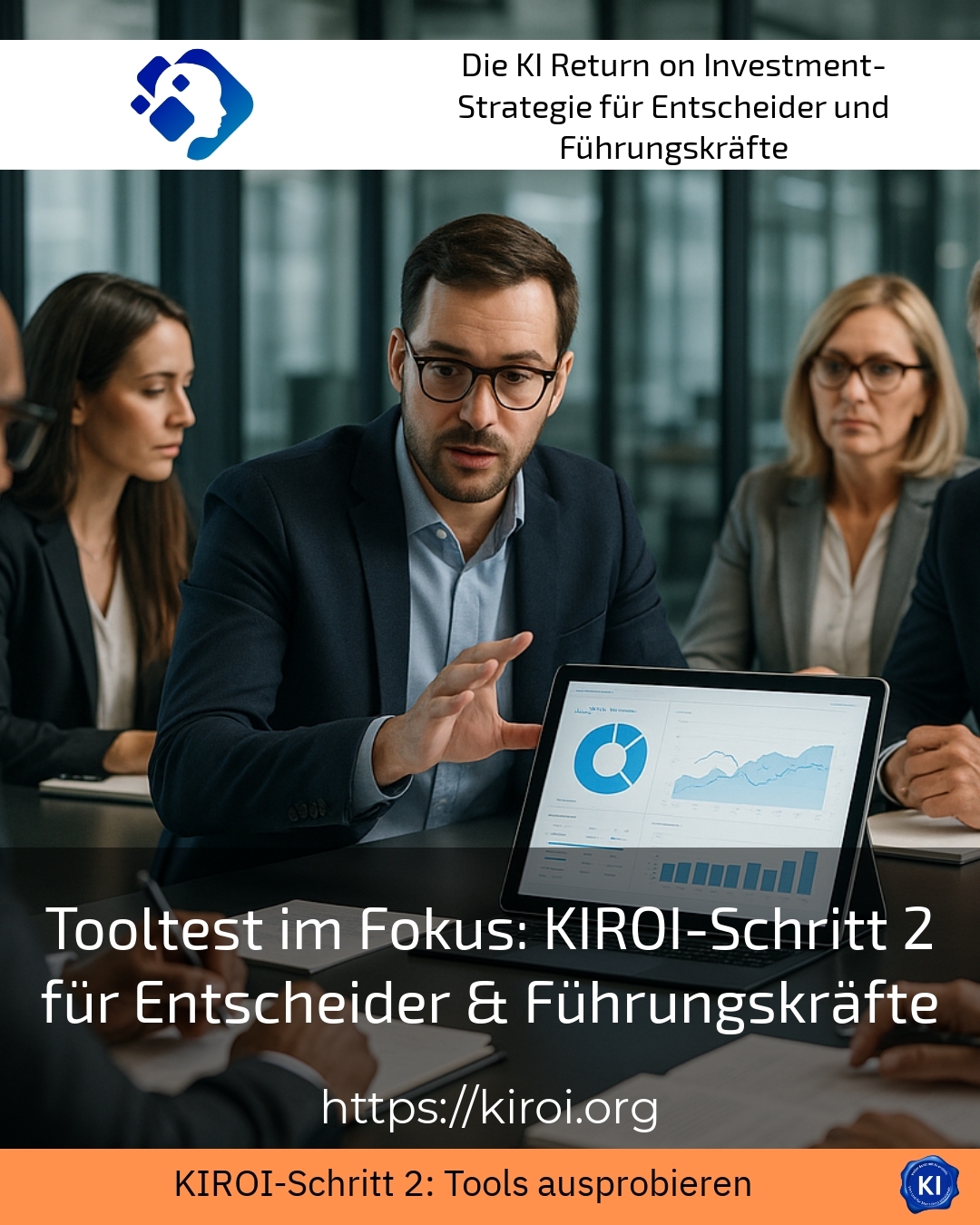
The term Tooltest is at the heart of a clearly structured process with which decision-makers and managers thoroughly test digital tools for their practical suitability. In the second step of the AIROI methodology, the Tooltest Companies in evaluating suitable technologies not just based on technical criteria, but also in terms of their integration into existing processes. This allows for comprehensively informed decisions to be made, accompanying the successful implementation of new solutions.
Systematic preparation: the foundation for a successful tool test
Before the Tooltest begins, the focus is on a precise analysis of individual company requirements and the definition of concrete use cases. For example, executives from the manufacturing industry focus on scenarios that test the efficiency of automated quality assurance. Service providers, on the other hand, test tools that improve customer communication and digitise processes. In the financial sector, too, emphasis is placed on the seamless integration of risk management solutions. Such practical application cases help to concentrate the entire process on relevant criteria and collect tested feedback from realistic environments.
Therefore, typical challenges include: Which software fits precisely with the existing IT systems? How user-friendly are the applications? And how are costs and follow-on costs assessed transparently? These questions can only be answered with a structured Tooltest answer, taking all relevant aspects into equal consideration.
Tool testing in AIROI step 2: Criteria and concrete implementation
Within the framework of Tooltests Decision-makers follow an iterative process. After selecting potential tools, tests are carried out in realistic, practical scenarios. A production company, for example, conducts tests with different sensor-based inspection systems to optimise the detection of manufacturing defects. In healthcare, documentation solutions are tested for their user-friendliness and data security. A financial service provider checks AI tools for risk assessment for their scalability and integration into existing risk management systems.
Important criteria when Tooltest include
- Technical functionality and adaptability to operational processes
- Compatibility with existing systems and databases
- Usability and employee acceptance
- Cost transparency and maintenance and subsequent costs
- Security and data protection standards
This comprehensive review ensures that not only theoretical functionalities are tested, but actual deployment possibilities are assessed realistically. This provides decision-makers with reliable data that optimises later implementation.
BEST PRACTICE with one customer (name hidden due to NDA contract)
BEST PRACTICE with one customer (name hidden due to NDA contract) and then the example with at least 50 words.
A media company used the Tooltest In AIROI's Step 2, different AI-based text creation solutions were compared. The focus was on text quality, adaptability to internal workflows, and user acceptance. Through this structured approach, the company was able to integrate a bespoke solution that sustainably supports the editorial team in content creation and simplifies work processes.
Success factors: User feedback and documentation in focus
A fundamental part of the Tooltests is the systematic collection of feedback from users. Only in this way can potential and possible hurdles be identified early on. For example, retail executives report that user surveys during testing provide important insights into user interface concepts that need improvement. In the manufacturing sector, documented feedback helps to realistically assess the compatibility of the tested systems with existing control systems. IT teams from the service sector also use this information to precisely plan training strategies.
The careful documentation of all test results also creates transparency, which is indispensable for management decisions. It ensures traceability and allows for targeted adjustments to be implemented in the further course of the project.
BEST PRACTICE with one customer (name hidden due to NDA contract)
BEST PRACTICE with one customer (name hidden due to NDA contract) and then the example with at least 50 words.
A financial services provider used the feedback process in the Tooltest, to better adapt an AI-powered forecasting algorithm to the needs of its risk department. The feedback revealed that the user interface was designed too simplistically for experienced analysts, which initiated targeted further development. This allowed the tool to be introduced with a broader acceptance base and significantly increased the effectiveness of risk assessment.
Practical tips for decision-makers and managers
In order to Tooltest To ensure an optimal design, it is advisable to involve interdisciplinary teams from the outset. This ensures that different perspectives from engineering, subject matter experts, and users are taken into account. Furthermore, it makes sense to import real data from day-to-day operations into the testing environment. This yields more realistic results compared to simulated scenarios.
Similarly, transparent communication helps to increase the acceptance and motivation of those involved. Managers often report that clearly communicated goals and open feedback sessions significantly facilitate implementation. Planning sufficient resources for training measures should also be part of the preparations.
BEST PRACTICE with one customer (name hidden due to NDA contract)
BEST PRACTICE with one customer (name hidden due to NDA contract) and then the example with at least 50 words.
A medium-sized company from the service sector integrated the Tooltest in its digitalisation project, focusing on close collaboration between IT and specialist departments. By jointly defining realistic use cases, a communication tool was selectively chosen that improves collaboration while also being easy to use. The project thus achieved a high level of user satisfaction and realised measurable efficiency gains.
My analysis
The Tooltest In AIROI Step 2 is an indispensable building block for specifically guiding executives in selecting suitable digital tools. The structured combination of requirements analysis, realistic tests, and systematic evaluation makes it possible to identify the optimal solution mix. Practical examples from various sectors illustrate that without sound Tooltest time and energy are often wasted. Furthermore, involving users promotes sustainable acceptance of new systems. Companies that Tooltest as an integral part of their digital strategy, they lay the foundation for long-term success and future-proof processes.
Further links from the text above:
AIROI Step 2: Tool Test – How Decision-Makers Evaluate AI Solutions
Tooltest: Successfully try out AI tools with AIROI Step 2
Tool Test in AIROI Step 2: How Decision-Makers Find the Best
For more information and if you have any questions, please contact Contact us or read more blog posts on the topic Artificial intelligence here.









 Deutsch
  English (UK)