
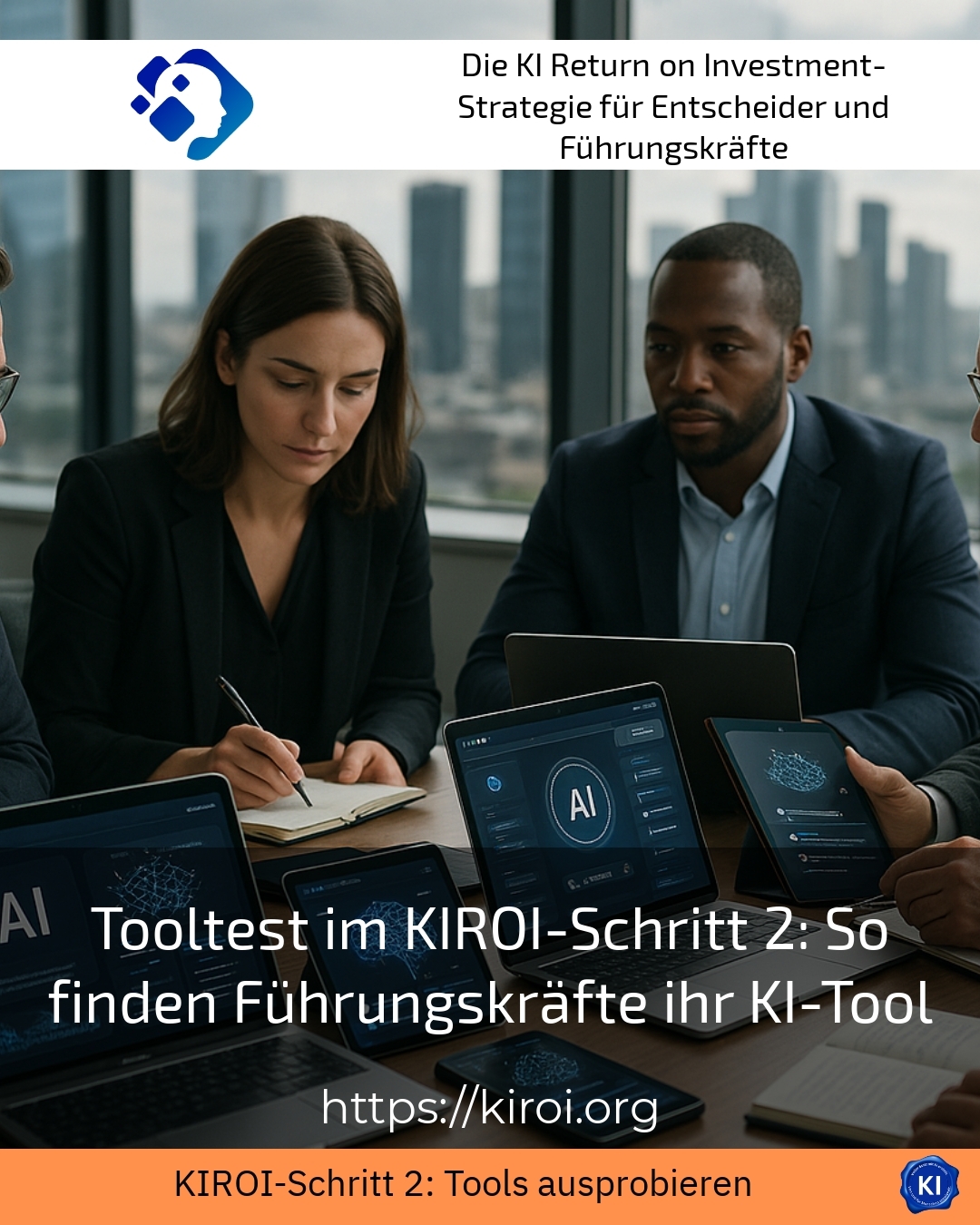
The **Tool Test** plays a central role in KIROI Step 2 for executives looking to find suitable AI tools for their company. This involves not only technical functionalities but also user-friendliness, integration, and practical applicability. A well-structured tool test supports decision-makers in selecting the right software and shaping digital transformation in a targeted manner.
Tool testing in the KIROI process: More than just a technology assessment
In the second step of the KIROI process, leaders begin with a detailed analysis of company-specific requirements. This analysis forms the foundation for subsequent tool testing. Concrete use cases are defined that play a role in daily operations. For instance, manufacturing companies examine how well an AI-based early warning system detects errors and stabilises production. Marketing teams test tools for automation or competitive analysis, while administrative departments evaluate solutions for secure and efficient documentation.
The tool test therefore goes beyond a purely technical assessment. It encompasses organisational aspects such as user-friendliness, data protection, and compatibility with existing systems. Only in this way can managers find tools that will actually hold up in day-to-day business and create added value.
Practical examples from various industries
In logistics companies, for example, AI-powered route planners are being tested that optimise complex supply chains and reduce costs. In the financial sector, the testing focuses on AI tools that enable risk analyses to be carried out efficiently and transparently. Another example comes from the healthcare sector: here, the aim is to test AI solutions primarily for user-friendliness and legal requirements such as data protection.
Managers frequently report that tool testing helps them gain a clear overview of the actual potential of the tools and avoid misinvestments. It repeatedly becomes apparent how important it is to simulate practical scenarios in order to obtain realistic assessments.
How leaders ensure successful tool testing
A systematic approach is the prerequisite for effective tool testing. First, a precise needs analysis is necessary: Which processes are to be improved or automated? This is followed by the selection of tools that are technically capable of doing so. It is essential to involve specialist departments and future users at an early stage in order to cover different needs and ensure high acceptance.
The actual test takes place using realistic use cases. For example, an HR team tests applicant pre-selection automation tools that filter candidates based on defined qualification profiles. In manufacturing, a team tests AI systems that detect quality defects early on. The results for usability, performance, and integration capability are precisely documented and analysed.
Managers should design test cycles iteratively to incorporate lessons learned directly and continuously optimise the selection. Transparent communication with all stakeholders, as well as professional support from coaches, can further enhance the success of tool testing.
BEST PRACTICE with one customer (name hidden due to NDA contract)
BEST PRACTICE with one customer (name hidden due to NDA contract) shows how a manufacturing company used the tool test to evaluate an AI-based early warning system. The team, together with the relevant department, defined precise criteria for error messages and checked how quickly and reliably the solution generated messages. Through iterative testing and the involvement of operators, acceptance was increased and an optimal solution for production monitoring was selected.
Important criteria for evaluation in the tool test
In addition to technical performance, the following aspects are essential:
- User-friendliness: A tool must be intuitive to use so that users can operate it without difficulty.
- Data Protection and Security: Compliance with legal requirements such as GDPR is mandatory.
- Compatibility: Integration with existing IT systems enhances efficiency.
- Adaptability: Tools should be able to react flexibly to new requirements.
- Support and Updates: Regular maintenance and ongoing development ensure long-term benefit.
In practice, many teams report that the combination of technical quality and ease of use, in particular, is the deciding factor when choosing a tool.
Tool testing as a driver of strategic leadership
Managers benefit from tool testing by being able to make informed, data-driven decisions. A structured test provides transparency about the strengths and weaknesses of different AI tools and supports the planning of further digitalisation steps. This way, decision-makers avoid expensive incorrect purchases or implementations that fail in everyday use.
Furthermore, the tool test provides important impetus for the development of new competencies within the organisation. Those responsible can identify which skills should be fostered in employees to work effectively with the tools. Involving the specialist departments in the test also strengthens trust in the digital transformation.
BEST PRACTICE with one customer (name hidden due to NDA contract)
BEST PRACTICE with one customer (name hidden due to NDA contract) In marketing, a tool test was used to examine new AI tools for campaign automation. The marketing experts defined use cases, such as automated target audience segmentation and competitor analysis, and tested various providers. The team systematically evaluated the results and successfully integrated the tools into the existing IT landscape, leading to a measurable increase in efficiency.
My analysis
The **tool test** in KIROI step 2 is an indispensable instrument that allows executives to carefully select their AI tool system. A structured, practical, and iterative testing process ensures the selection of software that is not only technically convincing but also organisationally suitable and accepted by users. The involvement of relevant stakeholders and the clear definition of use cases are crucial for meaningful results. Furthermore, the tool test provides valuable impetus for the further development of digital competence within companies.
Companies that professionally support tool testing by focusing on systematic analyses and iterative improvements lay the foundation for sustainable success in digital transformation.
Further links from the text above:
Tool Testing in Focus: How to Succeed in Step 2 of the KIROI Process
Tooltest: Successfully try out AI tools with KIROI Step 2
Tool test in KIROI step 2: How decision-makers get started
Tool testing in KIROI step 2: How leaders can find their AI tool
Tooltest: Trying out AI tools specifically with KIROI Step 2
For more information and if you have any questions, please contact Contact us or read more blog posts on the topic Artificial intelligence here.











 Deutsch
  English (UK)