
Will your employees soon be overtaken by intelligent algorithms, or do they belong to those who use this technology with confidence?
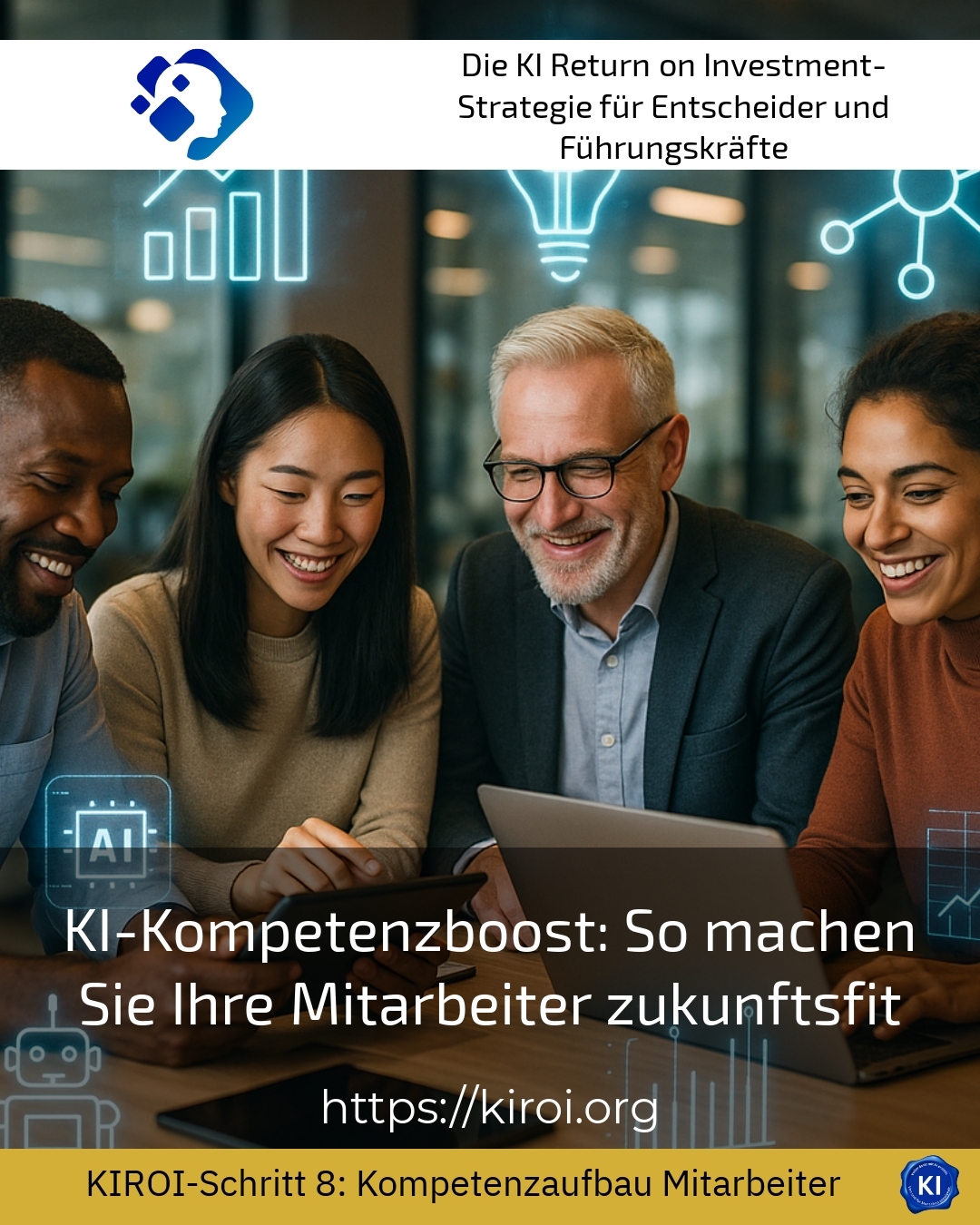
This question currently concerns executives and human resources managers in almost all industries. The AI Skills Boost This becomes the crucial competitive factor. Companies face the challenge of systematically training their workforce. At the same time, they must maintain ongoing operations. However, transformation is only successful if all parties actively participate in the change. Transruptive coaching provides professional support for complex change projects. The following sections show concrete ways to successfully train employees.
Why traditional continuing education concepts reach their limits
Traditional training formats often no longer suffice in the face of technological changes. A two-day seminar may provide basic knowledge, but practical application often falls by the wayside. Employees return to their workplace and quickly fall back into old patterns. The learning curve flattens because there are no concrete opportunities for practice. Furthermore, intelligent systems are advancing so rapidly that static curricula quickly become outdated.
In the financial sector, this phenomenon is particularly evident. For example, bank employees learn how to use automated credit scoring systems. However, after a few months, these systems receive significant updates. The original training thus loses its relevance. Insurance companies experience a similar situation when introducing damage assessment algorithms. Analysts require continuous guidance to keep up with the changes. Asset management companies, in turn, struggle to qualify their analysts for predictive models.
The AI Skills Boost Therefore, it requires a completely new approach. Learning must be integrated into everyday work. Short, focused learning units replace extended face-to-face events. Mentoring programs meaningfully complement formal training. Employees also need safe experimental spaces.
Best practice with a AIROI customer
A medium-sized financial services company faced the challenge of qualifying its customer advisors for the use of intelligent analysis tools. Initially, the HR department tried to engage external trainers for traditional workshops. However, the response was relatively low, as the content seemed too theoretical. As part of the transruptive coaching, we developed an alternative concept together. Experienced employees were trained to become internal multipliers. These individuals directly supported their colleagues in real customer cases. The learners could immediately gain practical experience and receive immediate feedback. Additionally, the company set up a digital knowledge platform where employees shared their insights and asked questions of the community. The acceptance of the new technology increased significantly as a result. Within six months, over eighty percent of the consultants used the intelligent tools regularly. Customer satisfaction also improved measurably, as the quality of the advice improved.
The human factor as a crucial component in the AI competence boost
Technical training alone is not enough to make employees future-ready. At least just as important are emotional aspects and the internal attitude towards change. Many people initially experience uncertainty when intelligent systems change their working environment. They fear becoming superfluous or not being up to the demands. These concerns must be taken seriously and addressed professionally.
In the healthcare industry, I often encounter such concerns. Caregivers wonder if robots will soon replace them. Doctors worry about their diagnostic authority in the face of powerful analysis systems. Administrative staff in hospitals fear that automated processes threaten their jobs. These concerns are understandable and deserve respect. At the same time, experience shows that new technologies often create new fields of work. The role of the human being changes, but it does not disappear.
Clients often report internal resistance to change. They know rationally that further education is necessary. However, they emotionally block it because the situation seems overwhelming. This is where transruptive coaching serves as a supportive measure. It involves identifying and gradually dissolving individual blockages. The affected individuals receive impulses for a constructive approach to uncertainty.
Another important aspect concerns communication within the company. Leaders must explain transparently why changes are necessary. They should present perspectives and share success stories. In the pharmaceutical industry, this is achieved, for example, through internal innovation labs. There, employees experiment with new technologies without pressure to perform. Hospitals set up pilot projects in which volunteer teams test new systems. Medical technology companies promote the exchange between experienced and younger employees.
Concrete measures for successfully boosting AI competencies in organizations
Practical implementation requires a well-thought-out overall concept. Individual measures only have their full effect when they are coordinated with one another. The first step consists of an honest assessment of the existing competencies. What skills do the employees already possess? Where are the greatest development needs? This analysis forms the basis for all further activities.
In the logistics industry, a step-by-step approach has proven effective. First, all employees receive basic training on the basic principles of intelligent systems. Subsequently, role-specific in-depth training follows for different functional areas. Warehouse workers learn how to operate automated picking systems. Supervisors train on working with route optimization algorithms. Executives develop skills in interpreting analysis results.
Retailers also benefit from structured qualification programs. Sales staff need to understand how personalized recommendation systems work. Buyers need knowledge of predictive demand analyses. Branch managers should learn to make data-based decisions and communicate them. The challenge is to include everyone. No one should feel left out or overwhelmed [1].
Mechanical engineering shows other interesting applications. Service technicians are increasingly working with predictive maintenance systems. They must learn to critically evaluate algorithm recommendations. Designers use generative design tools for innovative solutions. Quality inspectors cooperate with image processing inspection systems. All these changes require continuous coaching.
Best practice with a AIROI customer
An international logistics company wanted to qualify its warehouse employees for collaboration with autonomous transport systems. The initial skepticism among the employees was considerable, as many feared for their jobs. As part of the transruptive coaching, we initially developed an open communication strategy. The management made it clear that no positions were to be cut. Instead, the focus was on reducing physically demanding tasks. The employees were given the opportunity to qualify for the role of system coordinator. In this new role, they monitor the autonomous vehicles and intervene in case of disruptions. The training combined theoretical fundamentals with practical exercises in a separate test area. Experienced employees were involved from the outset and were able to contribute their practical knowledge. This appreciation significantly increased acceptance. After the successful pilot phase, the company rolled out the concept to other locations. Employee satisfaction remained stable, even though the work content changed fundamentally.
Sustainable embedding of new skills in everyday work
The real success is only shown when new skills are applied permanently. Many qualification initiatives fail at this point. The training ends, but the follow-up is lacking. Employees fall back into old habits because the pressure to change diminishes. Therefore, structures are needed that promote and reward continuous learning.
In the energy sector, regular reflection rounds have proven effective. Teams discuss their experiences with new systems weekly. They identify improvement potential and share successful practices. Network operators use digital dashboards to visualize learning progress. Energy providers have established internal communities where experts exchange knowledge. Municipalities specifically promote intergenerational knowledge transfer [2].
The automotive industry is increasingly relying on gamification elements. Employees collect points for completed learning units and achieved milestones. Leaderboards create playful competition between teams and departments. Achievements are publicly acknowledged and celebrated. Suppliers organize cross-company hackathons to jointly solve problems. Automotive manufacturers organize internal innovation competitions. These formats create motivation and a sense of community.
The telecommunications industry is also showing interesting approaches. Customer service employees receive real-time feedback on their use of assistance systems. Technicians complete virtual training using augmented reality glasses. Executives participate in monthly exchange formats with external experts. This diversity of learning formats increases the likelihood of sustainable behavioral changes.
The role of leaders as role models and facilitators
Leaders play a key role in any transformation. Their own behavior significantly shapes the corporate culture. When managers reject or ignore new technologies, employees follow suit. Conversely, enthusiasm is contagious when it is authentically lived. Leaders must therefore become active learners themselves.
This is particularly evident in the media industry. Editor-in-chiefs need to understand how automated content systems work. Publishing executives should be familiar with the possibilities of data-based reader analysis. Agency owners need knowledge of programmatic ad delivery. Only then can they make informed strategic decisions. At the same time, they are signaling to their teams that learning is not a weakness.
The construction industry is facing similar challenges. Project managers need to learn how to effectively use digital planning tools. Architects are increasingly working with parametric design systems. Project managers use predictive analysis tools for better time planning. All of these changes require the active support of senior management. Without support from the top, transformation projects regularly stall [3].
The chemical industry, in turn, relies on interdisciplinary leadership teams. Technical experts work closely with human resources managers. Together, they develop qualification strategies that take into account both professional and human aspects. Laboratory managers are trained to serve as mentors for their employees. Production managers learn to sensitively accompany change processes.
My AIROI Analysis
The transformation of the workplace by intelligent systems presents companies with complex challenges. Traditional training formats reach their limits because they are designed to be static and impractical. The key lies in a holistic approach that combines technical qualification with emotional support. Employees need safe spaces to experiment and continuous support in implementing what they have learned.
I consider the role of leaders to be particularly important as role models and facilitators. When they themselves actively learn and lead change, the teams follow this example. The various industry examples show that successful transformation always has to be tailored to the individual company. There is no one-size-fits-all solution that works equally well for all companies. Instead, customized concepts need to be developed that fit the specific corporate culture.
Transruptions coaching can provide valuable impulses and professionally accompany change processes. Experience shows that external perspectives often reveal blind spots and enable new solutions. However, the commitment of all involved is crucial for success. Only when management, leaders, and employees work together as one, is sustainable qualification achieved. The investment in human competence always pays off in the long term because it makes companies adaptable and resilient. The future belongs to organizations that understand continuous learning as a core competency and systematically promote it.
Further links from the text above:
[1] McKinsey: Building Workforce Skills at Scale
[2] World Economic Forum: The Future of Jobs Report
[3] Gartner: Future of Work Trends
For more information and if you have any questions, please contact Contact us or read more blog posts on the topic Artificial intelligence here.






 Deutsch
 English (UK)