
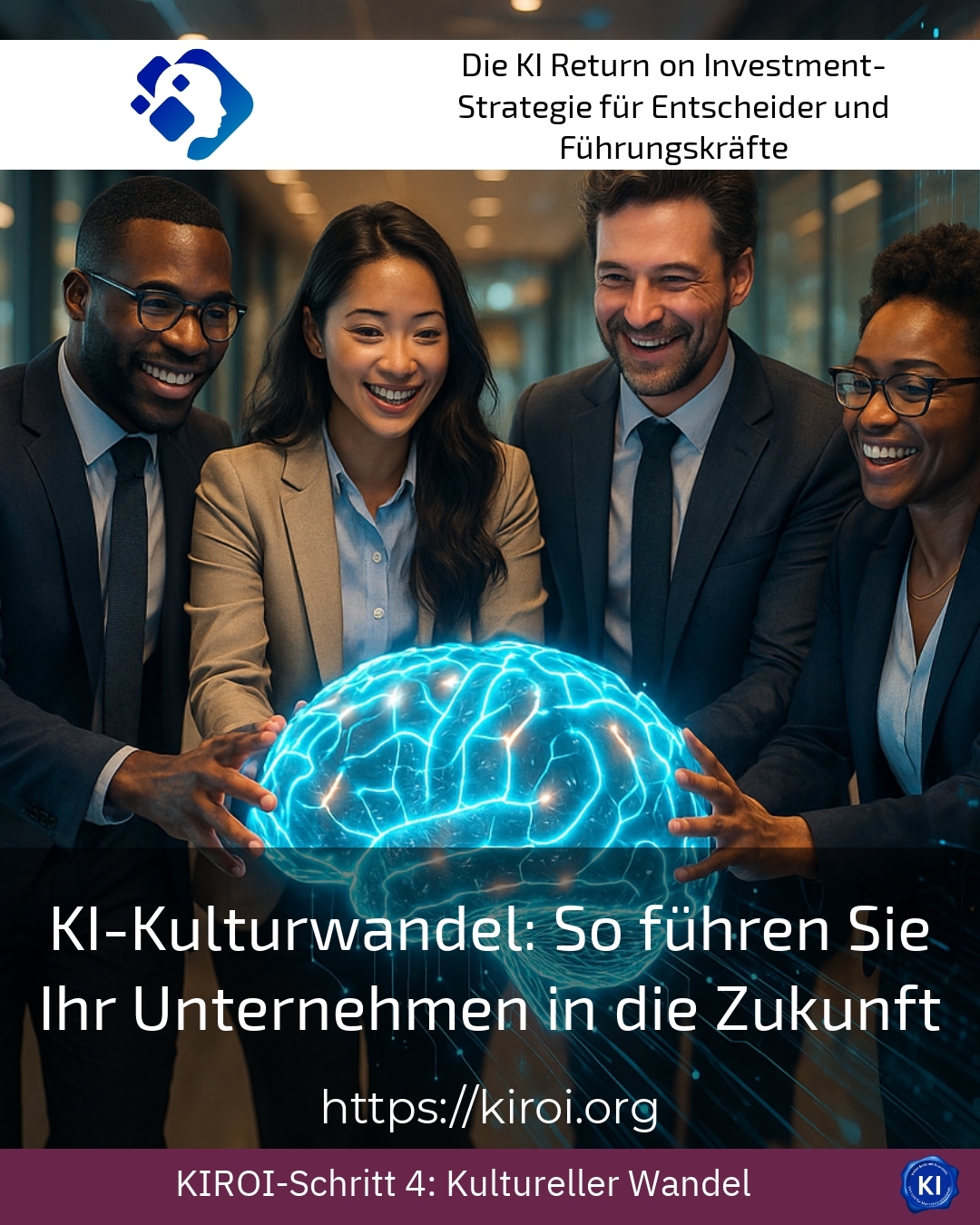
The question of how companies AI cultural change being able to shape successfully is currently occupying leaders in almost all industries and economic sectors. Whilst technological innovation is progressing at a rapid pace, many organisations are lagging significantly behind in terms of cultural transformation. Yet it is precisely corporate culture that determines whether new technologies can unfold their full potential. Those who fail to act today risk losing touch tomorrow. But how can employees be brought along while structures are fundamentally changed at the same time? This article answers precisely this question with concrete examples and practical recommendations for action.
Why the AI cultural shift requires more than just technology
Many companies make the mistake of introducing new technological tools without creating the necessary cultural frameworks. They invest significant sums in software and hardware while forgetting about the people. Yet studies by McKinsey clearly show that cultural factors determine the success of digital initiatives [1]. For example, a manufacturing company can implement the most modern algorithms for quality control. However, without appropriate training and an open culture regarding errors, these tools remain unused. The situation is similar in retail, where intelligent recommendation systems only work if employees understand their benefits and actively support them. Financial service providers also frequently report that automated analysis tools initially encounter skepticism. True acceptance only arises when teams experience the benefits for themselves.
Transruption coaching helps organisations navigate precisely these challenges. It supports leaders in combining technological change with cultural development. Clients frequently report resistance within their teams, which upon closer examination turns out to be a fear of change. These fears are understandable and must be taken seriously. This is the only way to achieve sustainable transformation.
Best practice with a AIROI customer
A medium-sized mechanical engineering company with around three hundred employees was faced with the challenge of integrating predictive maintenance systems into its production lines. The technical implementation was completed within a few weeks, but the workforce failed to accept it. Experienced technicians felt their expertise was being called into question by the new systems. They ignored warning messages or deliberately documented malfunctions incompletely. As part of the transruption coaching, we developed a multi-stage communication strategy together with the management. First, we ran workshops in which technicians could openly express their concerns. We then trained so-called technology ambassadors who acted as a bridge between the technology and the workforce. After six months of intensive support, the usage rate of the new systems had tripled. At the same time, the number of unplanned stoppages fell by more than forty per cent. The employees reported a new understanding of data-driven decisions. They realised that the technology supports their work rather than replacing it.
The role of leadership in the AI culture change
Leaders shape corporate culture significantly through their daily actions. If they themselves show reluctance towards new technologies, this attitude inevitably transfers to their teams. Conversely, exemplary behaviour acts as a catalyst for positive change. A Harvard Business Review study underlines the central importance of leadership behaviour in digital transformations [2]. In the healthcare sector, for example, the attitude of senior physicians determines whether assistance systems for diagnostic support are accepted. In the logistics industry, warehouse managers frequently report that automated route planning is initially perceived as a loss of control. Similar patterns also emerge in the education sector when adaptive learning systems are to be introduced.
Leaders must therefore learn to deal openly with their own uncertainties. They should show that they too have to familiarise themselves with new topics. This authenticity builds trust and encourages employees to take the initiative themselves. At the same time, clear guardrails must be set so that the change proceeds in an orderly fashion. Professional guidance can provide valuable impetus here.
Communication as a key element of cultural change
Transparent communication forms the foundation of any successful transformation. Employees must understand why changes are necessary and what opportunities they offer. In this regard, it is not enough to send out a single communication. Rather, cultural change requires continuous dialogue across all hierarchical levels. This is particularly evident in the banking sector: when automated credit decisions are introduced, questions arise regarding job security. Insurance companies face similar challenges with claims processing through intelligent systems. Law firms deploying document analysis tools must also communicate intensively.
Regular town hall meetings, in which questions are answered openly, have proven their worth. Equally effective are small dialogue formats such as coffee sessions with the management. The crucial factor here is the willingness to allow even uncomfortable questions. Anyone who suppresses critical voices only reinforces resistance.
Capacity building as the basis for sustainable change
The AI cultural change requires not only the right mind-set but also concrete skills. Employees must learn to handle new tools and critically evaluate their results. This by no means affects only technical departments. In human resources, for example, a growing number of companies are relying on intelligent pre-selection in job applications. Recruiters need to understand how these systems work and where their limitations lie. In marketing, on the other hand, analysis tools enable deep insights into customer behaviour. Interpreting these findings and translating them into strategies requires new competencies. In purchasing as well, where automated supplier evaluations are increasingly being introduced, employees need appropriate training.
Further training should not be organised as a mandatory event. Instead, a mix of formal training and informal learning is recommended. Mentoring programmes in which technically proficient colleagues share their knowledge often yield good results. Experimental spaces where new tools can be safely tried out also foster acceptance. In this context, the Gartner Institute emphasises the importance of continuous learning [3].
Best practice with a AIROI customer
A national energy supplier wanted to introduce intelligent grid management systems designed to generate consumption forecasts and optimise load balancing. The challenge was that many employees had been with the company for decades and were sceptical of innovation. Together, we developed a concept based on voluntary participation and positive experiences. First, we identified tech-savvy employees in various departments and offered them an intensive induction. They became internal ambassadors who provided low-threshold support to their colleagues. At the same time, we set up a digital sandbox where the new tools could be tried out without consequences. After nine months, more than eighty per cent of the relevant employees had completed at least one training session. The internal satisfaction survey showed significantly increased figures for perceived support from the company. It was particularly pleasing that older employees also reported positive experiences and actively contributed suggestions for improvement.
Adapt structures and break down silos
Cultural change often also requires structural changes within the organisation. Traditional departmental boundaries can become a barrier when cross-functional collaboration is necessary. In the automotive sector, this is evident in the development of connected vehicles, which must combine expertise from IT, mechanics and design. Pharmaceutical companies face similar challenges in data-driven drug discovery. In the media industry too, where personalised content delivery is gaining importance, editorial and technology teams must work more closely together.
Cross-functional teams have proven to be an effective response to these challenges. They bring together diverse perspectives and foster mutual understanding. It is important that these teams do not merely exist on paper. They need real decision-making authority and sufficient time for their work.
A culture of error as a driver for innovation
An open culture of error is one of the most important prerequisites for successful transformation. If employees are afraid of making mistakes, they will shy away from new paths. This applies in particular to the use of new technologies, the outcomes of which are not always predictable. In e-commerce, for example, recommendation algorithms can initially deliver inappropriate suggestions. It is important that such setbacks are understood as opportunities to learn. In the telecommunications sector, companies report similar experiences when introducing chatbots. Hotel chains that use automated revenue management systems have also had to pay their dues initially.
Leaders should actively communicate that experimentation is welcome. They can lead by example themselves and talk about their own failures. This creates a climate in which innovation can thrive. At the same time, of course, boundaries must be defined within which experimentation is permitted.
Embed AI cultural shift sustainably
Cultural changes take time and continuous attention. They cannot be ordered by decree or achieved through one-off measures. The AI cultural change is a process that can take years and requires constant adaptation. This is clearly evident in the construction industry, where Building Information Modelling is increasingly becoming standard. The transition from two-dimensional plans to three-dimensional models fundamentally changes how architects and engineers collaborate. In agriculture, farms face similar challenges when introducing precision farming. Craft enterprises that introduce digital job planning also go through profound processes of change.
Measuring success plays an important role in this. Companies should define how they want to recognise progress. These can be both hard metrics, such as usage rates, and soft factors, such as employee satisfaction. Regular reviews help to adjust the course if necessary. In its research, MIT emphasises the importance of an iterative approach to digital transformations [4].
My AIROI Analysis
After years of supporting companies through transformation projects, a clear pattern emerges: the technological aspect is rarely the decisive hurdle. Rather, initiatives fail due to cultural factors that are underestimated or ignored. Organisations invest millions in software licences and infrastructure, yet skimp on training and change management. This misallocation inevitably comes back to haunt them.
Successful companies are characterised by a few common features. They start with an honest stocktake of their cultural starting point. They take their employees' concerns seriously and address them proactively. They create spaces for experimentation and learning. They communicate transparently and continuously. And they understand that change is not a one-off project, but a permanent state.
Leaders who take these insights to heart have significantly better prospects of success. However, they should also be realistic: cultural change takes time. There are no quick fixes. Nevertheless, those who proceed patiently and consistently can make their company sustainably future-proof. Guidance from experienced partners can make this path considerably easier and help to avoid typical pitfalls. transruptions coaching offers precisely this support for projects concerning technological and cultural transformation.
Further links from the text above:
[1] McKinsey: Culture – The X-Factor in Digital Transformation
[2] Harvard Business Review: Digital Transformation Is Not About Technology
[3] Gartner: Future of Work Reinvented
[4] MIT Sloan Review: Strategy Drives Digital Transformation
For more information and if you have any questions, please contact Contact us or read more blog posts on the topic Artificial intelligence here.









 Deutsch
 English (UK)