
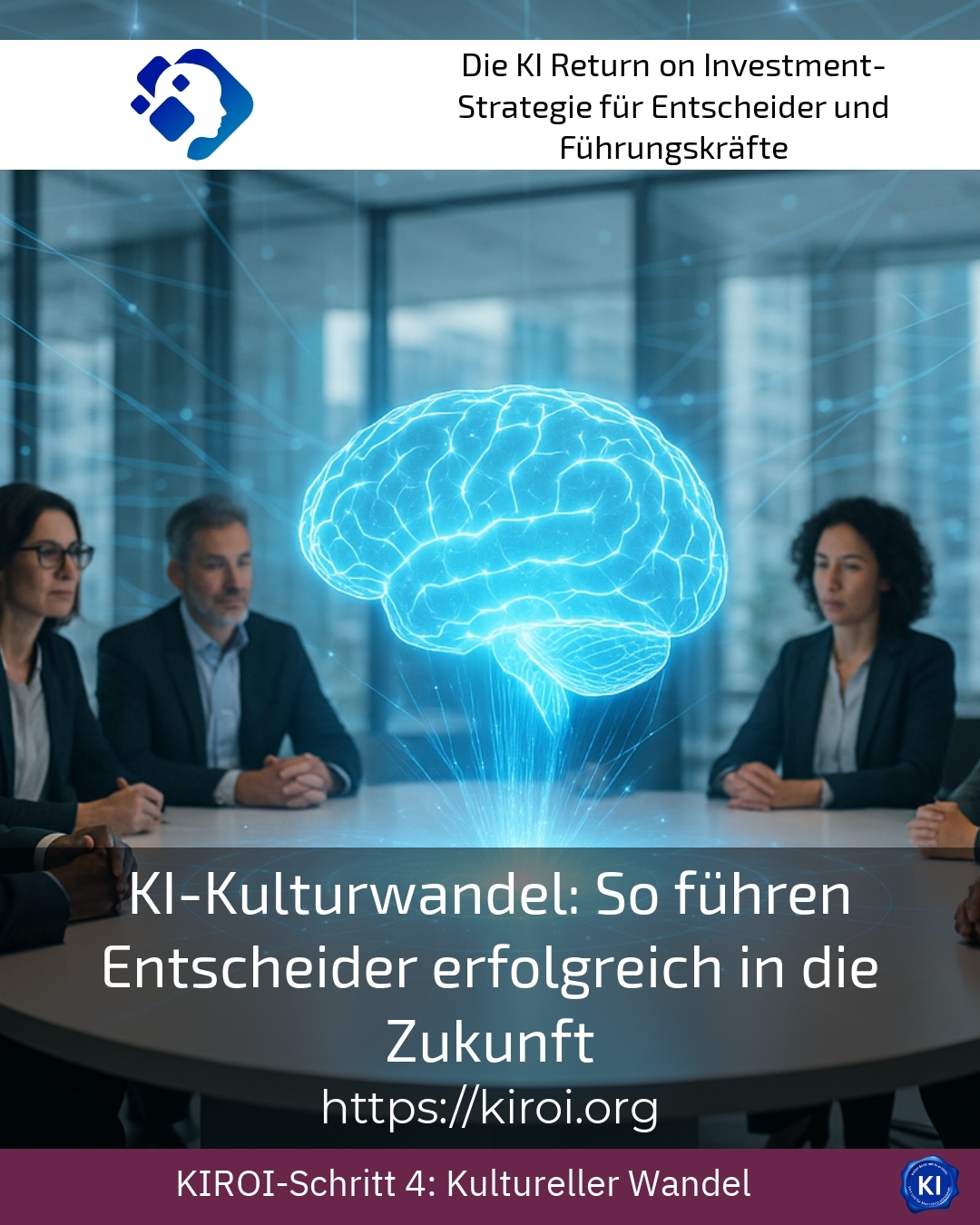
The world of business is facing an epochal turning point that goes far beyond technological innovations and requires fundamental changes in how leaders think, act, and shape their organisations. While many decision-makers still believe it is merely another IT project, far-sighted leaders already recognise that the AI cultural change encompasses and transforms the entire corporate identity. Those who sleep through this change risk not only market share but their organization's very right to exist. But how can decision-makers bring their teams along on this journey? Which strategies have proven successful, and which pitfalls should be avoided? This article offers well-founded impulses and illustrates why transruption coaching often provides crucial support in guiding such transformation projects.
The human factor as the key to AI cultural change
Technology alone does not create transformation. At best, it enables it. The real challenge lies in changing mindsets, habits, and established ways of working that have often grown over decades. Leaders frequently report resistance within their teams. This resistance rarely arises out of malice. It is rooted in uncertainty, fear of losing competence, and a lack of understanding of the necessity for change. A production manager in the automotive industry, for example, faced the task of getting experienced skilled workers enthusiastic about new quality assurance systems. The long-serving employees had perfected their craft over decades. Suddenly, they were expected to trust data-driven analysis methods. Acceptance was only achieved through intensive communication and the involvement of the experienced workers as mentors.
A similar pattern is emerging in the finance industry. Insurance companies are increasingly implementing automated claims processing. Claims adjusters, who have built up years of expertise, feel threatened. Successful transformations in this area actively involve these employees. They become trainers for the new systems. Their expertise is incorporated into the optimisation of algorithms. In this way, resistance is transformed into engagement. A third example is the retail sector. Branch managers face the challenge of combining traditional sales concepts with personalised recommendation systems. Human advisory skills are not being replaced. They are being enriched with additional information. Decision-makers who clearly communicate this added value experience significantly less rejection.
Best practice with a AIROI customer A medium-sized mechanical engineering company with over 800 employees was facing the introduction of predictive maintenance systems in its production. Management had made significant investments and expected rapid results. However, reality presented a different picture. The machine operators largely ignored the warning messages from the new systems, trusting their extensive experience instead. It was only through an accompanying "transruption coaching" programme that a turnaround was achieved. The most experienced machine operators were trained as so-called technology ambassadors. They received additional training and the task of supporting their colleagues. In parallel, management implemented pilot projects on individual production lines. The successes of these pilots were communicated transparently. After six months, acceptance had fundamentally changed. Machine availability increased by twelve percent. Even more importantly, employees developed personal initiative in improving the systems. They contributed suggestions based on their practical experience. This combination of human expertise and technological support created genuine added value.
Developing leadership skills for transformation
The AI cultural change requires new leadership qualities. Classic management virtues such as efficiency orientation and clear goal setting are no longer sufficient. Modern leaders must be able to tolerate ambiguity. They must be able to navigate their teams through phases of uncertainty. At the same time, they need a fundamental understanding of technological possibilities and limitations. In the pharmaceutical industry, we observe leaders who actively engage with research data analysis. They don't need to become programmers. But they should understand what questions data-driven systems can answer. A research director who develops this competence makes better decisions about resource allocation. They can communicate realistic expectations to their team.
The logistics sector provides another vivid example. Dispatchers are increasingly working with route optimisation systems. Their managers must understand how these systems make decisions. Only then can they intervene meaningfully when special situations arise. A logistics manager reported initial difficulties in introducing autonomous route planning. The dispatchers felt disempowered. The solution lay in a hybrid working approach. The systems provide suggestions. People make decisions in complex cases. This division of roles requires clear communication from management. The need for new leadership skills is particularly evident in the healthcare sector. Hospital management faces the task of introducing diagnostic support systems. Doctors often fear their expertise will be devalued. Successful leaders in this area position technology as an extension, not a replacement, of medical competence.
Communication strategies for the AI cultural shift
Transparent communication forms the foundation of any successful transformation [1]. Decision-makers often underestimate the communication requirements. They announce changes once and expect acceptance. Reality shows that people need repeated, consistent messages from various channels. An energy supply company implemented new grid control systems. The initial communication focused on technical aspects. Employees did not understand what impact the changes would have on their daily work. Only a revised communication strategy with clear answers to the question „What does this mean for me?“ led to acceptance.
The media industry is currently undergoing massive upheaval. Newsrooms are integrating research support systems and automated content analysis. Journalists are concerned about their creative autonomy. Editors-in-chief who openly discuss the possibilities and limitations of the new tools experience less resistance. They emphasise that investigative work and critical thinking remain indispensable. Technology takes over repetitive tasks; the core creative competence remains with humans. In the education sector, school leaders face similar communication challenges. Teachers fear becoming obsolete due to learning platforms and adaptive systems. Successful communication in this area emphasises the changed but more valuable role of educators. They are becoming learning facilitators and mentors. Individualised support is moving more into the foreground.
Structural prerequisites for sustainable change
Cultural change requires more than good intentions. It needs structural anchoring. Incentive systems, career paths and performance reviews must be adapted to the new requirements. A consumer goods company recognised this after initial setbacks. Sales staff were supposed to use new analysis tools. However, their remuneration was still based solely on sales figures. The time spent learning new systems was not rewarded. After an adjustment to the remuneration model, behaviour changed fundamentally. Employees received bonuses for the successful use of the new tools.
Structural hurdles are particularly evident in the construction industry. Construction companies are introducing digital planning systems and automated project management. However, site managers often lack access to powerful hardware. Network coverage on construction sites is inadequate. Technical infrastructure must precede cultural transformation. The tourism sector provides another example. Tour operators are implementing personalised advisory systems. Travel agents are expected to use these systems. At the same time, their consultations are evaluated based on duration. These conflicting incentives prevent the desired change in behaviour. The transformation only succeeded after a redesign of the performance indicators.
Best practice with a AIROI customer A retail company with over 150 branches faced the introduction of a comprehensive customer analytics system that analyses purchasing behaviour and enables personalised recommendations. Branch managers were expected to incorporate these insights into their product range planning. Initial acceptance was low. The experienced managers trusted their gut feelings and local market knowledge. As part of a transruption coaching support programme, the company developed a novel approach. Instead of forcing the branch managers, a voluntary pilot was implemented with fifteen branches. Participating managers received intensive support and regular feedback. After three months, the pilot branches showed measurably better results. These successes were communicated company-wide. The remaining branch managers now actively requested the introduction at their locations. The pull effect proved to be significantly more effective than any top-down approach. Management realised that cultural change is better achieved through persuasion than by decree. The investment in the pilot phase paid off many times over.
Constructively using resistance in AI-driven cultural change
Resistance is not the enemy of transformation. It is a valuable signal. Employees who raise objections demonstrate commitment to the company [3]. They often have important insights into practical obstacles. A chemicals company introduced automated laboratory analysis systems. The experienced chemists raised significant concerns. Instead of dismissing these concerns, management organised a workshop. The criticisms were systematically recorded and addressed. Several objections proved to be valid. The systems were subsequently adapted. The initial critics became the most engaged supporters.
A similar pattern is emerging in the telecommunications industry. Call centre employees are to be supported by conversation analysis systems. Inital reactions were resistant. Many feared surveillance and control. The company responded with maximum transparency. Staff were given access to the same analyses as their supervisors. The systems were positioned as a development tool, not a monitoring instrument. This reframing enabled acceptance. The hotel industry provides a third example. Reception staff are to work with digital concierge systems. Experienced employees argued that personal recommendations were more valuable than algorithmic suggestions. Management recognised the validity of this objection. The system was configured so that employees' personal notes take precedence over standardised recommendations.
The role of external support in transformation projects
Internal change projects often hit boundaries. Leaders are part of the existing system. They have blind spots and commitments that make objective perspectives difficult. External support through transruptive coaching can provide valuable impetus here. Coaches and consultants bring experience from other industries and contexts. They ask uncomfortable questions that insiders would not. An insurance group commissioned external support for the digitalisation of its claims processes. The internal project leads had already made several attempts. The external perspective identified cultural barriers that had been overlooked internally.
In the automotive supply industry, we observe similar patterns. Companies that utilise external support for their transformation projects frequently report faster progress [4]. The neutrality of external parties facilitates difficult conversations. Conflicts between departments can be addressed more openly. A supplier of electronic components benefited from external facilitation during the introduction of networked production systems. The production and IT departments had significant differences. A neutral mediator enabled constructive solutions. The food industry also demonstrates the value of external perspectives. A manufacturer of frozen food products implemented systems for quality assurance and traceability. The external consultants brought in experience from other regulated industries. These best practices significantly accelerated the implementation.
My AIROI Analysis
The transformation of businesses through new technologies is primarily a cultural challenge. Technical implementations rarely fail because of the technology itself. They fail due to the human factor. Decision-makers who recognise this create the foundation for sustainable success. AI cultural change requires patience, empathy and strategic communication. It requires the willingness to treat employees as partners, not as obstacles. The examples from various industries show clearly: there is no one-size-fits-all solution. Every company must find its own way. However, certain principles have proven themselves across industries. Transparent communication, structural anchoring and the constructive use of resistance form the foundation of successful transformations. Leaders must develop new competencies. They must learn to tolerate uncertainty and guide their teams through phases of change. External support through transruption coaching can offer valuable assistance. The neutrality and experience of external players sensibly complement internal resources. Companies that pursue this holistic approach often report more sustainable results. Investing in the cultural aspects of transformation pays off in the long term. It creates organisations that are equipped for the future not only technologically, but also humanly.
Further links from the text above:
[1] Harvard Business Review – Change Management
[2] McKinsey Insights – People and Organisational Performance
[3] MIT Sloan Management Review – Organisational Transformation
[4] BCG – Digital Transformation
For more information and if you have any questions, please contact Contact us or read more blog posts on the topic Artificial intelligence here.










 Deutsch
  English (UK)