
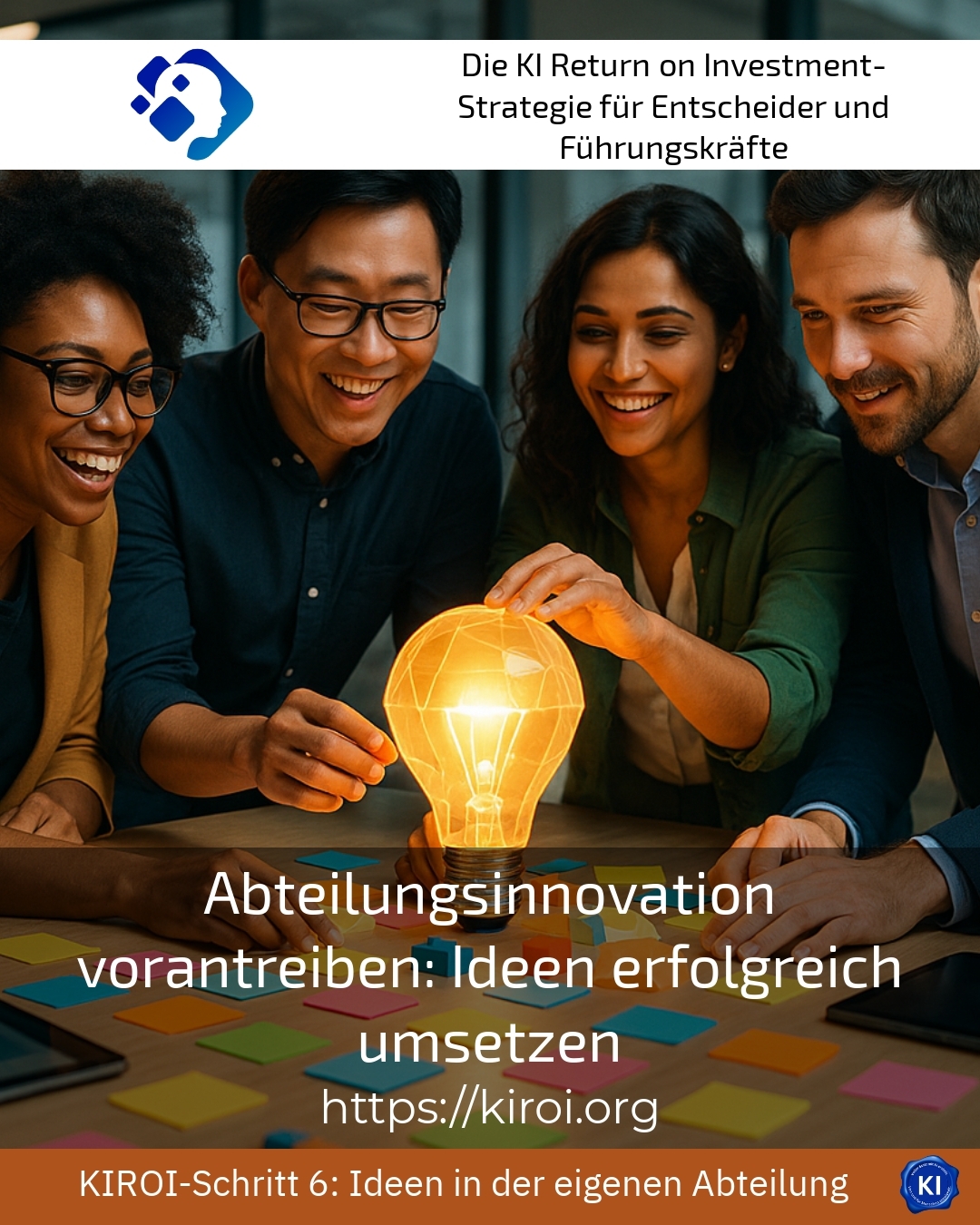
Imagine your department develops groundbreaking ideas, but they never see the light of day because they get bogged down in endless approval loops or simply fail due to resistance from individual stakeholders. This precisely is the frustrating situation countless managers and employees experience in companies daily, which is why the topic Driving departmental innovation has long become one of the most pressing challenges of our time. However, the good news is that with the right strategies, a clear methodology, and appropriate support, this cycle can be broken. In this post, you will learn how to proceed systematically to not only generate creative impulses but actually turn them into reality.
Driving the hidden hurdles towards departmental innovation
Before an idea can bear fruit, it must first overcome numerous obstacles. These barriers are often invisible and therefore underestimated. Many companies fail even at identifying these stumbling blocks. The first and at the same time most significant hurdle often lies in the lack of communication between different hierarchical levels, because managers demand innovative concepts but simultaneously fail to provide adequate resources or freedom. Furthermore, cultural factors play a crucial role. Teams that view mistakes as failures will hardly dare to break new ground. Another common stumbling block is the lack of connection between strategic goals and operational measures. Employees then do not understand why their ideas could be relevant.
In practice, clients often report similar experiences. They develop promising concepts for process optimisations or new service offerings. However, these get bogged down in bureaucratic structures. Others describe that their suggestions are heard. Nevertheless, no actual implementation takes place. Yet others struggle with the challenge of inspiring colleagues for their visions. All these situations illustrate that innovation requires far more than mere creativity.
Best practice with a AIROI customer
A medium-sized company in the technical services sector approached transruptions-Coaching with a specific concern. The management had realised that despite regular idea workshops, very few innovations were being integrated into their daily work. The coaching team initially analysed the existing communication structures and identified several weaknesses. It became apparent that while department heads collected ideas, they rarely forwarded them to decision-makers. The reason for this was the fear of being held personally responsible for any failures. Within the scope of the coaching, new feedback loops were established, which enabled communication free from fear. Additionally, the company introduced "innovation sponsorships," where experienced managers actively supported promising projects. After approximately six months, the company successfully implemented three internal improvement suggestions for the first time, something they had failed to achieve for years. Employees reported increased motivation and an improved working atmosphere because they finally felt heard and valued.
Creating structures that foster creativity
A sustainable innovation culture does not arise by chance or from individual flagship projects. It requires well-thought-out structures and clear processes. This is by no means about forcing creativity into rigid forms. Rather, ideas need a safe framework in which they can develop. Companies that consciously shape this framework achieve significantly better results. A first step is to reserve fixed periods for creative thinking. Many successful organisations have recognised that innovation cannot happen incidentally. They therefore reserve regular time slots for experimentation and reflection.
Another important aspect concerns the physical and digital working environment. Open spaces with flexible furniture concepts can encourage informal exchange. At the same time, employees need quiet spaces for focused work. Digital collaboration platforms complement these structures by enabling knowledge sharing across departmental boundaries. Clients often report that simply setting up a basic digital idea board has led to a noticeable increase in submitted suggestions. However, these technical tools can only develop their full potential if they are supported by a conducive company culture.
In the service sector, for instance, several consulting firms have established so-called innovation labs. In these protected spaces, employees are allowed to experiment with new approaches. The risk of failure is deliberately accepted. Another example can be found in the financial services sector. Here, some institutions have introduced regular hackathons where cross-departmental teams work together on solutions. A third example comes from the healthcare sector. Here, progressive institutions rely on interdisciplinary case conferences, which not only serve patient care but also act as a source for process improvements.
The role of the manager in driving departmental innovation
Leaders hold a key position when it comes to embedding innovations in departments. They act as role models and send important signals through their own behaviour. A leader who is open to new ideas themselves also encourages their employees. Conversely, a sceptical or even rejecting attitude can nip any creative impulse in the bud. Therefore, successful change always starts at the top. Leaders should actively seek feedback and take it seriously. They should celebrate successes together and learn constructively from failures.
Transruptions-Coaching helps leaders to embrace and excel in this new role. As part of these coaching processes, individual strengths are identified and purposefully utilised. At the same time, blind spots that unconsciously act as brakes on innovation are identified. Participants often report that it was only through external input that they became aware of how strongly their own communication behaviour influences team dynamics. This insight often forms the starting point for profound changes.
Best practice with a AIROI customer
A department head in the education sector sought support with transruption coaching because she felt alone with her ideas for change. Although highly motivated herself, she repeatedly encountered resistance from her team. Joint analysis revealed that she unconsciously maintained a leadership style that was too directive, inhibiting rather than fostering creative initiative. During the coaching process, she developed alternative communication strategies that allowed for more co-creation. Specifically, she learned to ask open-ended questions and to genuinely incorporate her employees' answers into decisions. Additionally, she established a monthly format where team members could present their own suggestions for improvement. The change did not happen overnight but required patience and continuous reflection. After about a year, however, the department head reported a significantly improved team climate and several successfully implemented projects that had originated from within the team itself. This experience strengthened her resolve to continue on the path she had taken.
From idea to implementation: practical steps
The journey from an initial spark of an idea to its actual realisation is often long and arduous. Many promising concepts fail not because of their intrinsic quality, but due to a lack of implementation expertise. Therefore, it is crucial to define clear processes that guide an idea through various stages of maturity. A proven approach is to first create a rough sketch of the concept, then discuss it with selected stakeholders, and further develop it based on the feedback received. This is subsequently followed by a small-scale pilot phase. Only when this proceeds successfully is a broader rollout initiated.
In the retail sector, some companies have established so-called innovation committees that regularly assess submitted suggestions. These bodies are composed of representatives from various functional areas in order to bring in different perspectives. A similar model can be found in the logistics industry, where process improvements are often initiated by those who are confronted with the operations on a daily basis. A third example comes from the public administration sector, where, despite bureaucratic frameworks, innovative approaches can be tested through clever pilot projects.
Guidance from experienced coaches can be particularly valuable during this phase. Transruptions coaching supports teams in identifying resistance early on and dealing with it constructively. Furthermore, methods are taught that enable structured decision-making. Clients often report that external support helps them to maintain an overview and not get bogged down in details. This assistance can make the crucial difference between success and failure.
Overcoming resistance when driving departmental innovation
Change naturally encounters resistance. People tend to cling to the familiar. This behaviour is deeply human and should not be condemned. Instead, it is important to understand and take seriously the needs underlying it. Often, resistance hides fears of being overwhelmed, losing control, or being devalued personally. Addressing these fears can often win over even the biggest sceptics.
A tried-and-tested strategy is to involve potential critics early in the process. When people feel they are being heard, their defensiveness decreases. Another approach involves introducing changes in small, manageable steps. This allows concerns to be addressed incrementally. Finally, it often helps to clearly communicate the concrete benefits of an innovation. People are more willing to support changes when they can recognise the personal advantage.
In the manufacturing sector, for instance, the introduction of new technologies often meets with scepticism from long-serving employees. However, these concerns can be mitigated if those affected are actively involved in the selection and implementation process. In the service sector, companies report similar experiences when introducing new customer service processes. It has been shown there that pilot groups who gain positive early experiences can act as internal ambassadors. A third example can be found in the cultural sector, where tradition-conscious institutions have been successfully modernised through participatory approaches.
My AIROI Analysis
The examination of the topic Driving departmental innovation reveals a central realisation. Successful change requires far more than good ideas or technical solutions. It demands a profound understanding of human dynamics and organisational contexts. The AIROI methodology offers a structured framework for this, taking into account both strategic and emotional aspects. In my analysis, it repeatedly becomes clear that organisations that take both dimensions seriously can act far more sustainably.
I find the significance of leadership culture particularly noteworthy. Without active support from management, even the best initiatives remain ineffective. At the same time, it is not enough for leaders to merely announce changes. They must also embody these changes and actively support them. The examples from various industries make it clear that successful innovation is always a collaborative undertaking. Lone wolves quickly reach their limits.
Transruptions Coaching has established itself as valuable support for projects concerning organisational change [1]. This systematic approach allows for the uncovering of hidden potential and activation of dormant resources. The focus is always on the people involved. Technologies and methods are important tools, but never an end in themselves. This stance distinguishes sustainable change processes from fleeting fads. Those who embark on this path invest in the future viability of their organisation and in the well-being of the people who sustain it.
Further links from the text above:
[1] Transruptions Coaching – Support for change projects
For more information and if you have any questions, please contact Contact us or read more blog posts on the topic Artificial intelligence here.







 Deutsch
  English (UK)