
Why do so many companies fail to prepare their executives for the digital future, even though the technology is already available?
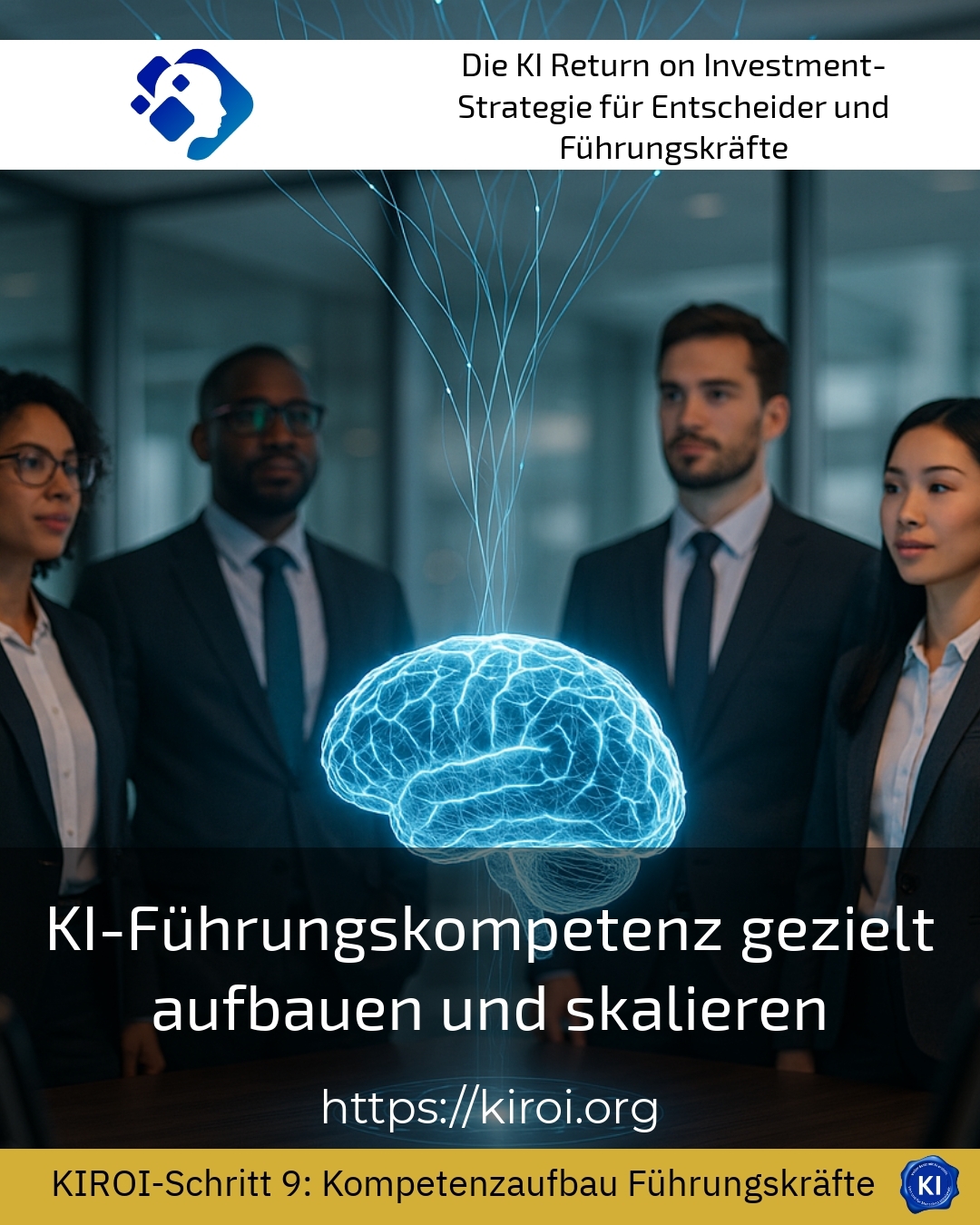
This question currently concerns executives, human resources managers, and strategy consultants alike, because it touches on the core of a fundamental change that is taking place in almost all economic sectors. The targeted building and scaling up of AI leadership skills It is becoming one of the crucial challenges of our time, because technological knowledge alone is no longer sufficient to successfully guide organizations through complex transformation processes. Rather, the goal is to develop a deep understanding of the possibilities and limitations of intelligent systems and to translate this knowledge into concrete leadership actions that meet both human and technological requirements.
Understand the starting position and act strategically
Executives today face a paradoxical situation. On the one hand, employees, customers, and investors expect clear guidance in times of change. On the other hand, many decision-makers themselves lack the necessary foundation to make informed decisions. The automotive industry demonstrates this particularly clearly. There, production managers suddenly have to understand how predictive maintenance systems work. At the same time, sales executives are tasked with unlocking the potential of personalized customer interaction. In the banking sector, on the other hand, compliance officers face the challenge of monitoring algorithmic decision-making processes [1].
This diversity of requirements makes it clear why a uniform training approach rarely leads to success. Instead, customized development programs are needed that take into account the individual knowledge of the executives as well as the specific challenges of their respective functional areas. In the logistics industry, for example, warehouse managers should understand the basic principles of demand forecasting. Marketing directors in retail, on the other hand, need insights into the functioning of recommendation algorithms. Chief physicians in hospitals, in turn, should be able to assess the capabilities of imaging diagnostic systems.
AI leadership competence as a strategic competitive advantage
Companies that invest early in the development of their leadership teams often report measurable benefits. These are manifested in faster decision-making processes and a higher acceptance of new technologies within the workforce. A chemical company was able to significantly shorten the implementation time for new process optimization systems through targeted training measures. An insurance group recorded a noticeably improved collaboration between technical teams and specialist departments after appropriate training. These examples illustrate that building appropriate competencies is by no means an end in itself. Rather, it directly contributes to value creation [2].
Best practice with a AIROI customer
A medium-sized mechanical engineering company faced the challenge of preparing its entire leadership team for new digital processes within twelve months, with the initial situation characterized by highly heterogeneous prior knowledge and partial skepticism towards technological changes. Through a multi-stage accompaniment program that included both individual coaching sessions and group-based workshops, it was possible to first work through the fundamental concerns and establish a shared understanding of the strategic necessity of change. In the second phase, concrete use cases from the executives’ daily work were used to make abstract concepts tangible, allowing, for example, the head of quality assurance to understand how image recognition systems could support his work, while the sales manager unlocked the potential of automated customer segmentation. The transruptions coaching accompanied each participant individually and helped them overcome personal resistance and develop concrete implementation plans for their own area of responsibility. Upon completion of the program, the participants reported a significantly increased confidence in dealing with technological issues and improved communication skills with IT teams and external service providers.
Mastering scaling as an organizational challenge
While the development of competencies for individual leaders appears relatively manageable, scaling up at a broader level presents companies with complex organizational issues. In the telecommunications industry, it has been shown that traditional training catalogs often fall short. A mere transfer of knowledge is not enough to bring about lasting behavioral changes. The food industry is therefore increasingly experimenting with peer-learning formats, in which more experienced executives serve as internal multipliers. In the energy sector, some companies, on the other hand, rely on external support from specialized coaches [3].
The scaling of AI leadership skills It also requires a clear governance structure. Responsibilities must be defined and resources made available. Success metrics should be established and regularly reviewed. In the pharmaceutical industry, so-called competence hubs have proven themselves as central points of contact for questions and development. Media companies, on the other hand, often prefer decentralized approaches, in which each editorial team develops its own learning formats. This diversity of approaches underscores the fact that there is no universal path to success.
Practical implementation across different functional areas
The specific design of development programs differs significantly depending on the functional area and industry. In human resources, for example, it often involves the responsible use of selection systems. Executives need to understand how algorithmic pre-selection works and what bias risks exist. In procurement, on the other hand, topics such as automated supplier evaluations are central. Transruptive coaching helps here by guiding the right questions to technical teams [4].
The construction industry offers further insightful examples. Project managers learn how automated construction progress forecasts can improve their planning. Managers receive insights on how drone monitoring and image analysis can support their control tasks. Small construction company directors, in turn, are exploring how to launch initial pilot projects with limited resources. These industry-specific use cases make abstract concepts tangible and significantly increase the motivation of participants.
Best practice with a AIROI customer
An internationally operating business group with more than five hundred executives worldwide faced the challenge of establishing a unified understanding of data-driven decision-making without leveling cultural differences between the country-based subsidiaries. The solution consisted of a modular program that combined a common core of foundational modules with country-specific in-depth units, so that, for example, executives in Germany engaged more intensively with data protection issues while their colleagues in Asia focused more on local platform ecosystems. Transruptive coaching played the role of a cultural bridge and helped bring together the different perspectives and develop a common narrative for change that resonated both in Hamburg and in Singapore. The use of virtual exchange formats was particularly valuable, where executives from different regions shared their experiences and learned from each other, leading to a noticeably strengthened sense of belonging and an accelerated spread of best practices within the group. After eighteen months, the company was able to record a measurable increase in technology adoption across all country-based companies.
Overcoming resistance and enabling sustainable change
The development of AI leadership skills In practice, this approach often encounters resistance. This is understandable and should be taken seriously. Some executives fear that their relevance will be diminished or that they will be perceived as technically incompetent. In the healthcare sector, experienced doctors encounter new diagnostic systems with some skepticism. In law firms, partners worry about the future of legal research. These concerns require an empathetic approach [5].
Successful programs address both the rational and emotional aspects of change. They create safe spaces for open discussions about fears and concerns. They emphasize the supportive role of new technologies, rather than outlining alternative scenarios. In the hotel industry, it has been shown that practical experiences with concrete applications are particularly effective. When a hotel manager personally experiences how a chatbot handles routine requests, skepticism often turns to curiosity. Similar experiences are reported by executives from the tourism and exhibition industry.
The role of accompaniment and coaching in the transformation process
External support can significantly accelerate and deepen the development of expertise. Coaches not only bring technical expertise but also act as neutral sparring partners. In the fashion industry, creative directors have benefited from such support when it comes to finding the balance between creative intuition and data-driven decision-making. In the publishing industry, coaches supported chief editors in helping them recruit teams for new working methods. In the sports apparel industry, positive effects are also being seen in the development of product managers.
Scaling such accompanying formats requires smart planning, however. Not every leader needs the same level of support. A careful needs analysis helps to target resources. In the aviation industry, it has proven effective to start with pilot groups and systematically evaluate their experiences before broader rollouts take place. The chemical industry often prefers a cascade approach, where top management is first developed and then serves as a model for subsequent levels.
My AIROI Analysis
The systematic development of AI leadership skills It proves to be one of the most pressing challenges for companies of all industries and sizes, with success largely dependent on whether it is possible to combine technical knowledge with emotional intelligence and strategic thinking. The numerous practical examples from such diverse fields as the automotive industry, healthcare, and the retail sector show that there are no universal "one-size-fits-all" solutions; rather, context-specific solutions are required. What is particularly remarkable to me is the realization that pure knowledge dissemination is significantly less effective than experiential learning, complemented by qualified guidance. The companies that perform most successfully are characterized by a combination of clear strategic direction, sufficient resource allocation, and a learning-promoting corporate culture. The emotional aspects of change must in no way be underestimated, as resistance and fear are normal accompanying phenomena of any profound transformation. Scaling such programs also requires organizational structures that ensure sustainability and enable continuous development. My analysis suggests that companies are well advised to begin building appropriate competencies early on, even if the path sometimes seems arduous, because the alternative would be a gradual loss of competitiveness in an increasingly technology-driven economic world.
Further links from the text above:
[1] McKinsey – The State of AI
[2] Gartner – Artificial Intelligence Insights
[3] Harvard Business Review – AI and Machine Learning
[4] World Economic Forum – Artificial Intelligence
[5] MIT Sloan – Artificial Intelligence Research
For more information and if you have any questions, please contact Contact us or read more blog posts on the topic Artificial intelligence here.







 Deutsch
 English (UK)