
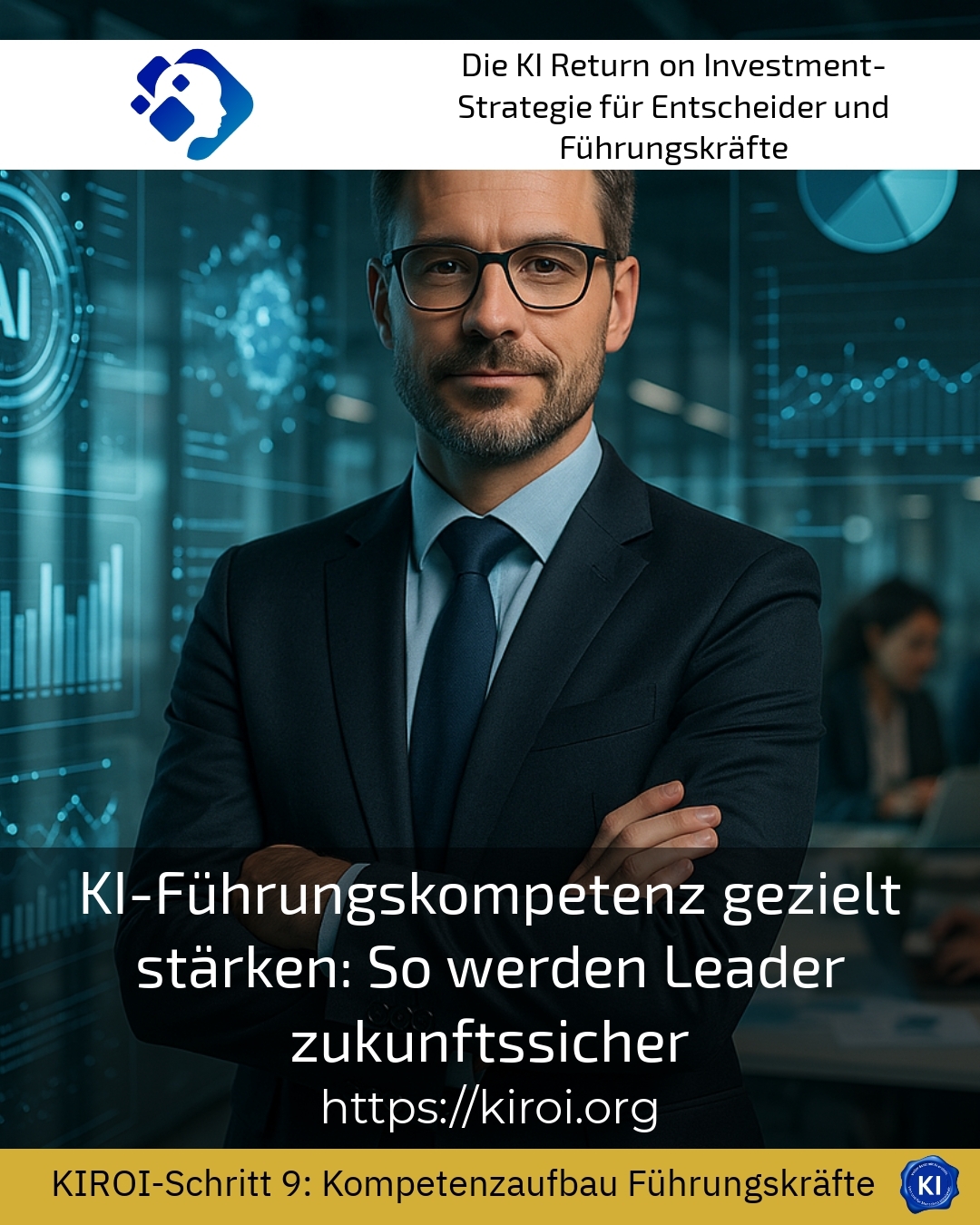
The transformation of our working world is progressing inexorably, and those who hold responsibility today are facing a decisive turning point. Strengthening AI leadership skills deliberately is no longer an option, but an imperative necessity for anyone who wants to remain relevant tomorrow. For while intelligent systems increasingly take over operational tasks, the actual creation of value is shifting to those skills that machines cannot replicate. Leaders must therefore learn today how to combine human intuition with technological precision. Only in this way can organisations be created that are resilient, innovative and fit for the future.
Why traditional leadership models are reaching their limits
The rules of the game in corporate management have fundamentally changed. Hierarchical command structures are increasingly giving way to networked decision-making processes. At the same time, the pace of change is accelerating exponentially. Leaders who were still acting successfully yesterday find themselves in completely new contexts today. They suddenly have to make decisions for which there are no historical precedents.
For example, a medium-sized manufacturing company implemented an intelligent production control system. As a result, plant management had to rethink their entire leadership philosophy. Instead of making detailed decisions, their new task lay in the interpretation of complex data streams. Another example shows a logistics company whose dispatchers initially developed resistance to automated route planning. Only through intensive support from the management level was it successfully achieved to create acceptance. A retail company also experienced similar challenges when algorithmic pricing was introduced. The sales management had to learn to understand and classify the recommendations of intelligent systems.
The new role of strategic decision-making
Modern decision-making processes require a fundamentally new understanding of leadership. Today, leaders must be able to combine quantitative analysis with qualitative assessment. They should understand when algorithmic recommendations are useful. At the same time, they must recognise when human judgement remains indispensable. This balancing act requires both a basic technical understanding and pronounced emotional intelligence.
A financial services provider used predictive analytics for risk assessment. The executives responsible had to learn to critically question these assessments. A mechanical engineering company relied on predictive maintenance using sensor data. The maintenance management developed new competencies in interpreting this information. A third example concerns an energy supplier that had load forecasts generated by intelligent systems. The grid control department had to completely change its way of working.
Targeted strengthening of AI leadership skills through tailored development measures
The development of future-proof leadership skills requires a structured approach. Isolated training sessions are not enough to bring about sustainable change. Instead, what is needed is a holistic programme that intelligently combines various learning formats. Both cognitive and practical elements play a crucial role here. Leaders do not need to become technical experts, but they do need to develop a sound basic understanding.
Transruption coaching accompanies leaders precisely through these transformation projects. It supports them in aligning personal development goals with organisational requirements. Clients frequently report that they initially feel uncertain when dealing with new technologies. Through structured guidance, however, they quickly develop self-confidence and the ability to act. The insights from the coaching help to identify blind spots and tackle them in a targeted manner.
Best practice with a AIROI customer
An internationally active manufacturing company faced the challenge of preparing its entire leadership team for cooperation with intelligent systems. The executive board recognised early on that technical implementation alone would not be sufficient. Therefore, a comprehensive development programme was established that involved all levels of the management hierarchy. As part of transruption coaching, the managers first worked on their personal attitudes towards technological change. Many harboured unconscious reservations that limited their openness to new ways of working. Through a reflective engagement with these internal barriers, it was possible to develop a constructive basic attitude. Subsequently, concrete use cases from daily business were analysed and strategies for action were developed. The participants learned to classify algorithmic recommendations and combine them with their experience. After six months, measurable improvements in decision-making quality and team satisfaction were evident. The managers reported increased self-confidence in dealing with technological innovations. The company was able to achieve its transformation goals significantly faster than originally planned. This success underlines how important the human component is in technological change processes.
Core competencies for leadership in technologically driven environments
Certain skills are gaining particular importance in the new world of work. This includes, first of all, the ability to recognise patterns in complex data landscapes. Leaders must be able to distinguish relevant signals from irrelevant noise. Furthermore, the competence to communicate technological topics is becoming increasingly important. Executives act as translators between technical teams and other corporate divisions [1].
A pharmaceutical company trained its research leaders in the interpretation of predictive models. As a result, they were able to make more informed decisions about development projects. A telecommunications provider enabled its team leaders to better understand customer analytics. Service quality subsequently improved measurably. An insurance company developed a special programme for its claims handlers. They learned to perceive algorithmic assessments as support rather than a threat.
Cultivating human strengths in a technologised world
Ironically, precisely those skills that machines cannot master are becoming more important. Empathy, creativity and ethical judgment are gaining strategic significance. Leaders who cultivate these qualities create sustainable value for their organisations. They can inspire employees and navigate through uncertain times. This is not about a competition between human and machine.
Rather, a synergetic interplay emerges that makes both sides stronger. A consultancy firm recognised that its managers needed to focus more on relationship building. Analytical tasks were increasingly automated, yet client trust remained human-centric. A media company found that creative management roles were gaining in importance. The strategic direction of creative processes required human intuition. A construction company invested in developing the emotional intelligence of its project managers [2].
Targeted strengthening of AI leadership skills: The balance between technology and humanity
The greatest challenge for modern leaders lies in the balanced integration of both worlds. Neither technology-driven actionism nor stubborn adherence to tried and tested methods leads to the goal. Instead, what is needed is a reflective attitude that realistically assesses opportunities and limitations. Leaders must learn to critically evaluate technological possibilities while simultaneously preserving the indispensable role of human judgment.
An automotive supplier developed a framework for technology-supported decision-making processes. This clearly defined when algorithmic recommendations took precedence and when human override was required. A retail company established regular reflection sessions for its managers. Experiences with automated systems were shared and jointly evaluated there. A healthcare provider introduced ethical guidelines for the use of intelligent systems. The management level was significantly involved in their development.
Practical steps for developing future-proof leadership skills
The transformation of leaders does not happen overnight. It requires a structured development process that addresses various levels of learning. First, it is important to build a fundamental understanding of technological contexts. Building on this, specific application competencies can be developed. Finally, it is about integrating new skills into everyday leadership practice [3].
A chemical company established a multi-stage development programme for its executives. The first phase imparted basic technological knowledge in an understandable form. The second phase focused on specific use cases from the respective area of responsibility. A logistics group relied on peer-learning formats in which executives learned from one another. Joint reflection proved to be particularly effective. A technology company integrated executive development into its agile work processes.
Best practice with a AIROI customer
A long-established family-owned mechanical engineering business was seeking support in preparing its next generation of leaders for the technological challenges of the coming years. Although the younger managers possessed a strong affinity for digital matters, they lacked sufficient experience in the strategic leadership of technological transformations. As part of the transruptions coaching, an individual development programme was designed that addressed both dimensions. The participants worked on concrete projects from their area of responsibility while receiving continuous guidance. The reflection of their own thought patterns and unconscious assumptions about technology and leadership proved particularly valuable. The coaching impulses helped to identify personal areas for development and to tackle them in a targeted manner. Upon completion of the programme, several participants assumed expanded areas of responsibility. They guided their teams through technological change processes with noticeably greater confidence than before. The business continues to benefit from the strengthened leadership competencies of this generation to this day. The investment in human development proved to be just as important as technological investments. This case illustrates that sustainable transformation always starts with people.
The role of coaching and mentoring in transformation processes
Change processes rarely succeed without external support. Leaders need safe spaces to reflect on their own uncertainties. They need competent sparring partners who understand both the technological and human dimensions. Transruption coaching offers precisely this combination of professional expertise and personal guidance. Clients often come with the feeling that they are losing touch.
Others report feeling overwhelmed by the multitude of technological options. Some struggle with resistance within their teams when introducing new systems. Coaching provides support with all these issues through structured reflection and practical impulses. A food manufacturer used coaching to accompany its digital transformation. In the process, the managers developed individual strategies for their areas. A real estate company relied on team coaching for its entire management level. The joint process sustainably strengthened cooperation [4].
My AIROI Analysis
The confrontation with Strengthening AI leadership skills deliberately clearly shows that we are at a turning point. Technological developments continue to accelerate, yet people remain the decisive factor for the success or failure of transformations. My analysis of the past few months proves that organisations with well-developed leaders navigate change processes much more successfully. The purely technical perspective falls short and frequently leads to costly misjudgements.
What never ceases to impress me in my consultancy practice is the adaptability of leaders when they receive the right support. Many already possess the essential foundations; these simply need to be activated. The biggest obstacles rarely lie in the realm of technical knowledge, but rather in unconscious assumptions and beliefs. Identifying these and addressing them constructively is the core task of professional coaching. The AIROI methodology offers a tried-and-tested framework for this, combining individual development with strategic business objectives.
For the future, I expect a further intensification in the demand for sound leadership development in this area. Companies are increasingly recognising that technology investments fall short of their impact without corresponding human investments. The leaders of tomorrow will be those who can combine human strengths with technological understanding. The path there leads via conscious development, reflected practice and professional guidance. Those who invest in these competences today are sustainably securing the future viability of their organisation.
Further links from the text above:
[1] Harvard Business Review – Leadership Insights
[2] McKinsey – People and Organisational Performance
[3] World Economic Forum – Future of Work
[4] MIT Sloan Management Review – Leadership
For more information and if you have any questions, please contact Contact us or read more blog posts on the topic Artificial intelligence here.








 Deutsch
  English (UK)