
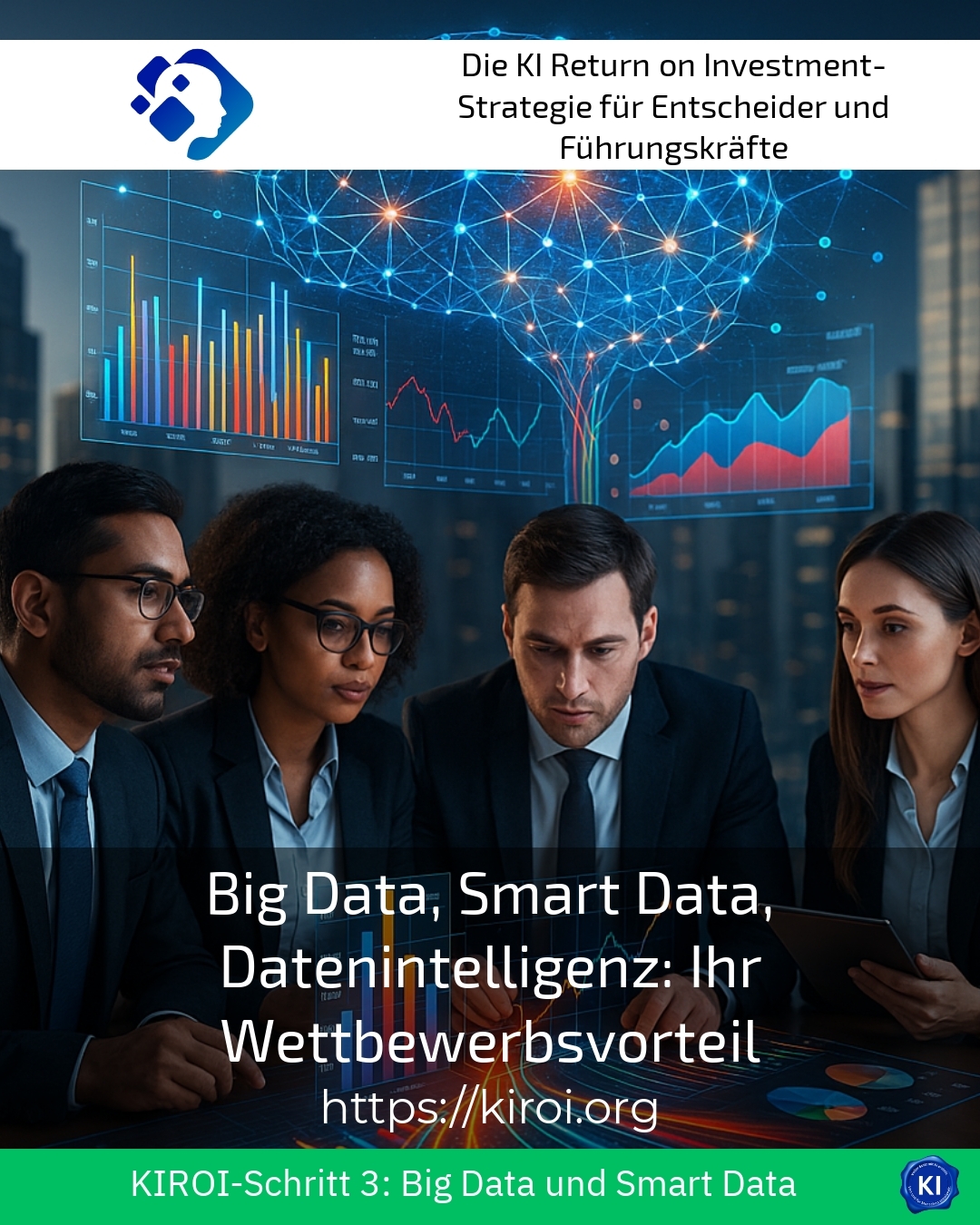
Imagine your company being able to make every decision based on precise insights, while your competitors are still navigating through a fog of uncertainty. In a world where unimaginable amounts of information are generated daily, the key to success no longer lies solely in collecting this data, but rather in processing and utilising it intelligently. Big Data, Smart Data, Data Intelligence: Your Competitive Advantage – these terms today describe a fundamental transformation in almost all economic sectors. Companies that sleep through this development risk their market position. On the other hand, those who recognise and exploit the opportunities open up entirely new horizons.
Understanding the Fundamentals: From Raw Data to Data Intelligence
Before we delve deeper, we must first understand the fundamental concepts. Raw data alone has no inherent value. It is only through structured processing and analysis that actionable insights are created. The first step is to separate relevant information from irrelevant. Modern algorithms and machine learning help considerably with this. The quality of the data significantly determines the quality of all subsequent decisions.
In manufacturing, sensors on machinery continuously collect operational data. This information enables predictive maintenance and significantly reduces downtime. An automotive supplier can thus increase production efficiency by up to thirty percent. Similarly, pharmaceutical companies use clinical study data for faster drug development. Financial institutions analyse transaction patterns for real-time fraud detection.
transruptions-Coaching supports companies precisely in this fundamental transformation. Clients often report feeling overwhelmed by the sheer volume of data. The challenge lies not in collecting it, but in using it meaningfully. Professional guidance with structured processes and proven methods supports this.
Best practice with a KIROI customer
A medium-sized logistics company faced the challenge of optimising its route planning while simultaneously increasing customer satisfaction. The company possessed extensive historical data on delivery times, traffic patterns, and customer behaviour, but was unable to effectively utilise it. As part of a transruption coaching project, we collaboratively developed a strategy for structured data analysis. Firstly, we identified the relevant data sources and defined clear quality criteria. Subsequently, we incrementally implemented automated analysis processes that recognised patterns in the delivery data. The team learned to make data-driven decisions and combine intuition with facts. After six months, the company was able to reduce average delivery times by eighteen percent. Simultaneously, fuel consumption noticeably decreased through optimised routes. Customer satisfaction increased measurably, as delivery times could now be predicted more precisely. This example impressively demonstrates how Big Data, Smart Data, Data Intelligence: Your Competitive Advantage can work in practice.
Develop data strategies for sustainable competitive advantages
A well-thought-out strategy forms the foundation of every successful data project. Without clear objectives, even the most ambitious initiatives will falter. The definition of relevant metrics is key at the outset. What questions should the data answer? Which business processes can be optimised with better information?
Retail companies use sales data to optimise their inventory levels and product assortment. Energy suppliers analyse consumption patterns for better grid utilisation and pricing. Insurance companies assess risks more accurately by analysing historical claims data. Hospitals improve treatment outcomes through the systematic evaluation of medical data. Telecommunications providers reduce customer churn by early detection of dissatisfaction.
The technical infrastructure must align with the strategic direction. Cloud-based solutions offer scalability and flexibility for growing data volumes. On-premise systems, on the other hand, ensure maximum control over sensitive information. Hybrid approaches often combine the best of both worlds.
Big Data, Smart Data, Data Intelligence: Your Competitive Advantage Through Customer Understanding
A deep understanding of one's own customers fundamentally distinguishes successful from less successful companies. Data analysis enables insights into preferences, behaviours, and needs. These findings flow into personalised offers and improved products. Customer loyalty rises, while acquisition costs simultaneously fall.
A streaming service recommends content based on the individual usage behaviour of its subscribers. Fashion retailers predict trends by analysing social media activity and search queries. Banks offer tailored financial products that suit individual life circumstances. Hotels optimise their offerings by evaluating guest feedback and booking patterns. Food manufacturers develop new products based on changing consumer habits.
Best practice with a KIROI customer
An established specialist publisher wanted to further personalise its digital offering and improve the user experience. The challenge was to analyse existing user data in a GDPR-compliant manner and derive actionable insights. In the transruptions coaching process, we first developed a comprehensive understanding of the existing data landscape. We identified gaps in data collection and defined new tracking parameters. Together with the internal team, we implemented a dashboard for real-time analysis of user behaviour. Employees received training on data-driven decision-making and the interpretation of key figures. The integration of qualitative feedback with quantitative data was particularly important. After implementation, the publisher was able to increase the time spent on its platform by thirty-five percent. The conversion rate for premium subscriptions also improved significantly. The editorial team now systematically uses the insights for content planning and topic selection [1].
Mastering challenges and avoiding pitfalls
The path to a data-driven organisation is rarely straightforward. Many companies underestimate the necessary cultural change. Technology alone does not solve problems if people are not brought along. Change management and continuous further training are therefore indispensable components of any transformation.
Data protection and security represent further central challenges. The European General Data Protection Regulation sets strict limits for the processing of personal data. Companies should not see these requirements as an obstacle, but rather as a framework. Transparency in data handling builds trust with customers and partners.
Clients frequently report difficulties in integrating various data sources. Legacy systems often do not communicate smoothly with modern platforms. Data silos arise when departments do not share their information. This fragmentation prevents holistic analyses and leads to suboptimal decisions.
For instance, a mechanical engineering firm struggled with inconsistent product data from various plants. An airline was unable to effectively consolidate booking and customer data. A retail group initially failed to integrate online and offline sales data. These examples illustrate typical hurdles on the path to data intelligence.
Data Quality as the Foundation for Data Intelligence
The best analysis is worthless if the underlying data is flawed. Data quality encompasses aspects such as completeness, timeliness, consistency, and correctness. Automated validation processes assist in ensuring high standards. Regular audits uncover weaknesses and enable continuous improvements.
Pharmaceutical companies invest heavily in the quality assurance of their clinical data [2]. Financial service providers are subject to strict regulatory requirements for data integrity. The manufacturing industry uses quality management systems to monitor process data. Research institutions validate their measurement data through multiple independent checks.
Technological Trends and Future Prospects
Technological development is advancing rapidly, constantly opening up new possibilities. Artificial intelligence and machine learning are increasingly automating complex analysis processes. Edge computing enables data processing directly at the point of origin. Blockchain technology promises new approaches for secure and transparent data transactions.
Autonomous vehicles will need to generate and process terabytes of sensor data daily. Smart Cities are collecting information from millions of connected devices to optimise infrastructure. Industrial plants will communicate autonomously with each other and automatically optimise production processes. Medical diagnoses will become more precise and faster through AI-supported image analysis [3].
Big Data, Smart Data, Data Intelligence: Your Competitive Advantage is particularly clearly manifested in these developments. Companies that lay the groundwork today will benefit from new technologies tomorrow. Those who only react when the competition has already moved ahead may have missed out.
Best practice with a KIROI customer
An industrial pump manufacturer wanted to expand its business model through data-based services. Traditional revenue streams were stagnating, while competition from Asia was squeezing margins. As part of the transruption coaching, we first analysed the existing data sources from connected products in the field. Together, we developed a concept for a predictive maintenance service for existing customers. The technical implementation was carried out step-by-step with a pilot project at selected customers. The sales team received input on marketing the new data-based offerings. The service technicians were trained and involved in interpreting the analysis results. After one year, the company had built a new, profitable business unit. Customer loyalty was significantly strengthened through the regular added value of the data services. The traditional product business also benefited from the insights gained about actual usage patterns.
Organisational prerequisites for data-driven decision-making
The successful use of data intelligence requires organisational adjustments on multiple levels. Leaders must exemplify and promote a data-driven culture. Employees need the skills to interpret and apply analysis results. Processes must be designed so that insights can be quickly translated into actions.
Many companies are creating dedicated roles such as Chief Data Officer or Data Scientists. Interdisciplinary teams bring diverse perspectives to data projects. Agile methodologies enable rapid iterations and continuous improvement. Collaboration between IT and business departments is gaining strategic importance.
A media company restructured its editorial department around data-driven workflows. A construction group established analytics teams in all regional branches for better project costing. An insurance group created a central data platform for all subsidiaries. These structural changes necessarily accompany technological transformation.
My KIROI Analysis
The examination of data-driven business models clearly shows that we are at a turning point. Companies of all sectors and sizes are faced with the task of fundamentally developing their data utilisation capabilities. This is not about technology for its own sake, but about creating sustainable competitive advantages. Examples from various sectors illustrate that the path to data intelligence must be individually designed.
Big Data, Smart Data, Data Intelligence: Your Competitive Advantage This arises from the combination of technological expertise, organisational maturity, and strategic alignment. Companies that address all three dimensions achieve the best results. An isolated consideration of individual aspects often leads to disappointment. The integration of all elements requires time, resources, and professional support.
transruptions-Coaching offers precisely this kind of support during digital transformation. We assist companies in developing and implementing their individual data strategy. The KIROI methodology helps to identify opportunities and minimise risks. We incorporate our experience from numerous projects into every consulting process. We provide impetus, support change processes, and empower teams for independent further development. The future belongs to data-driven companies, and the best time to act is now.
Further links from the text above:
[1] Bitkom – Information on Big Data and Digital Transformation
[2] European Medicines Agency – Data Standards in Pharmaceutical Research
[3] Fraunhofer-Gesellschaft – AI Research and Applications
For more information and if you have any questions, please contact Contact us or read more blog posts on the topic Artificial intelligence here.











 Deutsch
  English (UK)